A Premier Research Campus Runs on an Indigenous IP/MPLS Network

About the Institution
One of India's most active research campuses, running around the clock
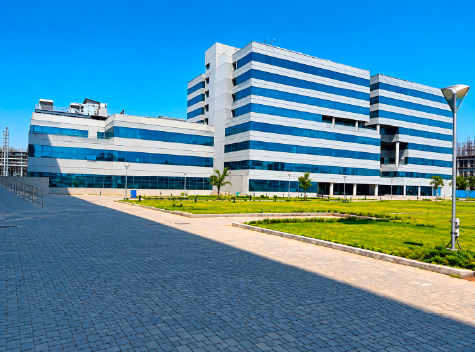
Established as part of India's national initiative to expand world-class technical education and research, this campus has grown rapidly into one of the country's most active research environments. Spanning programmes in artificial intelligence, computer science, electrical engineering, biomedical engineering, and materials science, it produces consistent output across national programmes, international collaborations, and an active patent pipeline.
Research here does not follow a 9-to-5 schedule. GPU clusters run training jobs through the night. Lab instruments collect data across multi-day experiments. Faculty collaborate with partners across time zones. Patents are filed. Papers go to international journals. The campus produces intellectual property of national significance, and the network carrying it cannot afford to be an afterthought.
The Challenge
One network serving four different needs, with no way to prioritise any of them
As the campus grew, its network had to serve four fundamentally different workload simultaneously. The problem was not insufficient bandwidth. It was a flat network where everything competed equally, with no mechanism to protect what mattered from what did not.
Research labs and computing systems
These demand uninterrupted, high-throughput connectivity with zero tolerance for congestion. A GPU training run does not pause gracefully when the network degrades. It fails. Restarting is not just a compute cost. It is weeks of a researcher's time gone. For experiments running unattended overnight, a 2:00 a.m. network fault means a corrupted dataset discovered at 8:00 a.m., with no recovery possible for time-sensitive readings that cannot be regenerated.
Beyond the continuity risk, there was a structural concern that the performance problem made worse. The data being generated in these labs are experimental datasets, AI model training outputs, pre-publication findings, and patent applications in early draft is nationally significant intellectual property. Before a patent is filed, that data has no legal protection. It exists only in lab systems and in the network paths carrying it between those systems. On a flat campus network, that data moved over the same unprotected paths as general internet traffic, through equipment with no domestic accountability chain. For research of this national importance, that was a governance problem sitting directly underneath the performance problem.
Academic and examination platforms
These serve thousands of concurrent users at peak periods. An online examination does not buffer and resume. A digital learning session cannot pick up mid-stream. When the network stumbles at the wrong moment, students bear the cost of infrastructure that was not good enough.
Administrative systems
Student records, finance, HR, and compliance data require reliable, separated access away from the noise of general campus traffic. An outage here cascades across every administrative function the institution depends on.
Student residential zones
These generate high-volume, unpredictable traffic that without intelligent architecture competes directly with all of the above. When hostel usage spiked in the evenings, research systems felt it. Fibre cuts left buildings digitally dark until someone intervened. And critically, research data including unpublished findings and patent-in-progress filings moved over the same paths as general internet traffic, with no architectural distinction between the two.
What the campus needed was not just a bigger bandwidth capacity. It needed a transport backbone built for how Indian campuses actually operate: 24/7 research workloads, variable power conditions, limited on-site technical staff, and the expectation that the network keeps running regardless of what time it is.

The Approach
Routing intelligently across a complex campus
The network problem was fundamentally a routing problem. Multiple traffic types sharing the same infrastructure, each with different performance requirements, and no mechanism to treat them differently. The answer was not more bandwidth. It was better routing decisions.
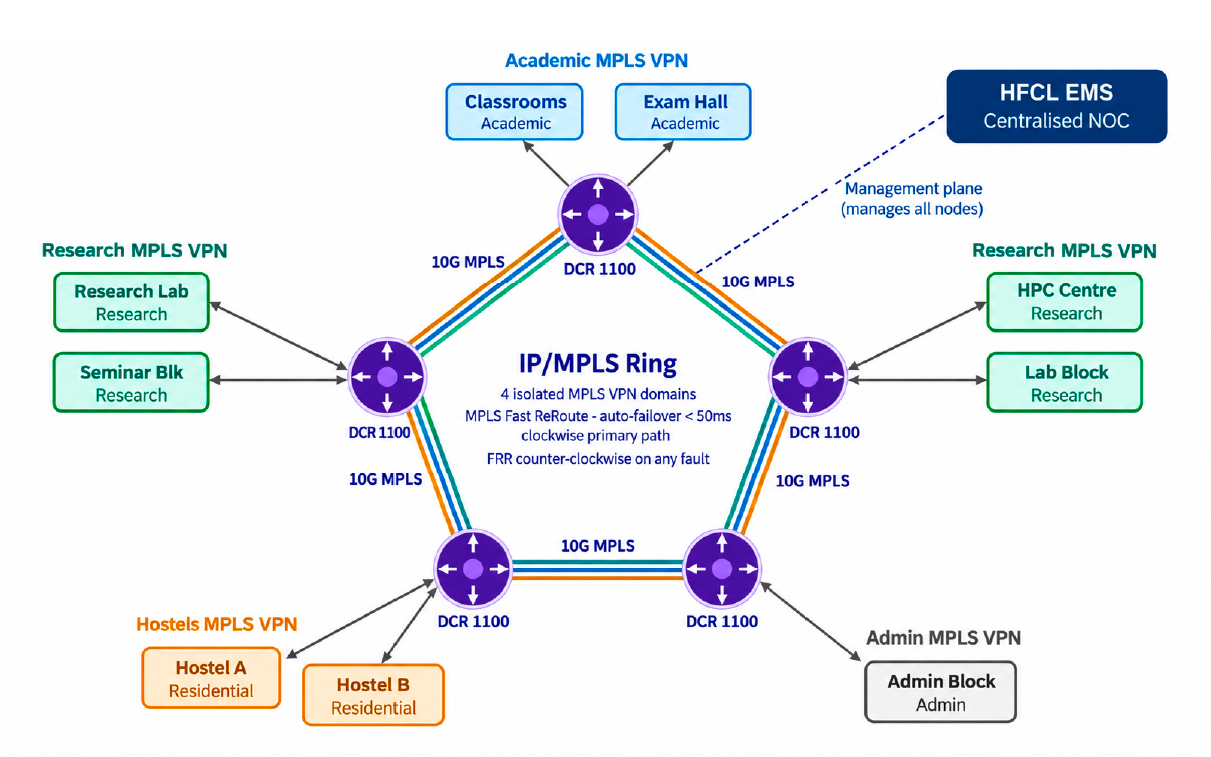
The DCR 1100 brought three things the campus network was missing. MPLS VPN to create true logical separation between research, academic, administrative, and residential traffic rather than the shallow separation that VLANs provide. QoS enforcement at the routing layer so traffic prioritisation happens where it matters, at the point where forwarding decisions are made. And a ring topology with MPLS Fast Reroute so a physical failure anywhere on the backbone resolves automatically without waiting for human intervention.
The Solution
A dedicated network for every use case
HFCL deployed the DCR 1100 Series IP/MPLS Routers as the campus routing backbone, connecting research facilities, academic buildings, administrative blocks, and residential zones into a single managed network where each operates in complete logical isolation from the others.
Traffic segmentation via MPLS VPNs
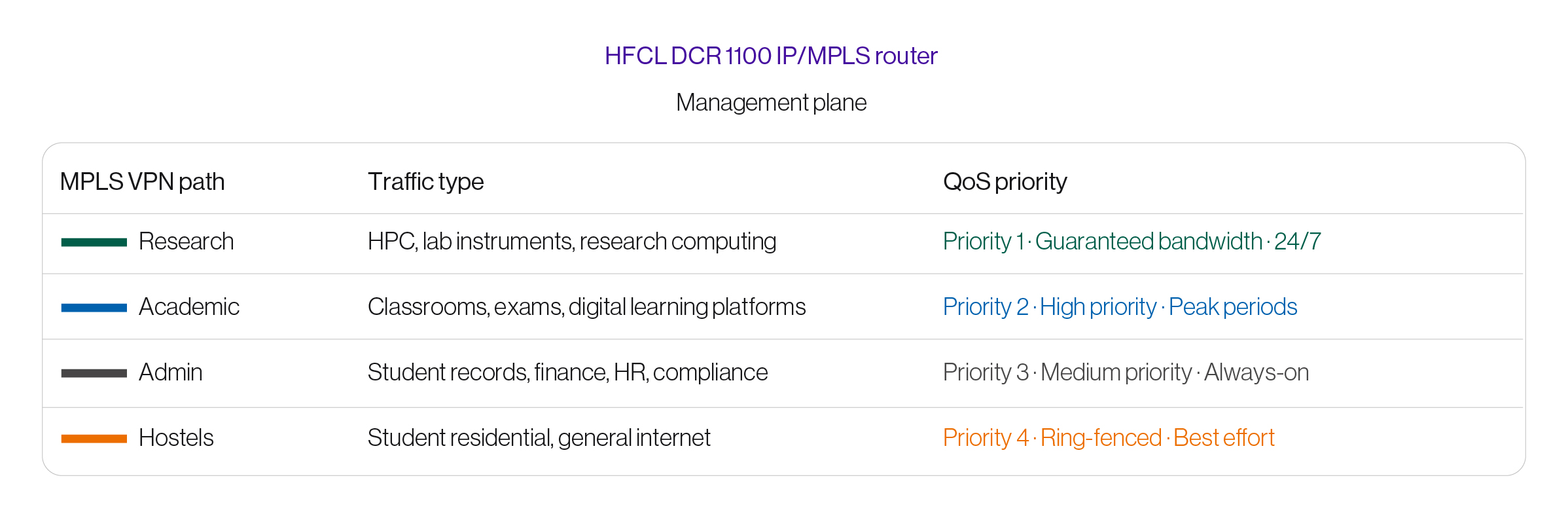
Four separate, dedicated network domains across shared physical infrastructure. Research labs and computing systems on their own isolated path with guaranteed bandwidth. Academic platforms in their own domain. Administrative systems in another. Student residential traffic contained separately. These domains share the same cables but are logically as distinct as separate physical networks. What happens in one has no effect on another.
This architecture addresses both the performance problem and the data governance problem simultaneously. Research data now travels in a logically isolated MPLS VPN domain, separated at the network layer from all other campus traffic. But equally important is what is carrying it. The DCR 1100 is indigenously designed and manufactured. The support chain is entirely domestic. When the network team contacts HFCL, that session stays within India. There is no international data handling pathway between the research data flowing through this network and the team responsible for the infrastructure carrying it. The MPLS VPN addresses the architecture. The indigenous router addresses the accountability.
QoS enforcement at the routing layer
Research and lab traffic gets permanent priority. When residential usage peaks at 11pm, the DCR 1100 protects research workloads automatically, through policy built into every forwarding decision, every second of every day. A PhD student's overnight GPU run gets the same network treatment at 11pm as it does at 4am, with no manual intervention required.
Ring topology with automatic failover
MPLS Fast Reroute monitors every link continuously. When a physical fibre is cut, traffic reroutes in milliseconds, well below the threshold at which any running session or experiment notices the disruption. An overnight run has the same network conditions at 3 am after a cable fault as before. Failover resolves before anyone notices.
Centralised management through HFCL EMS
The entire campus backbone is managed from a single interface. Real-time telemetry, fault alerts, and policy control across every node. Configuration changes pushed centrally, applied across the network simultaneously.

Network Architecture
The ring backbone and four MPLS VPN domains
Key Applications
What the DCR 1100 delivered
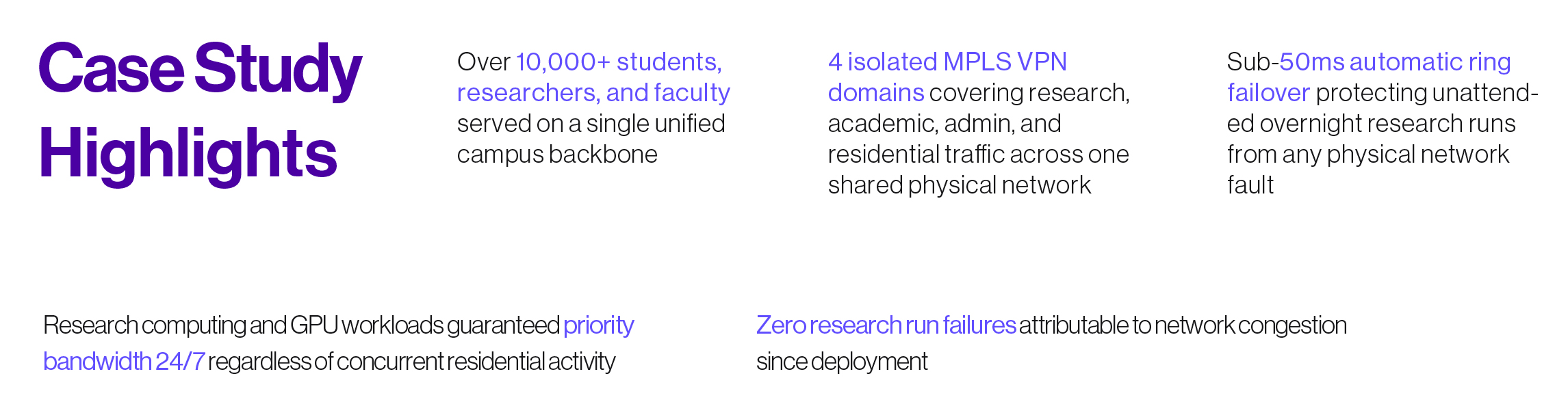
- MPLS L3 VPN creates four dedicated logical networks across the same physical cables. Each traffic type runs on its own isolated path with its own bandwidth guarantee. What happens in one domain has no effect on any other.
- Quality of Service is enforced at the routing layer, where forwarding decisions are actually made. Research and computing workloads receive committed bandwidth regardless of everything else happening on the network at the same time.
- MPLS Fast Reroute monitors every ring link continuously and triggers automatic rerouting in under 50ms when any link fails, below the threshold at which any running application or experiment detects a disruption.
- BGP and OSPF handle dynamic path selection and automatic convergence when the network topology changes, with no manual reconfiguration required.
- Ring topology is a closed-loop physical architecture with no single point of failure. Any individual link can be cut without isolating any building or zone.
- IPv6 and Segment Routing are natively supported, keeping the backbone forward-compatible as routing standards evolve.
- Indigenous design and manufacturing means the DCR 1100 is built and supported entirely within India. Firmware development, maintenance, and support all run through a domestic chain with no external dependency.
HFCL Element Management System
For a campus IT team managing a multi-node backbone across dozens of buildings, centralised management is not a convenience feature. It is what makes the architecture operationally realistic. HFCL EMS gives the team a single screen showing live status across every DCR 1100 node, with fault alerts that pinpoint the location and nature of an issue in real time before the a ected building calls. Policy changes, QoS adjustments, and configuration updates are pushed from one interface and applied across the entire network simultaneously. A team that previously logged into separate systems at each node now manages the full campus backbone from one place.
Results
What the campus network looks like now
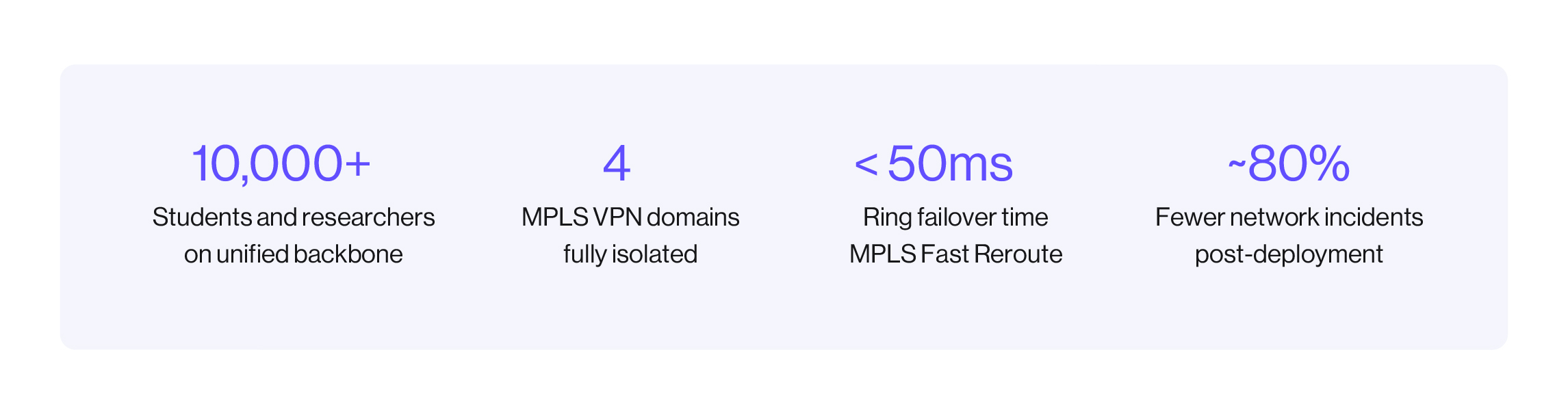
Indicative benchmarks based on this architecture type. To be confirmed with the customer's network team and HFCL deployment engineers before external publication.
Architecture
- Campus backbone segmented into 4 dedicated MPLS VPN domains, covering Research, Academic, Administrative, and Residential traffic across one shared physical network
Research continuity
- Zero run failures attributable to network performance post-deployment
- Research domain guaranteed 60% of backbone bandwidth during peak hours regardless of residential or academic traffic
Resilience
- Automatic failover resolves in under 50ms via MPLS Fast Reroute, below the threshold any running application detects
- Single points of failure on the campus backbone eliminated by ring topology
Operations
- Fault identification time reduced from 15 to 20 minutes to under 2 minutes through HFCL EMS real-time alerting
- Campus backbone managed from a single EMS interface, consolidating visibility previously spread across multiple separate systems
- Network-related helpdesk tickets during peak hours estimated down 80% through elimination of congestion-driven incidents
Why HFCL
When the institution evaluated its options, the DCR 1100 carried a deployment record that mattered in a way most vendors cannot match in India. Already running across BharatNet Phase 3 with over 60% market share, across geographies more demanding than any campus environment. The failure modes were known. Indian operating conditions were not a variable being accounted for. They were the baseline the product was built from.
Research data of this significance needs domestic accountability
The research produced here, from pre-patent findings to AI training datasets to experimental outputs, represents nationally significant intellectual property at its most vulnerable stage. Before a patent is filed, that data has no formal protection. The network carrying it is the only layer standing between that work and the world outside.
With HFCL, that layer is built and supported entirely in India. Firmware maintenance, diagnostic access, and support resolution all happen domestically, by a team with direct knowledge of this specific deployment. For an institution generating research of national significance, that domestic accountability is a practical consideration, not a symbolic one.
A rigorous proof-of-concept, evaluated by people who understand the technology
The faculty and staff at this institution understand network architecture at a depth most enterprise IT teams do not. When this institution runs a PoC, it tests under real conditions against real workloads. The DCR 1100 earned its place on the shortlist on performance. The indigenous argument made the decision defensible for an institution of this standing.
What this means for every Indian research institution evaluating their network
Across India's national technical universities, research institutes, and central universities, most network infrastructure runs on foreign-origin equipment by default, not because a better option was considered and rejected, but because it was assumed one did not exist. This deployment changes that assumption. It demonstrates that the performance bar for India's most demanding research environments does not require a foreign vendor anymore.
About HFCL
HFCL is a leading technology company specialising in creating digital networks for telcos, enterprises, and governments. Over the years, HFCL has emerged as a trusted partner offering sustainable high-tech solutions with a commitment to providing the latest technology products to its customers. Our strong R&D expertise coupled with our global system integration services and decades of experience in fibre optics enable us to deliver innovative digital network solutions required for the most advanced networks.
The company's in-house R&D Centres located at Gurgaon and Bengaluru, along with invested R&D houses and other R&D collaborators at different locations in India and abroad, innovate a futuristic range of technology products and solutions. HFCL has developed capabilities to provide premium quality Optical Fibre and Optical Fibre Cables, state-of-the-art telecom products including 5G Radio Access Network products, 5G Transport Products, Wi-Fi Systems, Unlicensed Band Radios, Switches, Routers and Software Defined Radios.
We are a partner of choice for our customers across India, Europe, Asia Pacific, the Middle East, Africa, and the USA.