What Is an Element Management System (EMS) and Why Telecom Networks Need It?

Every telecom network runs on hardware, routers, switches, gateways, and access nodes spread across hundreds or thousands of locations. Managing all of that manually was never truly efficient that is exactly the problem an Element Management System (EMS) solves. An Element Management System (EMS) is the software platform that solves this problem directly. It gives ISPs and telecom operators a single, centralised interface to provision, monitor, configure, and maintain every network device in their domain automatically, consistently, and at the scale modern networks demand. But understanding EMS goes well beyond the definition. To deploy and operate it effectively, network teams need to know how it fits into the broader management stack, what functions it must perform, how it handles the specific demands of IP/MPLS access and aggregation networks, and what separates a platform that delivers real operational value from one that simply wins procurement presentations.
This guide covers all of it from foundational concepts to the practical decisions that determine whether an EMS investment actually pays off.
What is an Element Management System (EMS)?
An Element Management System (EMS) is software that controls every network device in your infrastructure from one central platform. It sits one layer above the physical hardware directly managing routers, switches, gateways, and access nodes without requiring engineers to log into each device individually. Think of it as the control room for your entire network. Without an EMS, every device in the network is an island. Engineers log into each router and switch individually, apply configurations manually, and piece together network visibility from multiple disconnected vendor tools. That approach worked when networks had dozens of nodes. It breaks down completely when the network scales to hundreds or thousands. With an EMS in place, the picture changes entirely. Configurations push automatically to every device from one central system. Faults surface and correlate in real time. Performance data streams continuously from every node in the network. And when something breaks at a remote site, the EMS gives the NOC team enough diagnostic information to resolve it without sending anyone on-site. For ISPs and telecom operators, an EMS manages the full spectrum of network elements from last-mile access routers and cell-site gateways at the edge, all the way to aggregation switches and provider edge routers closer to the core. Every device in that chain gets provisioned, monitored, and maintained through a single system.
According to Grand View Research, the global EMS market was valued at USD 7.8 billion in 2023 and is projected to reach USD 15.4 billion by 2032, growing at a CAGR of 7.5 percent. That growth is not vendor enthusiasm it is accumulated operator demand from network teams who have run out of ways to scale manual processes any further.
Where Does an EMS Sit in the Network Management Hierarchy?
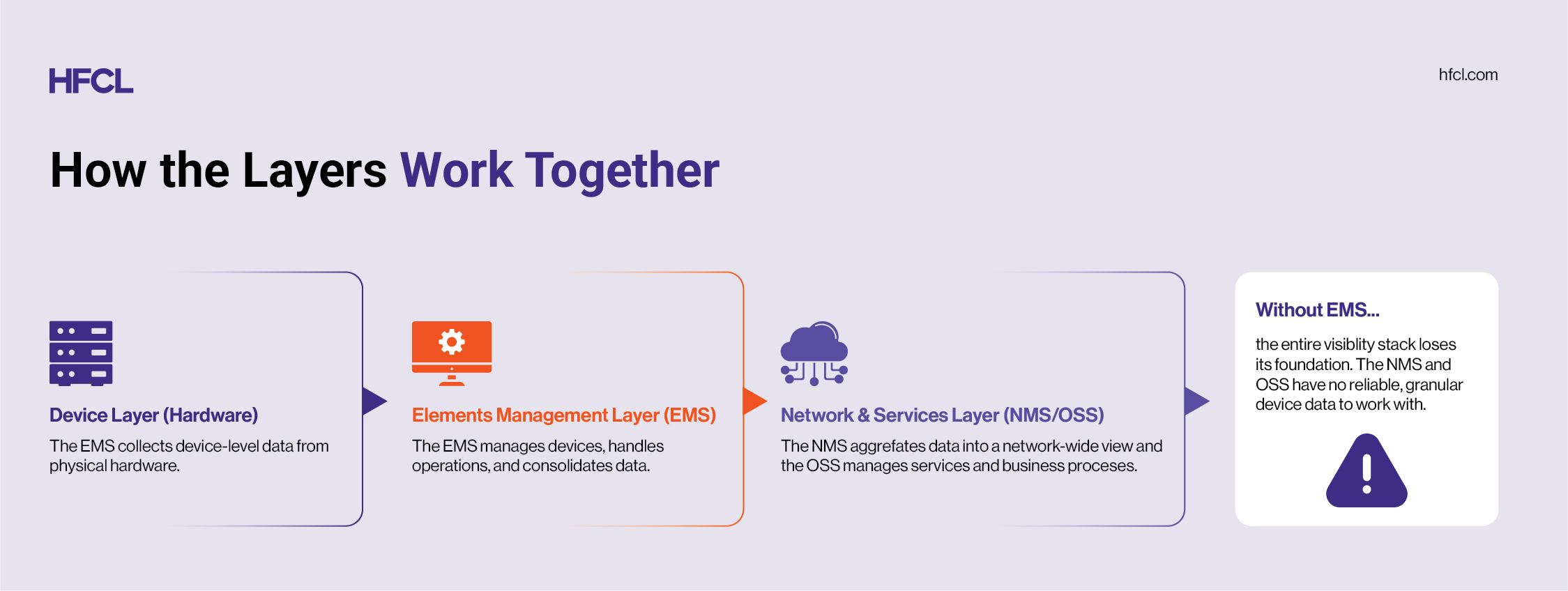
Every telecom network has three management layers, and each one has a specific job. Get the layers confused and you end up asking the wrong tool to do a job it was never designed for. Here is how those three layers sit and exactly where the EMS fits into that picture.
The device layer is the physical foundation. This is the hardware itself routers, switches, optical transceivers, cell-site gateways, and CPE devices. These devices carry traffic but have no awareness of the broader network around them. They need to be managed externally through a system designed specifically for that job.
The element management layer is where the EMS operates. It sits directly above the physical devices and manages them within a defined technology domain. The EMS communicates directly with hardware through standard protocols and handles all device-level operations provisioning, monitoring, configuration management, fault detection, and performance tracking.
The network and service layer sits above the EMS. This is where the Network Management System (NMS) and Operations Support System (OSS) operate. The NMS provides network-wide visibility across multiple domains. The OSS manages end-to-end services and the business processes around them service activation, order management, and billing integration.
Each layer depends on the one below it. The EMS feeds device-level data up to the NMS. The NMS aggregates that into a network-wide view and passes it upward to the OSS. Remove the EMS and the entire visibility stack loses its foundation the NMS and OSS have no reliable, granular device data to work with.
This layered model answers a question many operators ask early can an NMS or OSS simply replace an EMS? The answer is no. An NMS trying to manage individual device configurations across thousands of access nodes is like navigating inside a building using a city map. The tool operates at a completely different level of granularity, and forcing it to work at the device level creates slow, error-prone, and expensive operations.
EMS vs NMS vs OSS — What Is the Difference?
EMS, NMS, and OSS are three different tools that solve three different problems. Each one operates at a different level of the network and serves a different team. Using the wrong one for the wrong job creates real operational problems and costs money to fix once the mistake becomes clear in production.
.jpg)
The FCAPS Framework the Five Core Functions Every EMS Must Perform
Every EMS platform gets evaluated against five core functions. These five functions have a name FCAPS and they come from an ISO standard that defines what complete network management actually looks like. If an EMS platform cannot demonstrate capability across all five, it has a gap that will cost the operator operationally even if that gap is not obvious during procurement.
FCAPS stands for Fault management, Configuration management, Accounting management, Performance management, and Security management. Here is what each function means in the context of a live telecom or ISP network.
Fault Management:
Fault management is the EMS catching problems before they catch the operator off guard. When a device fails, a link drops, or an alarm fires anywhere in the network, the EMS detects it immediately, logs it with full context, notifies the right team, and tracks the resolution from detection to closure.
The capability that makes fault management genuinely useful rather than just another alarm dashboard is correlation. A single root-cause failure in a large access network triggers hundreds of downstream alarms simultaneously. Without correlation, the NOC team drowns in noise and wastes time chasing symptoms rather than causes. A well-built EMS filters and correlates those alarms automatically surfacing the two or three root-cause events instead of the hundred symptoms they generate, giving the operations team a clear picture of what actually failed and where.
Configuration Management:
Configuration management is the EMS keeping every device in the network exactly where it should be. It controls how devices get provisioned, how configurations stay consistent over time, and how every change gets tracked and audited across the full device lifecycle.
This covers Zero Touch Provisioning for new device onboarding, a golden configuration baseline for every device class, real-time detection of any deviation from that baseline, and the ability to push corrective configurations either automatically or with a single operator approval.
Configuration drift is one of the most damaging and least visible problems in large networks. Two devices that were identical at deployment gradually diverge as engineers make undocumented changes during incidents and maintenance. Six months later, nobody knows what the authoritative configuration actually is and troubleshooting becomes expensive guesswork on a network nobody fully understands. Configuration management eliminates that problem by making every change visible, tracked, and reversible.
Accounting Management:
Accounting management is the EMS tracking exactly who is using what across the network. It records which customers consume which bandwidth, which circuits are active, for how long, and how network resources map to individual services and customers at any given moment.
For telecom operators, this data feeds directly into BSS billing systems. For ISPs, it drives the usage reports that form the basis of customer invoicing and SLA compliance documentation. An EMS that delivers clean, accurate, real-time accounting data eliminates the manual reconciliation process between network operations and finance teams a process that is time-consuming, error-prone, and a consistent source of billing disputes with enterprise customers.
Performance Management:
Performance management is the EMS watching every device and every link continuously not to react to failures, but to catch degradation before it becomes one. The goal is to identify problems while they are still small enough to fix without customer impact.
For IP/MPLS networks, the metrics that matter include interface utilisation, queue depths, MPLS label switching statistics, BGP session health, BFD session status, packet loss rates, and end-to-end latency. The EMS collects all of these continuously, compares them against defined thresholds, and alerts the NOC team the moment anything starts trending in the wrong direction.
A slowly filling queue, a BFD session starting to flap, interface utilisation creeping toward saturation these are early warnings. An EMS that surfaces them gives the operations team time to act. That time is the difference between a proactive fix during a maintenance window and a reactive outage during peak traffic hours.
Security Management:
Security management is the EMS controlling access and enforcing policy across every device in the network. It defines who can access what, records every change with full attribution, and ensures no device drifts into a configuration state that creates a vulnerability.
In practice this means role-based access control across all team members, detailed audit logs of every configuration change showing who changed what and when, policy-based configuration templates that prevent security misconfigurations from reaching production devices, and continuous monitoring for unauthorised access attempts across the device estate.
For operators running consumer broadband and enterprise MPLS VPN services on the same physical infrastructure, security management is a direct commercial obligation not an optional capability. A single misconfigured access control list can expose enterprise customer traffic to other tenants sharing the same physical plant. An EMS that enforces configuration policy templates and logs every change closes those vulnerabilities automatically without relying on every individual engineer to get every manual step correct under pressure.
Zero Touch Provisioning — How an EMS Automates Network Deployment
Manual device commissioning is the biggest deployment bottleneck in any large-scale network rollout. An engineer travels to the site, logs into the device, and configures it from the command line one device at a time. Zero Touch Provisioning eliminates that process entirely. The device configures itself the moment it powers on.
Here is exactly how ZTP works in practice, step by step:
- A new device arrives at the remote site and gets physically installed by non-technical staff
- The device powers on and connects to the network
- It automatically contacts the central EMS provisioning server
- The EMS identifies the device by its serial number or MAC address
- The device downloads its software image, configuration template, and security policies
- It configures itself completely with zero command-line input from any engineer
- The EMS validates the configuration and confirms the device is fully operational
The result is a device that comes up in a known, validated, consistent state every time, at every site, regardless of which technician connected the cables or how remote the location is.
The operational impact is well-documented. According to DigitalOcean's published deployment benchmarks, 50 data centre switches were deployed in five minutes using a ZTP workflow a task that previously required a full working day of manual engineering effort. For telecom operators, that same principle scales directly to access router deployments, cell-site gateway commissioning, and CPE rollouts across hundreds or thousands of sites simultaneously.
ZTP delivers three specific gains that operators measure immediately after deployment. First, it eliminates truck rolls for initial commissioning non-technical staff handle the physical installation and the EMS handles the rest. Second, it guarantees configuration consistency from day one every device starts from the same verified baseline with no manual variation between sites. Third, it compresses deployment timelines dramatically rollouts that previously took months of scheduled engineer visits complete in weeks of parallel installation activity.
According to market research published by Grand View Research, the Zero Touch Provisioning market was valued at USD 3.5 billion in 2024 and is projected to reach USD 8.1 billion by 2032, growing at 11.11 percent annually. That growth reflects exactly how broadly operators have recognised automated onboarding as a fundamental requirement not an optional upgrade.
Why ISPs and Telecom Operators Cannot Scale Without an EMS
Running a large access and aggregation network without an EMS does not just create inconvenience. It creates five specific operational problems that compound over time each one making the next harder to solve. Left unaddressed, they turn into the reason networks miss SLA targets, rollouts run over budget, and NOC teams spend more time firefighting than operating.
Manual site commissioning reaches an unsustainable scale. Every new device deployment requires a certified engineer on-site to configure it from the command line. At tens of sites this is manageable. At hundreds of sites it becomes the single largest bottleneck in any network expansion programme directly delaying revenue from new infrastructure while operators who have automated the same process are already delivering services.
Fragmented fault visibility creates dangerous blind spots. Most operators run equipment from multiple vendors across their access and aggregation tiers. Without an EMS, alarms from each vendor arrive in separate management systems. NOC teams manually correlate events across multiple interfaces to reconstruct what actually happened adding hours to every significant incident, and consistently finding the root cause only after service has already degraded.
Configuration drift compounds silently over time. Every undocumented change an engineer makes on a device during an incident creates a small deviation between that device's running configuration and its intended baseline. Individually each deviation is minor. Collectively, across hundreds of devices over months and years, configuration drift builds a network that nobody fully understands where troubleshooting grows progressively more expensive with every passing month.
Reactive maintenance cycles breach SLAs regularly. Without continuous performance monitoring and automated anomaly detection, problems appear only after they become service-affecting. By then SLA thresholds have already crossed, the customer has already experienced degradation, and the commercial cost is already incurred before the operations team even knows a problem exists.
No single source of truth makes every operation harder. Capacity planning, compliance audits, and incident post-mortems all require accurate, current data about what is in the network, how it is configured, and how it is performing. Without an EMS, that data lives in spreadsheets, individual vendor tools, and the institutional memory of specific engineers none of which is reliable, current, or accessible under pressure.
According to research published by MIT Technology Review Insights, network automation delivers OPEX savings of 30 to 50 percent over a three-year horizon, with primary gains coming from eliminating manual configuration and reducing error-driven repair cycles. A separate study by Analysys Mason found OPEX reductions of up to 56 percent through automating network lifecycle management across optical and IP networks. These figures represent the measurable gap between what operators pay today to run manual operations and what they pay after deploying unified EMS automation.
What to Ask Before Choosing an EMS Platform
EMS platforms look almost identical in product presentations. The differences only appear in real network operations and by then the contract is already signed. These five questions surface those differences before commitment. Each one is designed to separate a platform built for real operator environments from one built to win procurement evaluations.
How complete is the ZTP implementation? Does ZTP cover the full onboarding workflow image management, configuration templating, service policy application, and post-provisioning validation and testing? Or does it stop at basic DHCP-based bootstrap and leave the remaining steps to manual processes? The answer reveals whether the vendor has deployed ZTP at real operator scale or whether it is a demonstration feature that stops short of production readiness.
Which device types are supported, and what does adding a new one actually cost? Many platforms claim broad multi-vendor support but require significant custom engineering to add any device type not already on their certified list. Get a specific answer on effort and timeline not a general assurance. The ongoing cost of expanding device support is a real constraint that directly affects how quickly the platform adapts as the network evolves.
At what scale does the platform require architectural changes? Ask specifically at what node count do additional management servers become necessary? At what point does database architecture need to change? At what scale does query performance degrade noticeably? Honest answers reveal whether the platform was designed to reach the operator's target network size or designed to close the initial contract.
Walk through the actual troubleshooting workflow for a remote access node fault. Do not accept a theoretical description. Ask for a live demonstration. Can a single NOC engineer execute the full diagnostic and resolution process without escalating to a platform specialist? If specialist involvement is required for routine faults, the platform's automation only works under ideal conditions during business hours exactly when it is needed least.
What APIs does the platform expose and what integrations already exist? Gaps in northbound API coverage become expensive custom integration projects after the contract is signed. Verify specific integration support for the existing ticketing system, capacity planning tools, and BSS platform before committing. Integration gaps found in production cost significantly more to fix than gaps found during procurement.
FAQ
An Element Management System (EMS) is software that manages network devices routers, switches, gateways within a specific part of a network. It lets operations teams configure, monitor, troubleshoot, and maintain thousands of devices from one central platform instead of managing each device individually. For ISPs and telecom operators, an EMS is the operational foundation that makes large-scale network management efficient and scalable without proportionally growing the operations team.
FCAPS stands for Fault management, Configuration management, Accounting management, Performance management, and Security management. It is the ISO standard framework defining the five core functions any complete network management system must perform. Checking that an EMS platform fully addresses all five FCAPS dimensions is the most reliable method for assessing whether it is genuinely complete or has gaps that will create operational problems after deployment.
An EMS manages individual network devices within a specific technology domain it operates at the device level. An NMS provides visibility across the entire network spanning multiple domains it operates at the network level. In practice, an EMS feeds detailed device data up to the NMS, which aggregates it into a broader network-wide view. Both serve different purposes and mature operator environments use them together rather than as alternatives to each other.
When a new network device powers on for the first time, ZTP triggers it to automatically contact a central EMS provisioning server. The device downloads its software image, configuration template, and security policies, then configures itself completely without any engineer touching the command line. Non-technical installation staff handle the physical installation at the remote site. The device manages the rest automatically and comes up in a known, validated operational state every single time.