How EMS Connects ZTP to Zero Touch Operations in IP/MPLS Networks
Why modern telecom operations need more than automated provisioning
A new transport router is installed at a remote block site. The field team powers it on, connects the management interface, and informs the NOC that the device is ready. Zero Touch Operations is the lifecycle model that picks up from here. Where Zero Touch Provisioning automates the first moment a device comes online, ZTO extends that automation across service activation, assurance, compliance, and upgrades, with the EMS as the governed system that coordinates all of it. For operators managing hundreds or thousands of IP/MPLS routers across access and aggregation tiers, this distinction determines whether network growth compounds operational confidence or operational risk. In a traditional rollout, this is where the real operational work begins. Someone must verify reachability, confirm device identity, apply the right configuration, activate services, check protocol status, monitor alarms, validate performance, and ensure the router becomes part of the production IP/MPLS network without introducing risk.That process can work when the network has a limited number of sites. It becomes fragile when an operator is managing hundreds or thousands of routers across access, aggregation, and transport layers. The issue is not whether engineers know how to configure a router. They do. The issue is whether the organization can repeat the same operational quality at scale, across every site, every change, and every lifecycle stage.This is why the industry conversation needs to move beyond Zero Touch Provisioning and toward Zero Touch Operations.
ZTP is a milestone. ZTO is the operating model.
What is Zero Touch Provisioning (ZTP)?
Zero Touch Provisioning is how a router becomes reachable without an engineer manually configuring it on site. The device powers on, contacts a central provisioning server, downloads its software image and configuration, and joins the network. ZTP solves one specific problem: how to bring a device online consistently at scale without sending a certified engineer to each location.
What is Zero Touch Operations (ZTO)?
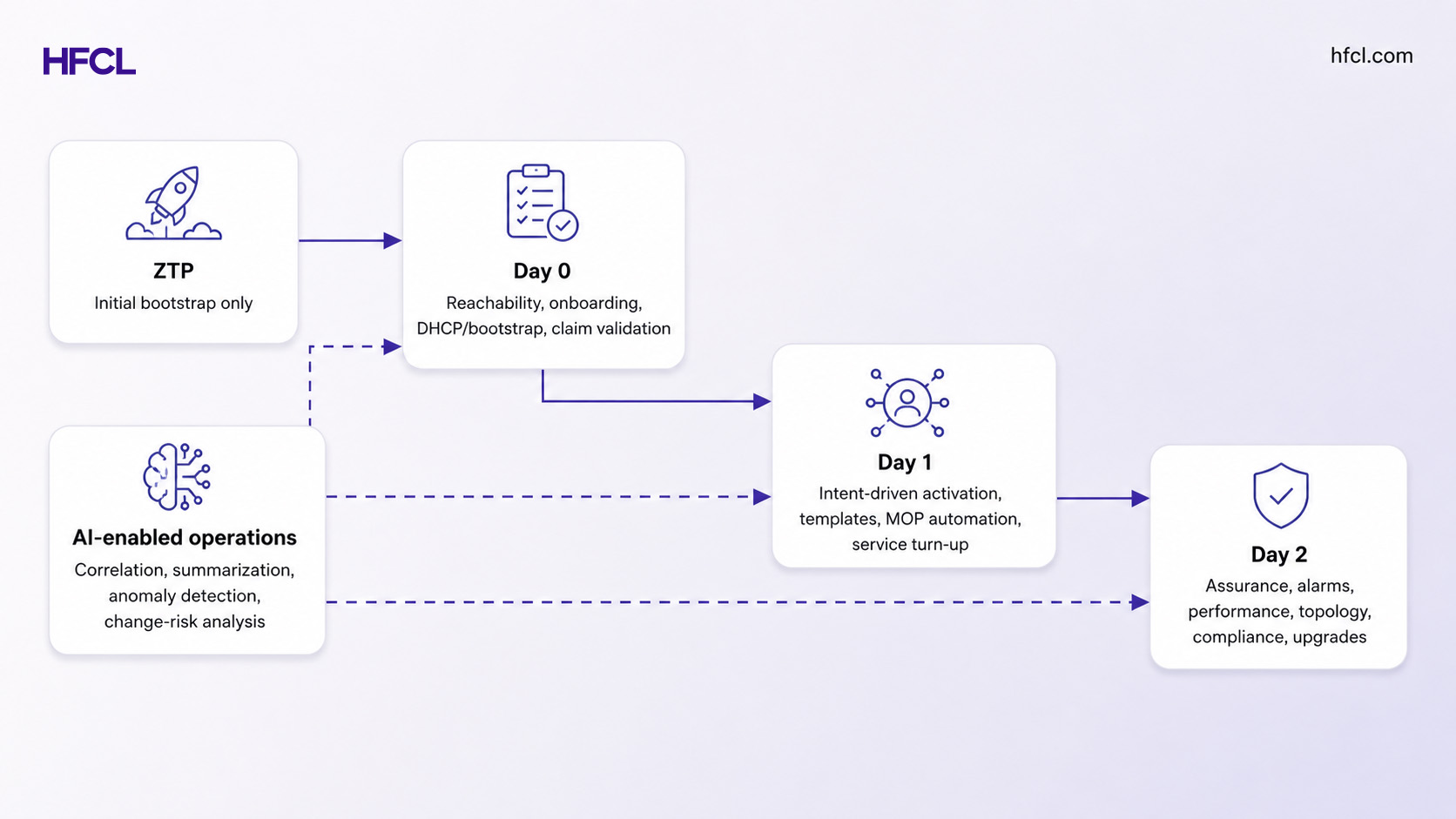
Zero Touch Operations is what follows. It is the operational model that extends automation from that first moment of connectivity across the complete lifetime of the device and the services it carries: Day 1 service activation, Day 2 assurance and compliance, software upgrades, configuration drift correction, and alarm correlation. All of it governed and auditable, through a single platform. A router that receives an IP address and downloads an initial configuration is only at the first checkpoint. It still needs to be validated, activated, monitored, audited, upgraded, and continuously kept aligned with the intended network design.
ZTP answers: How do I onboard this device without manual site-level configuration?
ZTO answers: How do I manage the complete device and service lifecycle with consistency, control, and minimal manual intervention?
This distinction matters deeply in IP/MPLS networks. Reachability is only the beginning. The operator must also know whether the right device is installed at the right site, whether the correct service intent has been applied, whether the network is behaving as expected, and whether future changes can be executed safely. That is where the EMS changes role. It is no longer just a monitoring application. It becomes the lifecycle control plane for operations.
EMS as a lifecycle control plane
In many environments, EMS is still viewed mainly as a system for monitoring devices, collecting alarms, and showing operational dashboards. Those capabilities are important, but they are not enough for modern telecom automation. A production-grade EMS should connect inventory, reachability, configuration intent, service activation, alarms, performance, topology, compliance, upgrades, and operational workflows into one governed lifecycle. Think of it as the system that continuously compares two views of the network: what the network is supposed to be, and what the network currently is. When those two views are aligned, operations are stable. When they drift apart, risk increases. The EMS should help the operator detect that gap, understand its impact, and close it through controlled workflows.
This is the core idea behind EMS-driven Zero Touch Operations.
Day 0: Reachability and trusted onboarding
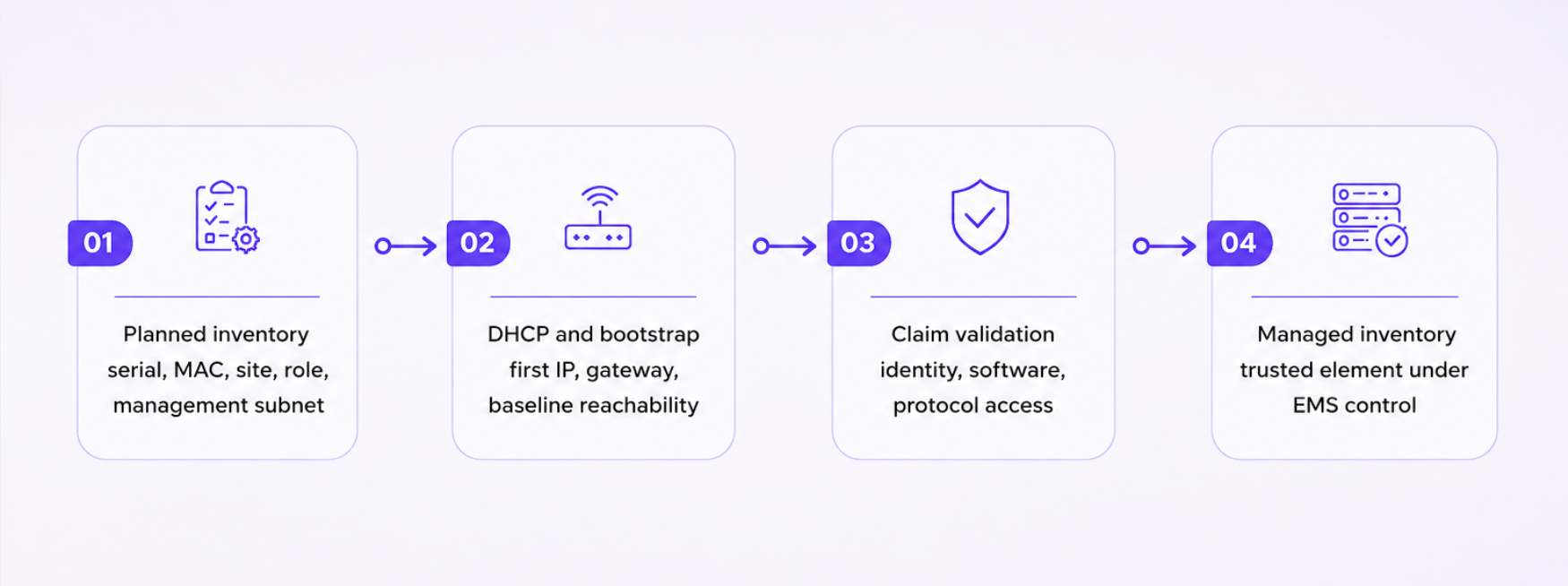
Day 0 is not just about bootstrapping a router. It is about converting a physically installed device into a reachable, validated, and trusted network element. The process should begin before the router is powered on. The EMS should already have the planned inventory record: device name, serial number, MAC address, model, site, block, ring, management subnet, planned IP, credential policy, software expectation, and template association. When the router boots, DHCP and bootstrap services establish the first reachable state. The device gets management connectivity and enough initial information to become visible from the NOC. But the EMS should not blindly accept every reachable device. It must claim the device through validation. The serial number, MAC address, hostname, model, software version, site mapping, and protocol access must match the intended plan. This is an important shift. Day 0 is not successful simply because the router responds to ping. It is successful when the EMS can confirm that the right device is reachable, manageable, and safe to promote into the managed inventory.
Day 0 outcome: The device moves from physical installation to trusted EMS-managed inventory with controlled reachability and identity validation.
The importance of this validation step becomes clearest at the scale of programmes like BharatNet, where IP/MPLSaccess routers are deployed across thousands of block-level sites in geographically distributed locations across rural India. At that scale, validating device identity and onboarding status through EMS before a device enters the managed inventory is not a convenience. It is the operational foundation on which consistent service delivery across the entire network depends. HFCL's Element Management System is built for this deployment context, with planned inventory management and claim validation workflows designed for large-scale IP/MPLS rollouts where Day 0 consistency determines operational quality for every stage that follows.
Day 1: Intent-driven service activation
Day 1 is where the device becomes useful to the network.
This is the stage where service intent is applied: interface roles, VLANs, routing behavior, MPLS-related parameters, VPN services, QoS policies, management access, and other site-specific configurations. In many networks, this stage is still driven by MOP documents, spreadsheets, CLI snippets, and manual execution. The process is familiar, but it is also vulnerable. A missing command, a wrong interface name, a formatting issue, or a site-specific variation can create problems that are difficult to detect before the change reaches the router.
A lifecycle-oriented EMS changes the operating model. It does not treat configuration as random CLI text. It treats configuration as structured intent. The operator defines what needs to be activated. The EMS validates the input, maps it to approved templates, generates clean device-specific configuration, shows a preview, executes the change through controlled workflows, and records the result. This is where MOP automation becomes valuable. Engineers can still own the design and approval process, but the EMS removes repetitive manual risk. Instead of copying commands into devices one by one, the team works through validated inputs, reusable templates, approval gates, and post-change verification. For IP/MPLS operators, this is especially important because service activation often touches multiple configuration areas at once. The EMS helps keep those changes consistent across sites, device roles, and service types.
Day 1 outcome: Service activation becomes faster, repeatable, auditable, and less dependent on manual CLI execution.
The financial case for this shift is documented. Research published by Analysys Mason in collaboration with Nokia in February 2024, drawing on interviews with global operators who had deployed network and service lifecycle automation, found that operators can expect up to 81 percent in cost savings for network and service management. The underlying mechanism is the same one at work in IP/MPLS Day 1 operations: when service activation is template-driven and intent-based rather than CLI-based and individually executed, variation between sites collapses, the time required to activate services compresses, and the probability of introducing a configuration inconsistency that requires correction after the fact falls substantially. At scale, across hundreds of routers and multiple service types, this difference between manual and governed activation determines whether rollout programmes run to schedule or accumulate correction debt that follows them into Day 2.
Day 2: Assurance and operations at scale
Day 2 is where most operational cost is created or avoided.
Once the router is live, the network must be continuously assured. Interfaces can flap. LDP or BGP sessions can drop. MPLS forwarding can change. Optics can degrade. CPU or memory can rise. Configuration drift can appear. Software upgrades may become necessary. Faults can cascade across rings, links, and services. A Day 2-ready EMS must go beyond collecting alarms and counters. It must convert operational data into context. Alarm handling should help the NOC identify likely root cause instead of showing only a flood of symptoms. Performance monitoring should reveal trends before they become customer-impacting incidents. Topology awareness should show which device, link, interface, ring, or service may be affected. Compliance checks should highlight where actual configuration has drifted from the approved baseline.
Upgrades also belong in Day 2 operations. At scale, a software upgrade is not simply an image push. It requires eligibility checks, backups, pre-checks, staged execution, post-checks, failure handling, and audit records. This is where EMS-driven ZTO becomes most visible to the NOC. The EMS becomes the place where alarms, performance, topology, configuration state, and operational workflows are connected into a single operating view.
Day 2 outcome: The network is continuously monitored, correlated, verified, and kept aligned with intended design.
The OPEX case for Day 2 investment in EMS-driven assurance is well established. Research conducted by MIT Technology Review Insights in association with Ericsson, based on interviews with senior network executives at leading global telecom operators, found that expectations for OPEX reduction from network automation range from 30 to 50 percent over a three-year horizon. The primary contributors to those savings are the elimination of manual configuration cycles and the reduction in time required to identify and resolve operational errors. Day 2 is where this overhead accumulates most visibly in a large IP/MPLS network: in the engineer-hours spent investigating alarms without contextual correlation, in compliance checks that happen only after a service incident rather than continuously, and in upgrade programmes that stall because pre-check and post-check processes are not standardised across the fleet.
What breaks without Zero Touch Operations
Without Zero Touch Operations, networks can still run. But the operating model becomes harder to scale and easier to break. The first issue is inconsistency. Similar routers may be configured differently over time because changes are applied manually during incidents, maintenance windows, or urgent rollouts. These differences may remain hidden until a failure occurs. The second issue is fragmented visibility. Alarms, topology, performance, inventory, and change history may live in separate tools or spreadsheets. During an incident, the NOC loses time reconstructing the story instead of acting on a clear operational view. The third issue is change risk. Manual execution at scale creates avoidable errors. Even experienced engineers can make mistakes when repetitive changes are performed under pressure. The fourth issue is slow rollout. Network expansion, service activation, and upgrade programmes become dependent on manual coordination. That slows business execution and increases operational cost. The fifth issue is weak operational memory. If the system does not know what was planned, what was deployed, what changed, and what failed, every future troubleshooting activity becomes harder. Configuration error sits at the root of most of these failures. The MIT Technology Review Insights research that quantifies 30 to 50 percent OPEX reduction from network automation identifies manual configuration and error correction as the primary contributors to that overhead. In an IP/MPLS network where a single misconfiguration can propagate across a ring, affect multiple services simultaneously, and generate cascading alarms before the root cause becomes clear, that is not an efficiency argument alone. It is a risk management one. Zero Touch Operations addresses these issues by making the EMS the governed system of lifecycle truth.
AI in EMS: Assistant, not unchecked controller
AI has a practical role in EMS, but it must be positioned correctly.
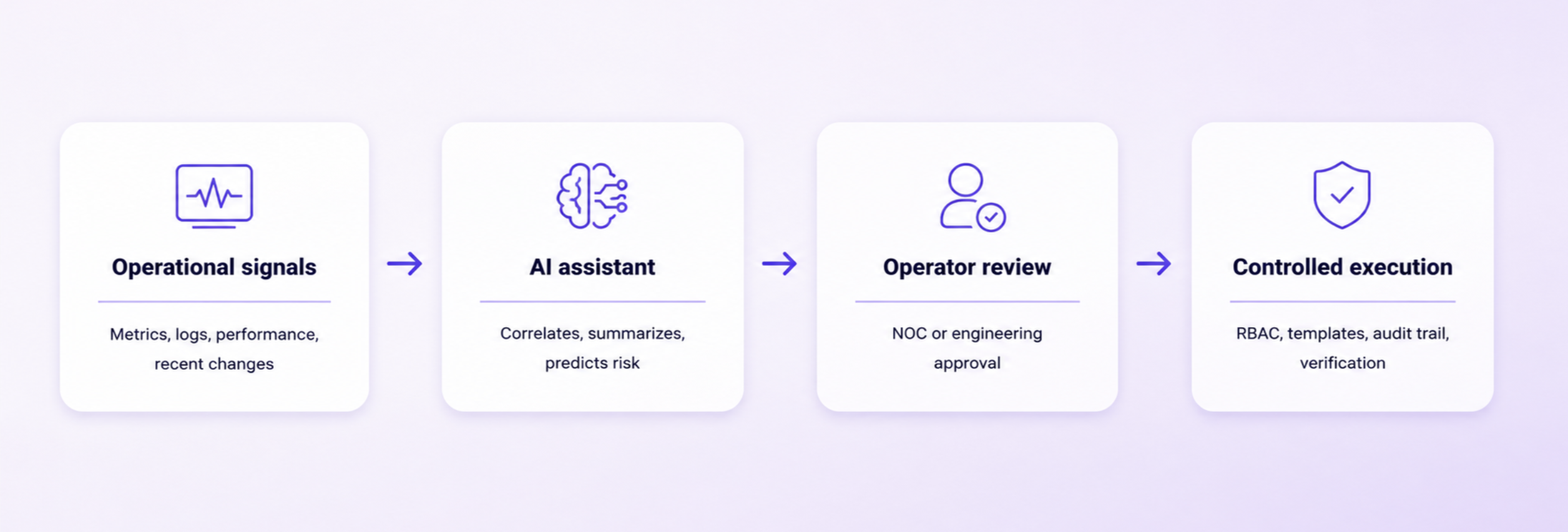
In telecom networks, AI should not be an unrestricted controller making silent changes to production routers. The blast radius is too large. The right model is AI as an operations assistant working inside EMS guardrails. For fault management, AI can group related alarms, reduce noise, identify likely root cause, and summarize impact for the NOC. Instead of forcing engineers to read hundreds of rows, the EMS can present a concise operational narrative: what happened, what changed, what is affected, and what should be checked next. For performance management, AI can detect anomalies that static thresholds may miss. A slow rise in drops, repeated short flaps, unusual latency patterns, or abnormal resource behavior can be surfaced before they become major incidents. For configuration and upgrades, AI can support change-risk analysis. It can compare the planned change with recent alarms, device health, topology dependencies, past failures, and maintenance history before recommending whether the change is safe to proceed. For operations reporting, AI can summarize incidents, shift handovers, maintenance outcomes, and recurring issues in a readable format. But every AI-assisted workflow must be governed. RBAC, approvals, audit logs, templates, policy checks, and rollback planning are not optional. AI can recommend, summarize, and assist. The EMS must still control execution through approved operational workflows.
AI should improve operator judgment, not bypass it.
The practical boundary this implies is an important one. NETCONF (RFC 6241) and YANG data models (RFC 7950) have become the standard southbound interfaces for structured, machine-readable device communication in IP/MPLS environments precisely because reliable, auditable configuration delivery requires a governed protocol, not direct instruction. The AI layer sits above this, not below it. Insights flow up from device data through EMS context into AI-assisted summarisation and correlation. Execution flows down through approved templates, validated workflows, and RBAC controls before anything changes on a production router. That separation is what makes AI genuinely useful in operations rather than a source of uncontrolled change in a network that cannot afford it.
A simplified architecture view
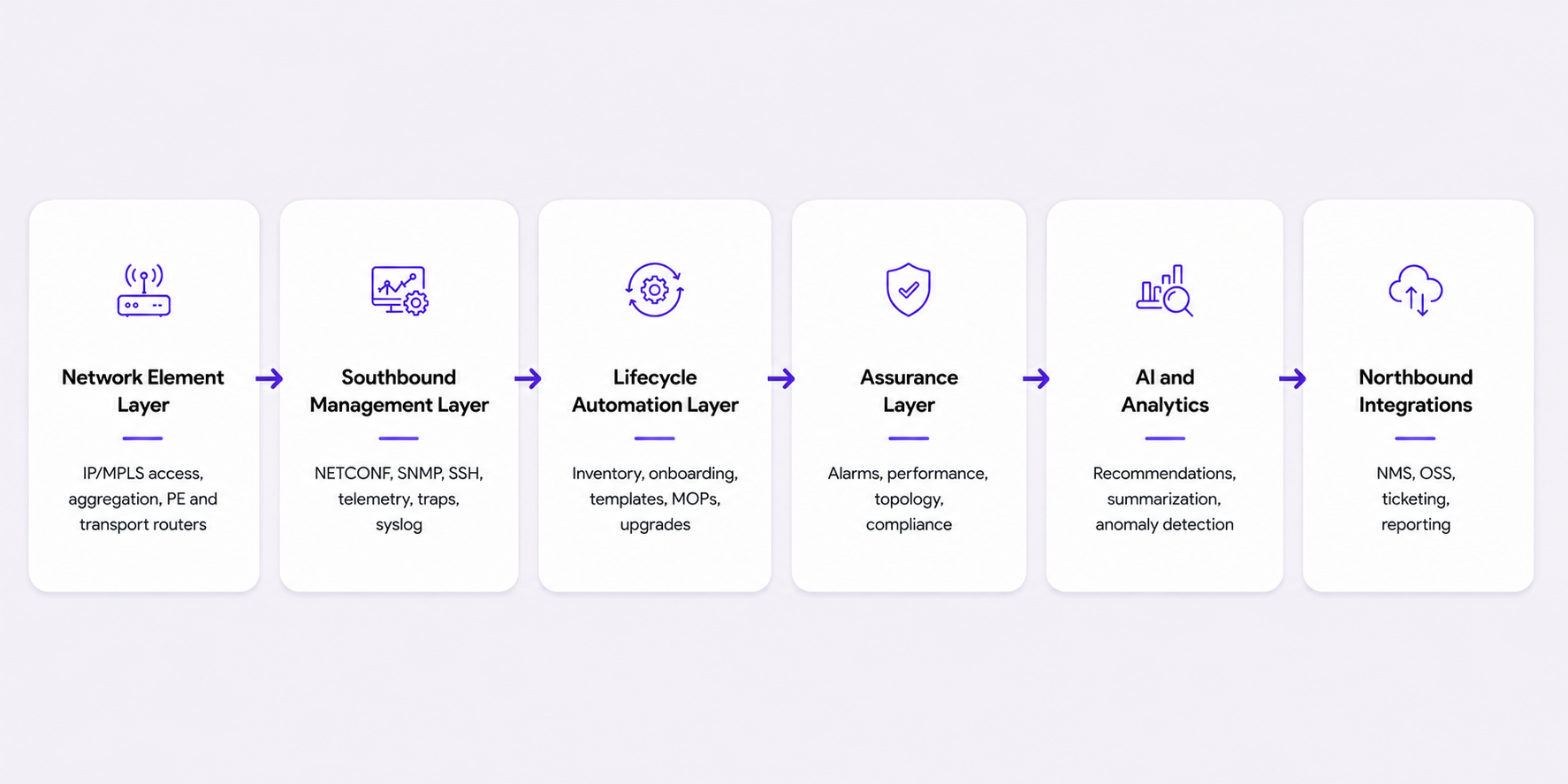
A practical EMS architecture for Zero Touch Operations can be understood in layers.
At the bottom are the network elements: IP/MPLS routers, access routers, aggregation nodes, transport devices, and supporting infrastructure. These devices carry traffic and expose operational data through management interfaces. Above that is the connectivity and protocol layer. This includes NETCONF, SNMP, SSH, telemetry, syslog, traps, and other southbound mechanisms used by the EMS to communicate with devices. The lifecycle automation layer manages planned inventory, onboarding, claim validation, templates, MOP automation, service activation, compliance checks, and upgrade workflows. The assurance layer handles alarms, performance metrics, topology, service health, correlation, dashboards, and historical analysis. The AI and analytics layer enhances lifecycle and assurance functions through summarization, anomaly detection, correlation, and risk insights. The northbound integration layer connects EMS with NMS, OSS, ticketing platforms, reporting systems, and business workflows. This layered view reinforces the main point: EMS is not just a screen for viewing device status. It is the operational bridge between device-level reality and network-level intent.
What good looks like in production
A mature Zero Touch Operations model does not mean every action happens automatically without people. It means routine work is automated, risky work is governed, and every action is visible, auditable, and verifiable. In a good deployment, new devices enter the network through planned inventory and controlled claim validation. Service activation is template-driven and intent-based. MOP execution is safer because inputs are validated and generated configurations are previewed before execution. Alarms become more meaningful because they are correlated with topology, service, and device context. Performance monitoring becomes proactive because the EMS highlights trends and anomalies before they become outages. Compliance becomes continuous because the EMS compares actual state with intended design. Upgrades become controlled lifecycle events instead of isolated maintenance tasks. The business impact is clear: faster rollouts, fewer manual errors, reduced field dependency, improved SLA protection, better NOC productivity, and stronger operational confidence.
Most importantly, the EMS becomes the operational memory of the network. It knows what was planned, what was deployed, what changed, what failed, what was fixed, and what needs attention next.
Where HFCL's EMS fits this model
HFCL's Element Management System is designed specifically for IP/MPLS access and aggregation environments, including large-scale national transport programmes where routers are deployed across thousands of geographically distributed sites. The platform supports the full Day 0 to Day 2 lifecycle described in this article: planned inventory management before devices ship to site, ZTP-based onboarding with identity validation and claim workflows, intent-driven service activation through template-controlled provisioning, continuous performance monitoring and alarm correlation, compliance checking against configuration baselines, and governed software upgrade execution with full audit records. What this means in practice is that the EMS functions as the operational memory of the network: the system that knows what was planned, what is deployed, what has changed, and what needs attention, without depending on institutional knowledge, manual reconciliation, or a NOC team reconstructing history from separate tools during an incident. At BharatNet scale, where HFCL manages IP/MPLS transport infrastructure across block-level sites across rural India, this is not an architectural aspiration. It is an operational requirement the network enforces every day. For network teams working through EMS platform decisions, the practical test is whether Day 1 and Day 2 are as governed and consistent as Day 0. An EMS that provisions reliably but cannot maintain configuration integrity two years later, or cannot execute a software upgrade with pre-checks and audit records, has solved only part of the problem. Zero Touch Operations requires the full lifecycle to be managed through the same governed system.
Conclusion: The future of EMS is lifecycle control
The next stage of telecom automation is not only about provisioning faster. It is about operating better.
ZTP helped reduce manual effort during onboarding. But the larger opportunity is Zero Touch Operations across Day 0 onboarding, Day 1 activation, and Day 2 assurance.
For IP/MPLS networks, complexity does not end when a router comes online. In many ways, that is when the real operational responsibility begins.
A modern EMS must therefore be more than a monitoring platform. It must act as a lifecycle control plane that connects inventory, intent, configuration, assurance, topology, compliance, upgrades, and AI-assisted operations into one governed operating model.
The goal is not to remove engineers from the network. The goal is to remove avoidable manual effort, reduce operational risk, and give engineers a trusted system through which they can operate large networks with confidence.
FAQ
No. Zero Touch Provisioning focuses mainly on initial device onboarding. Zero Touch Operations covers the complete lifecycle, including onboarding, service activation, assurance, compliance, upgrades, and AI-assisted operations.
An EMS has direct device-level visibility and control. It understands inventory, configuration, alarms, performance, topology, and operational state. This makes it the right platform to coordinate lifecycle automation across IP/MPLS routers and services.
Not without guardrails. AI is most useful as an assistant for correlation, summarization, anomaly detection, and risk analysis. Execution should remain governed through RBAC, approvals, templates, audit logs, and policy controls.
The biggest benefit is consistency at scale. ZTO reduces manual errors, improves rollout speed, strengthens assurance, and helps operators manage large networks without increasing operational complexity at the same rate.
No. It changes where engineers spend their time. Instead of repetitive manual tasks, engineers focus on design, validation, exception handling, optimization, and controlled decision-making.