Deploying Indigenous IP/MPLS Routers for BharatNet Rural Broadband Network

How HFCL's Indigenous IP/MPLS Routers are Rebuilding India's Rural Digital Backbone for Seamless Service Delivery.
Key Highlights
- 80,000 HFCL IP/MPLS Routers in BharatNet Phase 3
- 600M+ Rural Citizens reached by BharatNet across 2.14 lakh gram panchayats (IBEF, 2025)
- 60% National Routing Footprint of BharatNet Phase 3 managed by HFCL
EXECUTIVE SUMMARY
BharatNet is one of the world's largest rural broadband programmes, connecting over 2.14 lakh gram panchayats through a centrally coordinated national fiber backbone. The network carries pension disbursements, rural employment wage disbursements formerly MGNREGA wage transfers, farm insurance claims, and banking sessions at Common Service Centres, making every minute of downtime a direct human consequence (PIB, March 2025). According to IBEF, BharatNet has the reach to bring over 60 crore rural citizens into the digital economy, making network reliability not a performance metric but a welfare obligation.
The core problem was structural. A single fiber cut in a linear network segment could isolate 40 to 80 downstream gram panchayats simultaneously, and restoring connectivity required manual field intervention taking two to four hours, an unacceptable window for a network carrying real-time financial transactions in areas with no alternative channel.
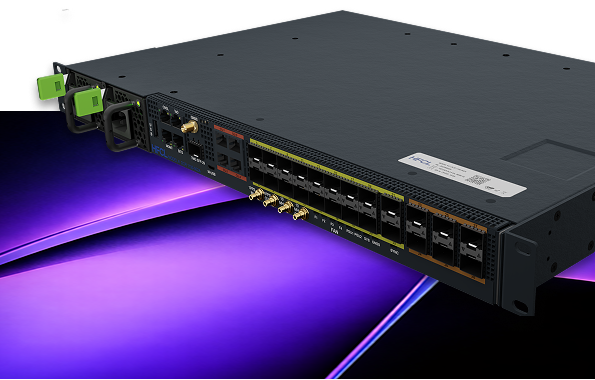
BharatNet Phase 3 addresses this with a fundamental architectural shift to IP/MPLS ring and mesh topologies, enabling automatic fault detection and millisecond traffic rerouting. HFCL is responsible for designing and supplying IP/MPLS routing systems across approximately 60 percent of the national network, with a total supply scope of 80,000 routers.
In the initial deployment phase, HFCL achieved the highest router integration rate among all BharatNet Phase 3 vendors, within the first operational window, with full State Network Operation Centre (SNOC) visibility from day one.
THE CHALLENGE
When a Fiber Cut Stops a Farmer's Pension Payment
In BharatNet's earlier phases, the network was designed for one objective: maximum speed of geographic coverage. Linear middle-mile topologies were the right choice for a rollout programme. They are fast to deploy and simple to commission.
But as digital service dependency deepened, those same topologies became a systemic vulnerability. The network was no longer just carrying data. It was carrying MGNREGA wage disbursements, PM-KISAN transfers, farm insurance settlements, and banking sessions at Common Service Centres. For millions of rural citizens, the CSC is the only point of access to their money and their government. A one-hour outage does not mean inconvenience. It means a family does not receive a payment that day.
According to PIB (March 2025), over 2.14 lakh gram panchayats are now connected under BharatNet. IBEF estimates this gives the programme reach to over 60 crore rural citizens, for whom a Common Service Centre is the only point of access to banking, government services, and welfare transfers.
The structural problem under linear topology had three dimensions:
- Failure propagation: A single fiber cut does not stay local. It can simultaneously disconnect every downstream node on that segment, in some cases 40 to 80 gram panchayats at a time, across entire blocks.
- Manual recovery dependency: In the absence of automatic rerouting, restoration depended on field teams physically locating and repairing the fault. In rural geographies with power instability and limited road access, this consistently took two to four hours, sometimes longer in remote blocks.
- No service differentiation: All traffic shared the same forwarding priority. A financial transaction and a file download received identical treatment. Under congestion or partial degradation, critical services experienced the same unpredictable latency as non-critical workloads.

BUSINESS OBJECTIVES
From Connectivity Expansion to Service Continuity
.png)
BharatNet Phase 3 was not scoped just as a capacity upgrade. It was defined as a transition to a network capable of operating reliably under continuous load, where performance consistency and recovery behaviour are as critical as connectivity reach.
Four specific requirements shaped the programme objectives:
- Failure containment: Topology redesign to ensure that no single fiber cut can propagate across downstream segments. Failures must be contained within defined boundaries.
- Deterministic recovery: Automatic rerouting with millisecond restoration, eliminating dependence on manual field intervention and delivering consistent recovery behaviour regardless of location.
- Service-aware traffic handling: Quality of Service enforcement to ensure that financial transactions, governance platforms, and public service delivery applications receive prioritised, predictable forwarding, independent of network load conditions.
- 5G readiness: The underlying transport network must be capable of handling the higher traffic volumes and tighter latency requirements that rural 5G expansion will introduce, without requiring another architectural replacement.
SOLUTION AND IMPLEMENTATION
HFCL addressed the structural limitations of the BharatNet network through a combination of topology redesign and a four-phase deployment approach calibrated to field conditions at rural scale.
Technical Approach
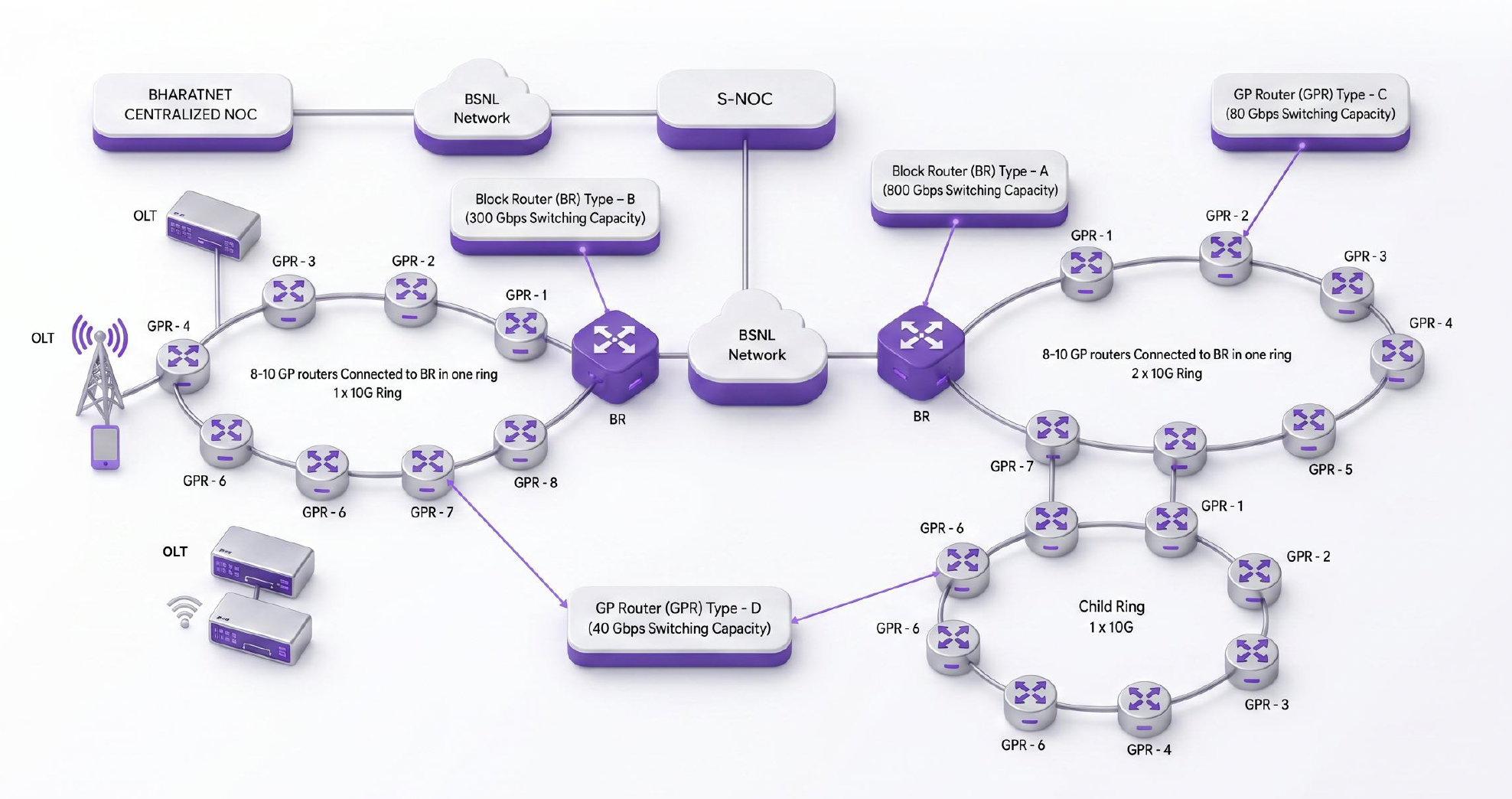
- Ring and mesh topology: The network backbone was redesigned from linear paths to ring and partial mesh configurations, removing dependency on individual fiber routes and enabling failure containment within defined segments.
- IP/MPLS fast reroute: Pre-established alternate paths allow traffic to be rerouted automatically within milliseconds of a link or node failure, eliminating the two-to-four-hour manual recovery window of the prior architecture.
- QoS enforcement: Policy-driven traffic classification ensures that payments, governance systems, and healthcare platforms receive deterministic forwarding priority, independent of congestion conditions.
- EMS and SNOC integration: All deployed routers are connected to Element Management Systems and State Network Operation Centres, providing centralised real-time monitoring and coordinated fault response.
Network Architecture
BharatNet Network Envisaged Network Architecture
Implementation Approach
The deployment was structured into four sequential phases to ensure consistency, reduce commissioning risk, and maintain operational visibility throughout the rollout:

One deployment reality worth acknowledging: zero-touch provisioning was critical not just for speed, but for quality. In rural environments where a second site visit can require a full day of travel, eliminating manual configuration errors at initial commissioning had a direct impact on deployment efficiency and first-time activation rates.
RESULTS AND OUTCOMES
Before and After: What the Architecture Change Delivered
The following outcomes reflect performance validated under live network conditions in the initial deployment phase across 85 blocks. Baseline figures reflect observed behaviour in earlier BharatNet phases operating under linear topology.

Deployment Milestones
- Highest integration rate: 3,649 routers activated across 3,540 gram panchayats and 109 blocks. HFCL achieved the highest router integration and SNOC visibility performance among all BharatNet Phase 3 vendors in the initial deployment window.
- 17,000 routers in four months: Executed despite global supply chain constraints, enabled by in-house R&D-backed manufacturing and pre-positioned logistics.
- 60% of national routing footprint: HFCL's total deployment scope represents approximately 60 percent of BharatNet's Phase 3 routing infrastructure, the largest single-vendor contribution to the programme.
- Full SNOC visibility from activation: 100 percent of deployed routers integrated with State Network Operation Centres from initial commissioning, enabling centralised monitoring from day one rather than as a post-deployment activity.
.jpg)
WHY HFCL
India-First Engineering at National Scale
The BharatNet Phase 3 vendor selection process required more than IP/MPLS technical capability. The scale of the programme required a partner with proven logistics at national scale, deep integration experience with India's government network infrastructure, and the ability to deliver without dependence on extended import lead times.
What We Stand For
- Technology sovereignty for critical infrastructure: Avoiding expensive and fragile import dependencies for India's digital backbone. Critical national communication infrastructure should not be contingent on foreign supply chains.
- Innovation in India: HFCL's router technology for BharatNet Phase 3 is designed and engineered in India, demonstrating that indigenous R&D meets global deployment standards at national programme scale.
- Inclusive economic participation: Rural broadband infrastructure creates direct employment and economic participation across the supply chain, installation, and operations, embedded in the communities it serves.
- Recognised globally: HFCL has won three industry awards for this deployment, validating our approach against international benchmarks.
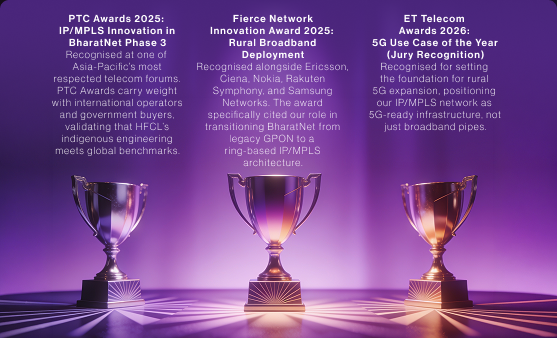
- PTC awards 2025: IP/MPLS Innovation in BharatNet Phase 3: Recognised at one of Asia-Pacific's most respected telecom forums. PTC Awards carry weight with international operators and government buyers, validating that HFCL's indigenous engineering meets global benchmarks.
- Fierce Network Innovation award 2025: Rural Broadband Deployment: Recognised alongside Ericsson, Ciena, Nokia, Rakuten Symphony, and Samsung Networks. The award specifically cited our role in transitioning BharatNet from legacy GPON to a ring-based IP/MPLS architecture.
- ET Telecom awards 2026: 5G Use Case of the Year (Jury Recognition): Recognised for setting the foundation for rural 5G expansion, positioning our IP/MPLS network as 5G-ready infrastructure, not just broadband pipes.
Featured Across Leading Industry Platforms
- PTI: India's Largest Indigenous Router Deployment Recognised: HFCL's IP/MPLS router rollout was recognised as the largest deployment of indigenously designed and manufactured network routers for Bharatnet.
- Business Standard: India-Made Routers Enter Live Network Deployment: Reported HFCL's India-made routers entering live network deployment for BharatNet alongside ITI, validating production readiness at national scale.
- ET Telecom: 5G-Ready Scalability for Operator Networks: Reported HFCL's IP/MPLS router deployment for Vodafone Idea's 5G network, noting the routers deliver up to a five-fold increase in network capacity.
- Communications Today: 60% Market Share Across BharatNet's IP/MPLS Layer: Reported over 60% market share in BharatNet's IP/MPLS infrastructure, with active deployments running from Himachal Pradesh to Andaman and Nicobar Islands.
- Dataquest: From R&D to Real IP: Indigenous Innovation at Scale: Positioned HFCL among Indian technology companies that have moved beyond just manufacturing to R&D, IP, deployment at scale, and building genuine capability in complex networking infrastructure.
What We Deliver
- R&D-backed manufacturing at scale: HFCL's in-house R&D and manufacturing capability enabled faster procurement cycles and greater supply chain resilience compared to vendors reliant on international production, a critical advantage given post-pandemic supply constraints.
- IP/MPLS engineering depth: HFCL's routing systems were validated for the specific combination of ring topology, fast reroute, and QoS enforcement required by BharatNet's architecture, not retrofitted from enterprise configurations.
- National-level programme experience: HFCL's existing deployments within India's public sector network infrastructure provided proven integration patterns for EMS and SNOC connectivity, reducing programme risk in the operational layer.
- Programme-scale delivery model: The ability to deliver 17,000 routers within four months, alongside survey, zero-touch provisioning, and SNOC integration, demonstrated a delivery model suited to national programme execution.
LOOKING FORWARD
Foundation for Rural 5G and Expanding Service Delivery
The Phase 3 architecture is not being built for today's traffic volumes. It is being built for the traffic patterns that rural 5G expansion will introduce, higher throughput, tighter latency requirements, and more dynamic load profiles than current broadband services generate.
With IP/MPLS ring and mesh topology, centralised operational control, and QoS enforcement already in production, the BharatNet network is positioned to absorb 5G-driven demand without requiring another architectural replacement. HFCL continues the rollout across the remaining blocks in scope, with integration, monitoring, and optimisation activity ongoing through the SNOC layer.
The broader significance of this deployment is the engineering capability it establishes. India now has a proven, locally designed and engineered IP/MPLS routing system operating at national programme scale, a foundation that extends beyond BharatNet to future public digital infrastructure.
Is this relevant to your network?
This architecture applies to any operator managing distributed access networks at scale, state-level broadband programmes, large telco middle-mile infrastructure, or government digital service networks, where failure containment, millisecond recovery, and traffic predictability are critical to service delivery outcomes. If your network serves populations where digital connectivity is the primary channel for financial or government services, the resilience requirements are the same regardless of programme size.
Discuss your network architecture
Whether you are planning a greenfield deployment or evaluating an architecture upgrade, HFCL's routing and network infrastructure teams are available to assess your requirements and share deployment learnings from BharatNet.