L2VPN vs L3VPN: Same MPLS Core, Two Different VPN Architectures

Enterprises no longer connect two offices and call it a network. A single customer today may need a data center interconnect that behaves like one Ethernet segment, a multi-site WAN with hundreds of branches routing independently, and a 5G transport slice that keeps mobile traffic separated from fixed broadband, all on the same shared MPLS core. Two VPN architectures make this possible: Layer 2 VPN (L2VPN) and Layer 3 VPN (L3VPN). Mordor Intelligence estimates that nearly 65% of enterprise workloads had shifted to public or hybrid cloud platforms by 2025, a shift that is pushing operators to re-examine which VPN model fits which workload rather than defaulting to one architecture for every customer. In this blog, we break down how L2VPN and L3VPN actually work, where each one fits, and what to weigh before choosing between them.
TL;DR: L2VPN (VPWS, VPLS, EVPN) extends a customer's Ethernet Layer 2 domain across the provider network without the provider touching the customer's IP routing, making it the fit for point-to-point circuits and data center interconnect. L3VPN (BGP/MPLS IP VPN, RFC 4364) has the provider's edge routers actively route customer IP traffic through per-customer VRFs, making it the fit for large, any-to-any enterprise WANs. Neither encrypts traffic by itself.
What Is a VPN in a Service Provider Network?
In a service provider context, a VPN is not a consumer privacy tool. It is a mechanism that lets a shared MPLS or IP backbone carry traffic for multiple customers while keeping each customer's traffic and routing information completely isolated from every other customer on the same physical infrastructure. The Internet Engineering Task Force (IETF) formalized this model in RFC 4364 for Layer 3 services and in RFC 4664 for Layer 2 services, and both rely on the same underlying idea: one physical network, many logically separate networks. Where the two approaches diverge is the layer at which that separation happens, and that difference decides almost everything about how a customer's traffic is handled, routed, and scaled.
What Is Layer 2 VPN (L2VPN)?
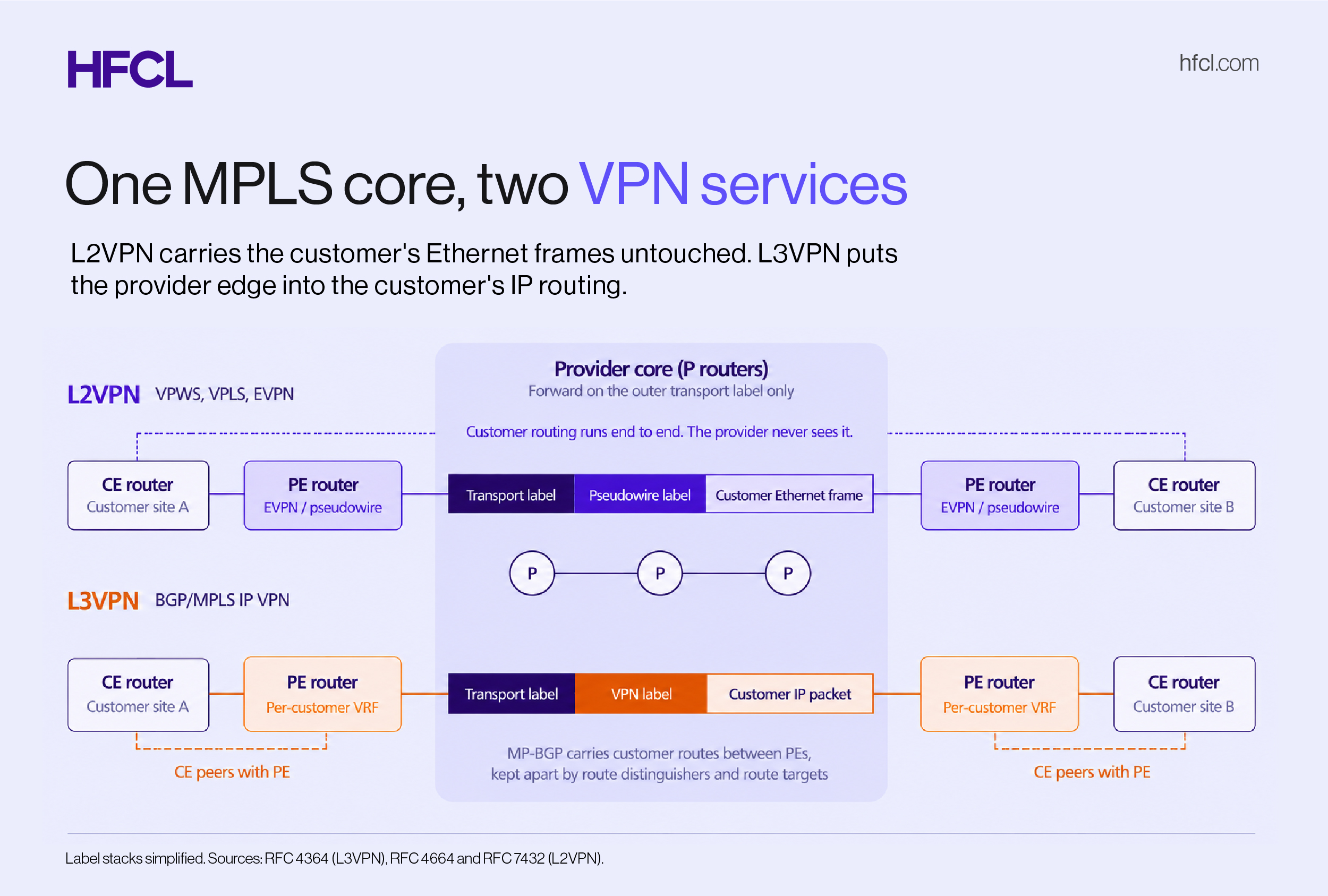
L2VPN extends a customer's Layer 2 domain, typically Ethernet, across a service provider's MPLS or IP core so that two or more sites appear to be connected by a single switch or a private wire, regardless of the physical distance between them. The provider network is transparent to the customer at Layer 3: the service provider carries Ethernet frames without inspecting or participating in the customer's IP routing at all. This makes L2VPN the natural replacement for a physical leased line or a private Ethernet LAN extension. The IETF's L2VPN working group formalized this architecture in RFC 4664, which defines the reference model for both point-to-point and multipoint Layer 2 services delivered over a packet-switched MPLS core.
What Is Layer 3 VPN (L3VPN)?
L3VPN, most commonly deployed as BGP/MPLS IP VPN under RFC 4364, operates one layer higher. Instead of forwarding Ethernet frames transparently, the provider's edge routers actively participate in the customer's IP routing. Each customer site connects into a dedicated Virtual Routing and Forwarding (VRF) table on the provider edge (PE) router, and Multiprotocol BGP (MP-BGP) distributes routes between VRFs across the core while keeping every customer's address space separate, even when two customers use overlapping private IP ranges. RFC 4364 describes this as a "peer model," in which customer edge (CE) routers exchange routes directly with the provider's PE routers rather than peering with each other across an invisible overlay. Because the provider router is doing the routing, L3VPN is the architecture of choice for any-to-any enterprise WANs where dozens or hundreds of sites need to reach one another efficiently. In telecom and enterprise circles this same service is often marketed as IPVPN, and the two terms describe the same underlying BGP/MPLS IP VPN architecture.
Core Components of an MPLS VPN Architecture
Both L2VPN and L3VPN are built from the same three functional roles inside the provider network, and understanding them makes the rest of the architecture easier to follow.
Customer Edge (CE) Router
The CE router sits at the customer's premises and connects into the provider network. In L3VPN, the CE exchanges routes with the PE using a routing protocol such as BGP, OSPF, or static routes. In L2VPN, the CE simply sends and receives Ethernet frames; it has no visibility into the provider's routing at all.
Provider Edge (PE) Router
The PE router is where the VPN logic actually lives. It maintains per-customer VRFs for L3VPN or per-customer virtual switching instances for L2VPN, attaches MPLS labels that identify both the destination PE and the specific customer VPN, and forwards the labeled traffic into the core. This is also the router where route distinguishers (RDs) and route targets (RTs) are applied in L3VPN to keep customer address spaces distinct and to control which sites can reach which other sites.
Provider (P) Router
P routers form the core of the network and are unaware that VPNs exist at all. They simply forward MPLS-labeled packets based on the outer transport label, without inspecting the inner VPN label or the customer's IP or Ethernet header. This separation of concerns, intelligence at the edge and simple label switching in the core, is what allows both L2VPN and L3VPN to scale to large numbers of customers without adding per-VPN state to every router in the network, and it's the same principle HFCL's DCR 1100 IP/MPLS routers are built around: edge intelligence, simple core forwarding.
How Does L2VPN Work? VPWS, VPLS, and EVPN
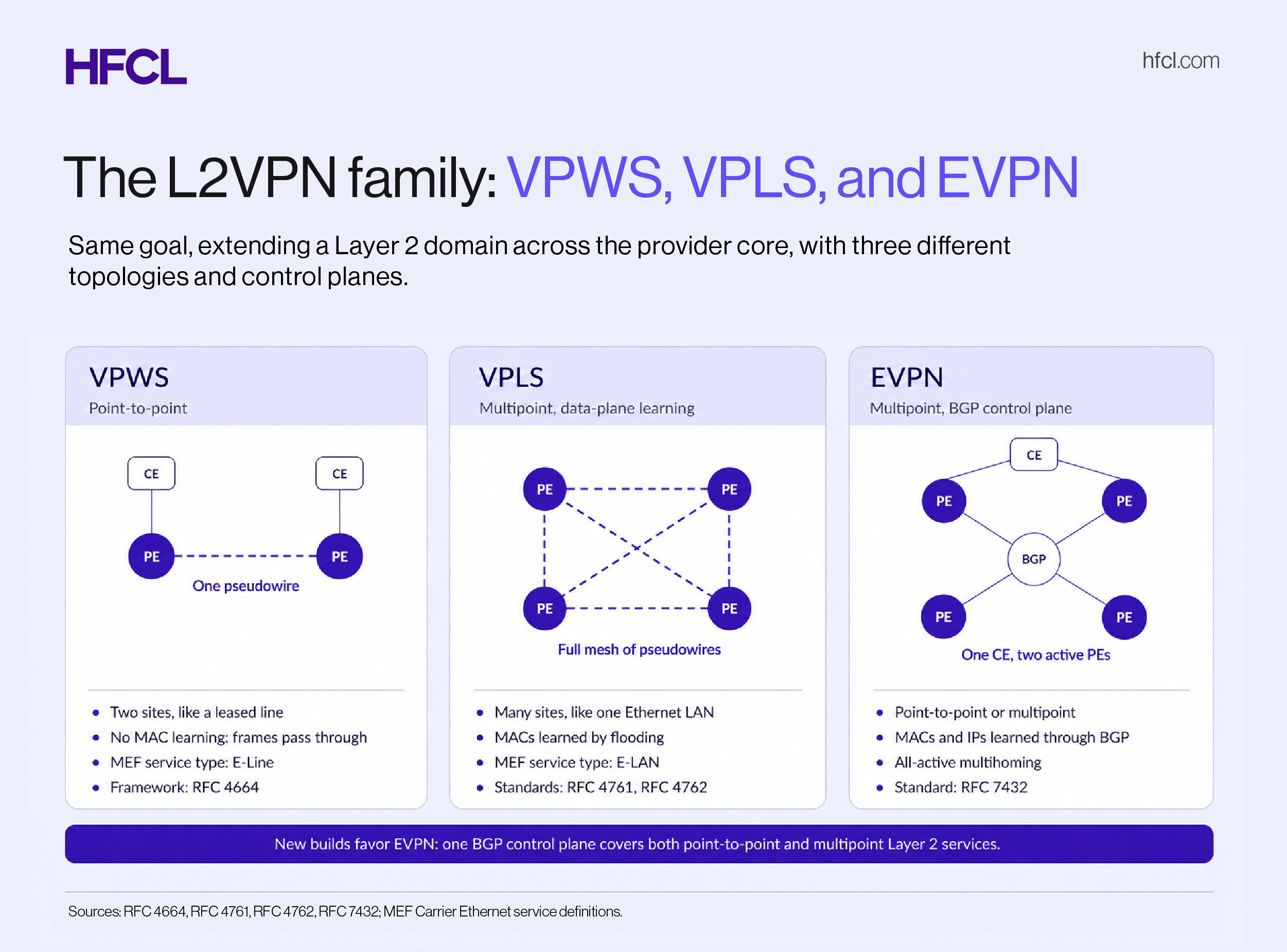
L2VPN is not a single protocol but a family of services, each suited to a different topology. All of them are built on pseudowires, which the IETF defines in RFC 4664 as emulated point-to-point circuits carried over the MPLS core.
Virtual Private Wire Service (VPWS)
VPWS delivers a strict point-to-point connection between exactly two customer sites, functioning as the virtual equivalent of a leased line. Cisco's implementation of VPWS, Any Transport over MPLS (AToM), encapsulates the customer's frame with two MPLS labels, an outer transport label that gets the packet across the core and an inner pseudowire label that identifies the specific circuit, and forwards it to the far-end PE. VPWS is well suited to connecting two data centers or two specific branch offices where no additional sites are involved. The Metro Ethernet Forum's Carrier Ethernet framework maps this to its point-to-point E-Line service type.
Virtual Private LAN Service (VPLS)
VPLS extends the same idea to multiple sites. As defined in RFC 4761 and RFC 4762, each PE maintains a Virtual Switching Instance (VSI) that maps multiple attachment circuits to multiple pseudowires in a full mesh, so that every site can reach every other site as though they all sat on the same Ethernet LAN. This corresponds to MEF's multipoint E-LAN service type. Because VPLS relies on flood-and-learn MAC address learning across the full mesh, it can face MAC-table scaling limits and lacks a native active-active redundancy model as the number of sites grows, a constraint that became one of the main drivers behind the next generation of Layer 2 services.
Ethernet VPN (EVPN)
EVPN, standardized in RFC 7432, was introduced specifically to address VPLS's scaling and redundancy limitations. Instead of learning MAC addresses through data-plane flooding, EVPN distributes MAC and IP reachability information through the BGP control plane, the same mechanism L3VPN already uses for IP routes. This gives operators faster convergence, native all-active multihoming so a site can connect to two PEs simultaneously without a loop, and a single control-plane framework that can support point-to-point (replacing VPWS), multipoint (replacing VPLS), and even IP routing services. RFC 8365 extends EVPN further as a network virtualization overlay solution, which is a significant reason EVPN has become the reference architecture for new L2VPN deployments rather than legacy VPLS.
How Does L3VPN Work? VRFs, Route Distinguishers, and MP-BGP
L3VPN's forwarding model has three moving parts that work together to keep customer routing tables separate while sharing one physical core.
Step 1: VRF Isolation at the Edge
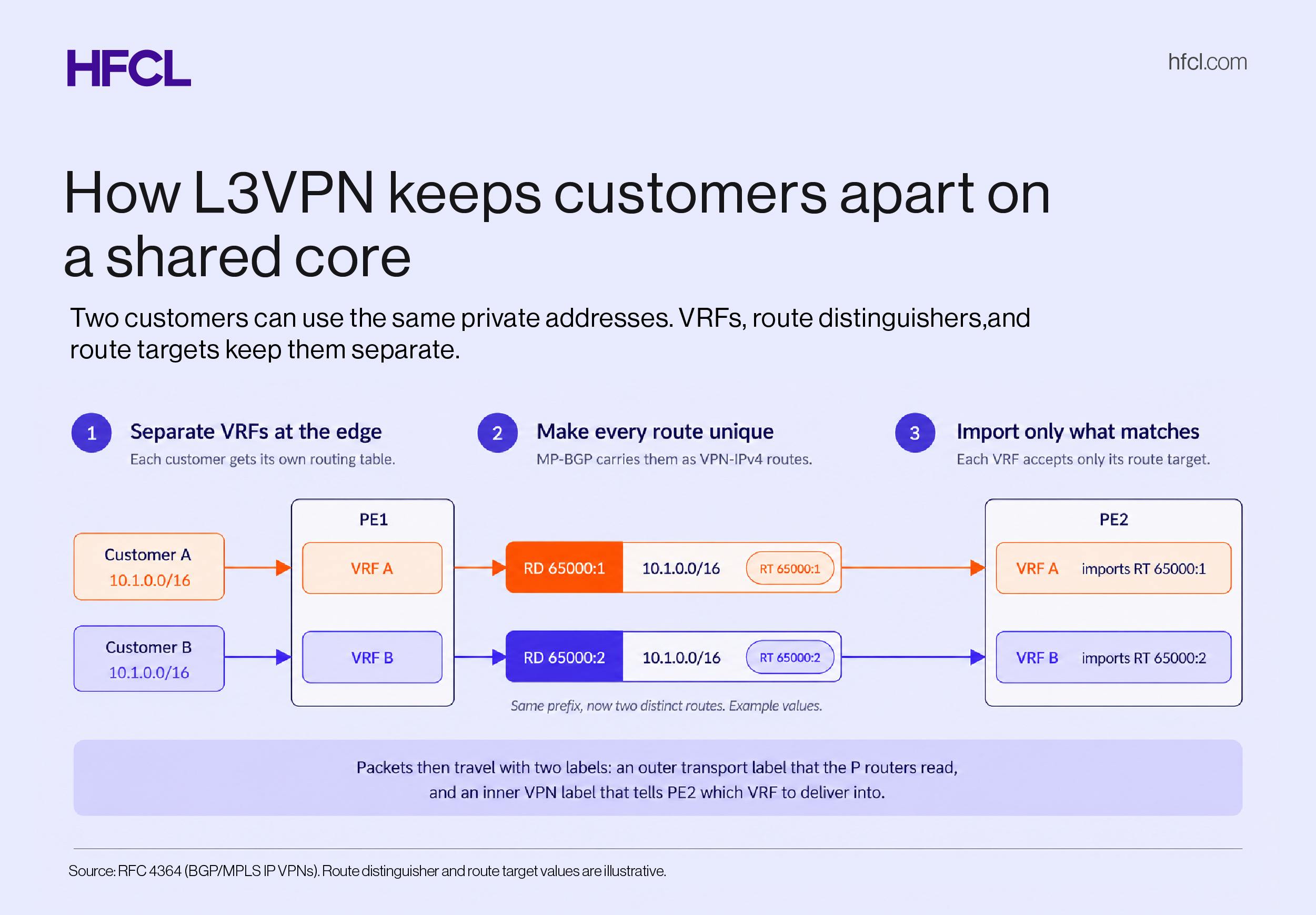
Every customer site connects into its own VRF on the PE router. A VRF is a completely separate routing and forwarding table, which means two different customers can both use the 10.0.0.0/8 private address range without any conflict, because their routes never mix.
Step 2: Route Distinguishers and MP-BGP Distribution
Because standard BGP cannot carry two identical IPv4 prefixes from different customers at once, RFC 4364 defines the Route Distinguisher (RD), a unique value prepended to each customer prefix that makes it globally unique as a VPN-IPv4 or VPN-IPv6 route. Multiprotocol BGP then carries these VPN-tagged routes between PE routers across the core. Route Targets (RTs), a separate BGP extended community attached to each route, control which VRFs actually import a given route, which is what allows operators to build anything from a simple hub-and-spoke topology to a full-mesh any-to-any VPN or a controlled extranet between two otherwise separate customers.
Step 3: MPLS Label Forwarding
Once a PE learns a remote site's route through MP-BGP, it forwards traffic to that site using two stacked MPLS labels: an outer label that the P routers use to reach the destination PE, and an inner VPN label that tells the receiving PE which VRF to deliver the packet into. As with L2VPN, the P routers in the core only ever look at the outer label, so the core stays simple even as the number of customer VPNs grows.
Which One Should You Choose? A Decision Framework
The right architecture depends on what the customer actually needs the network to do, not on which technology is newer.
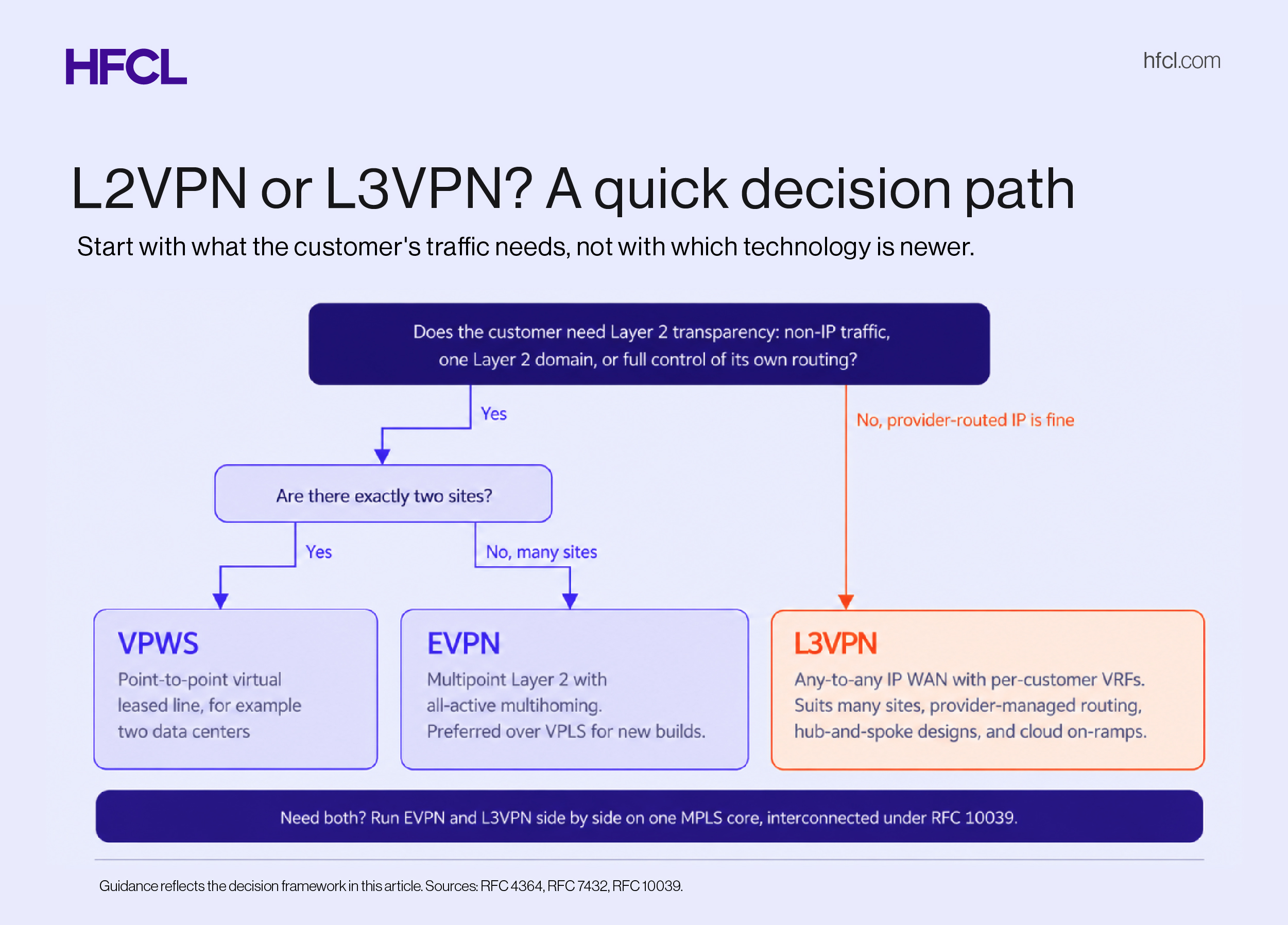
Choose L2VPN when:
- The customer needs to run non-IP or IP-agnostic traffic transparently, such as storage replication protocols or legacy protocols that were never designed for routed networks.
- The requirement is a small, fixed number of sites, particularly two, that need to behave like they are on the same LAN or connected by a dedicated wire.
- The customer wants full control of their own routing and does not want the provider participating in IP route decisions at all.
- The use case is data center interconnect, where extending a Layer 2 broadcast domain between facilities supports workload mobility and clustering.
Choose L3VPN when:
- The customer has many sites, often dozens or hundreds, that all need efficient any-to-any reachability without the customer managing a full routing mesh themselves.
- The provider is expected to deliver a managed enterprise WAN service, including route control, QoS, and multi-tenant isolation for large enterprise or government WAN rollouts.
- Sites need selective connectivity patterns, such as hub-and-spoke for branch-to-headquarters traffic or controlled extranets between business units, which route targets make straightforward to implement.
- Internet access, cloud on-ramp, and other IP-native services need to be delivered through the same VRF framework as the private WAN.
Many operators do not treat this as an either/or decision. It is common to see the same MPLS core delivering EVPN-based Layer 2 services for data center interconnect and BGP/MPLS L3VPN for enterprise WAN customers side by side, since both services share the same PE and P router infrastructure and the same MPLS label-switching core.
The Role of L2VPN and L3VPN in 5G and Cloud Transport
Mobile transport networks draw on both architectures, often within the same deployment. RFC 9889, published by the IETF's TEAS working group, formalizes how operators realize 5G network slices using the IP/MPLS technologies already covered in this post: EVPN-based L2VPN services connect radio units to baseband and core functions where Layer 2 transparency and multihoming redundancy matter, while L3VPN's VRF model separates traffic belonging to different network slices or different enterprise customers sharing the same transport infrastructure. Because VRFs and EVPN instances are provisioned entirely at the network edge, without requiring per-service configuration changes on every core router, operators can bring up a new enterprise WAN customer or a new 5G transport slice without re-touching the P routers that make up the backbone. This edge-provisioning model is the same architectural principle that underpins segment routing, and the two technologies are increasingly deployed together: segment routing handles how traffic gets steered across the core, while L2VPN and L3VPN define the service the customer actually buys.
Security and Isolation: What L2VPN and L3VPN Do and Do Not Guarantee
It is worth being precise here, because this is a common point of confusion. Both L2VPN and L3VPN provide traffic and routing isolation between customers sharing the same physical infrastructure, which is a meaningful security boundary in a private MPLS backbone. Neither one, by itself, encrypts customer traffic. RFC 4364's own applicability guidance is explicit that if the underlying backbone includes the public internet rather than a provider-controlled core, IPsec tunnels should be used to protect VPN traffic, since MPLS label switching alone does not provide confidentiality, sender authentication, or protection against replay attacks. Operators building managed VPN services over a private, provider-owned MPLS core rely primarily on the routing and forwarding isolation these architectures provide; operators or enterprises extending a VPN over any shared or public transport should layer encryption on top rather than treating MPLS separation as a substitute for it.
What's Changed Recently: EVPN-IPVPN Interworking and SRv6-Based VPN Services
Both L2VPN and L3VPN standards are still actively evolving, not sitting still as legacy protocols. A few developments from the IETF's BESS (BGP Enabled Services) and TEAS working groups are worth knowing as of 2026.
L2VPN and L3VPN Can Now Interwork Directly: RFC 10039
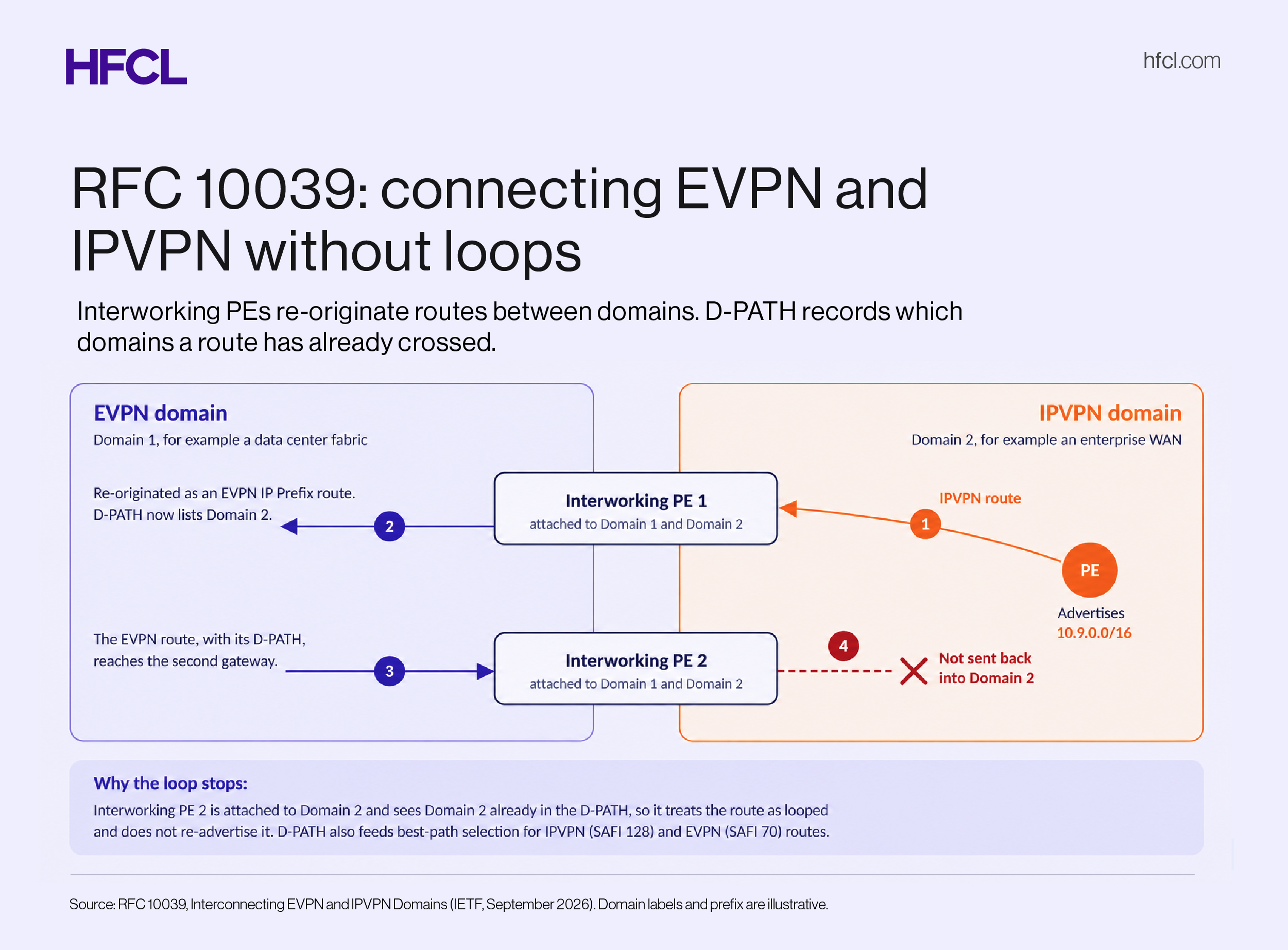
For most of their history, EVPN (Layer 2) and IP VPN (Layer 3) have run as separate domains that meet only at a gateway, with each vendor handling the handoff its own way. That changed in September 2026, when the IETF published RFC 10039, Interconnecting EVPN and IPVPN Domains, as a Standards Track specification from the BESS working group. RFC 10039 defines how an Interworking PE imports routes from one domain, installs them in an IP-VRF, and re-originates them into the adjacent domain, covering EVPN-to-IPVPN as well as EVPN-to-EVPN and IPVPN-to-IPVPN interconnection. It also introduces a new BGP Path Attribute, Domain Path (D-PATH), which stops control plane loops when redundant gateways connect the same domains and updates BGP best-path selection for IPVPN (SAFI 128) and EVPN (SAFI 70) routes. For a network running both L2VPN and L3VPN services, as most carrier cores do, this closes a real operational gap: stitching an EVPN-based data center interconnect to an L3VPN-based enterprise WAN, so a workload can migrate seamlessly between them, no longer depends on a proprietary gateway design. It is now a standardized, multi-vendor procedure.
SRv6 Is Becoming the Default Transport for New VPN Deployments
RFC 9252 defines how L3VPN and EVPN routes are carried over Segment Routing over IPv6 (SRv6) transport rather than traditional MPLS labels, and IETF work has continued to build on it. Recent drafts address practical gaps operators run into at scale: fast convergence and multihoming for SRv6-based L3VPNs, and anycast SIDs that let two PEs advertise the same service identifier to improve load balancing during failover. These are still individual proposals working through IETF review rather than finalized standards, but they show where the vendor community is investing engineering effort. Independent testing backs this up: EANTC's 2025 Multi-Vendor MPLS & SDN Interoperability Test Report found multiple vendors' EVPN and SRv6 implementations working together, evidence that this is moving from lab drafts toward deployable multi-vendor reality.
The Base EVPN Specification Is Being Revised
RFC 7432, the foundational EVPN standard cited earlier in this post, is itself being updated through draft-ietf-bess-rfc7432bis, an IETF effort to consolidate a decade of EVPN clarifications and extensions into a single revised specification. Meanwhile, RFC 8560 already standardizes how EVPN and legacy VPLS or Provider Backbone Bridging networks can interoperate during migration, which is why Cisco, Juniper, and other vendors publish seamless VPLS-to-EVPN migration paths rather than requiring a hard cutover.
What This Means Day to Day
None of this changes the fundamentals covered above, VRFs, route targets, MP-BGP, and pseudowires still describe how these services actually work. What is changing is the transport underneath (SRv6 replacing MPLS labels in new builds) and the boundary between L2 and L3 services (RFC 10039 interworking replacing bespoke gateways). Operators evaluating new IP/MPLS infrastructure should confirm SRv6 VPN support and RFC 10039 interworking roadmaps from vendors now, even if a given rollout starts on traditional MPLS transport.
Conclusion
L2VPN and L3VPN solve different problems by design. L2VPN keeps a customer's Layer 2 domain intact across distance, which suits point-to-point circuits, data center interconnect, and workloads that need protocol transparency. L3VPN puts the provider's routers to work as part of the customer's IP routing, which suits large, any-to-any enterprise WANs and managed connectivity services delivered at scale. Most carrier networks need to deliver both, often to the same customer base, from the same MPLS core. HFCL's DCR 1100 IP/MPLS router portfolio is built on an MPLS and Segment Routing-enabled core designed for exactly this kind of dual-service delivery, giving telecom operators and enterprises a foundation for both L2VPN and L3VPN services as their networks scale toward 5G and cloud-native architectures.
FAQ
L2VPN extends a customer's Ethernet Layer 2 domain across the provider network without the provider participating in the customer's IP routing, while L3VPN has the provider's edge routers actively route the customer's IP traffic using dedicated VRFs and MP-BGP, as defined in RFC 4364. The practical difference is control: with L2VPN the customer's routers peer directly with each other across the provider network; with L3VPN the customer's routers peer with the provider's edge router instead. Most carrier networks end up delivering both, which is why routing platforms are generally built to handle either role, including HFCL's DCR 1100 IP/MPLS series.
No. Both are multipoint Layer 2 services and both map to MEF's E-LAN service type, but they use different control planes. VPLS, defined in RFC 4761 and RFC 4762, learns MAC addresses through data-plane flooding across a full mesh of pseudowires. EVPN, defined in RFC 7432, distributes MAC and IP reachability through BGP instead, which gives it faster convergence and native active-active multihoming that VPLS does not support natively. Most new Layer 2 VPN deployments favor EVPN over legacy VPLS for this reason, and operators refreshing their infrastructure typically prioritize EVPN support when evaluating new IP/MPLS platforms, including HFCL's DCR 1100 series.
Not by itself. L2VPN and L3VPN isolate customer traffic and routing information from other customers sharing the same MPLS backbone, but neither encrypts the data. RFC 4364 explicitly recommends IPsec tunnels when VPN traffic crosses the public internet rather than a provider-controlled core, since MPLS label switching alone does not provide confidentiality or protection against replay attacks. This holds regardless of the router vendor, including deployments built on HFCL's DCR 1100 IP/MPLS routers: the isolation is architectural, the encryption is a separate layer you add where the transport demands it.
L2VPN fits scenarios where the customer needs to carry non-IP or IP-agnostic traffic, wants full control of its own routing without the provider participating, or needs a small number of sites to behave like a single LAN or a private wire, such as data center interconnect. L3VPN fits scenarios with many sites needing efficient any-to-any reachability, where the provider is expected to manage routing, QoS, and multi-tenant isolation as part of the service. Most carrier networks end up needing both delivered from the same core, which is why platforms such as HFCL's DCR 1100 IP/MPLS routers are built to support L2VPN and L3VPN service delivery side by side.
Yes, and as of September 2026 there is a published standard for it. Historically, EVPN and IP VPN domains only met at a purpose-built gateway. RFC 10039, Interconnecting EVPN and IPVPN Domains, now defines how the two domains exchange routes directly through an Interworking PE, using a new BGP Path Attribute called Domain Path (D-PATH) to prevent control plane loops when redundant gateways connect the same domains. For operators, this means EVPN-based data center interconnect and L3VPN-based enterprise WAN can be stitched together on the same network using a Standards Track procedure rather than a vendor-specific gateway design.
The DCR 1100 series is built around a Carrier Ethernet, MPLS, and Segment Routing feature set spanning both Layer 2 and Layer 3, the same categories L2VPN and L3VPN services are built from. For the exact protocol and RFC-level support relevant to a specific deployment, VPWS, VPLS, EVPN, or BGP/MPLS L3VPN under RFC 4364, confirm current conformance against the latest datasheet or with HFCL's product engineering team for the specific model in question, since capability sets vary across the DCR 1100 range (52 Gbps, 56 Gbps, X120, X360, X800) and can change between firmware releases.