HFCL Recognized by ISE for Advancing High Density Fiber Infrastructure Innovation
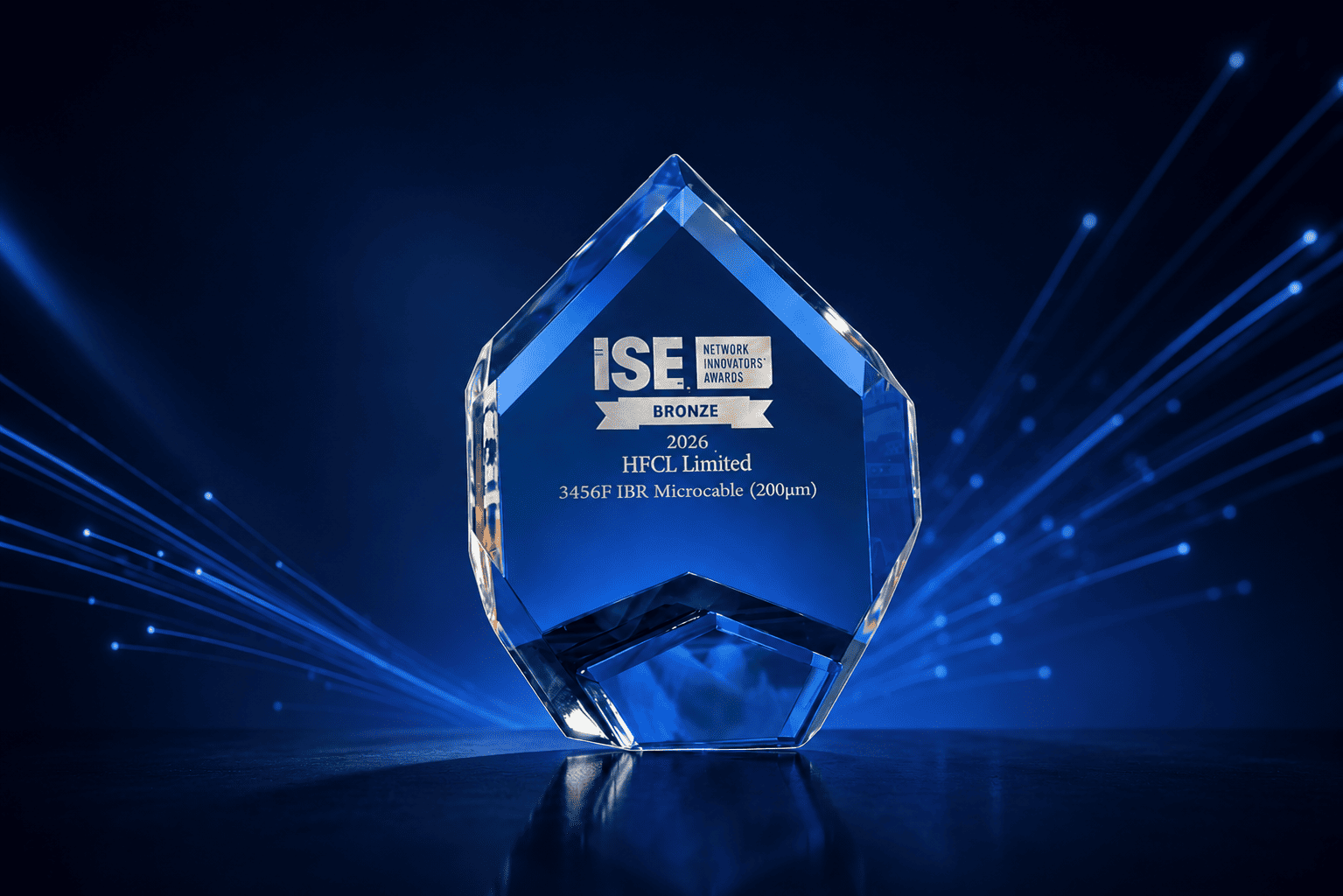
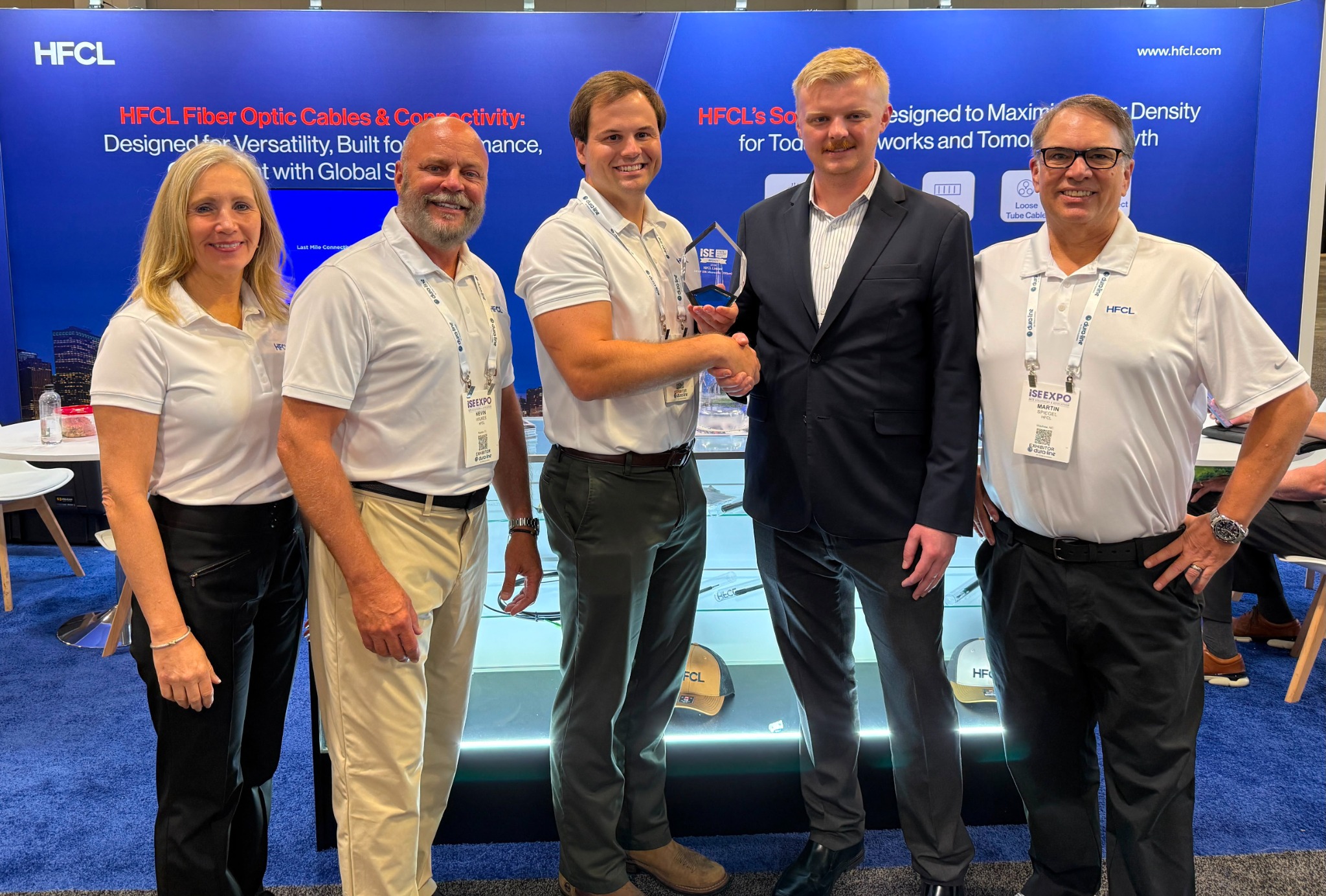
HFCL's 3456F Intermittently Bonded Ribbon (IBR) Microcable has won Bronze recognition in the Network category at the ISE Network Innovator Awards, a global honor that highlights innovations powering AI infrastructure, hyperscale data centers, and next-generation optical networks.
Artificial intelligence, cloud computing, hyperscale data centers, and digital services are accelerating demand for bandwidth across every region of the world. As organizations continue to scale their digital infrastructure, network operators face a fundamental challenge: how to deliver significantly more capacity without proportionally increasing deployment costs, complexity, and environmental impact.
Against this backdrop, HFCL is proud to announce that its 3456F IBR Microcable has received Bronze recognition in the Network category at the ISE Network Innovator Awards, reinforcing HFCL's standing as a global leader in high-density fiber infrastructure.
For us, this recognition is about more than a product innovation. It reflects the growing importance of high-density fiber infrastructure in enabling the next generation of digital networks.
The Growing Need for Smarter Fiber Infrastructure
The rapid growth of AI infrastructure is reshaping network requirements worldwide.
From AI training clusters and cloud applications to hyperscale data centers and high-performance computing environments, organizations are generating and processing more data than ever before. This growth is creating unprecedented demand for scalable and reliable connectivity.
At the same time, operators face increasing pressure to expand network capacity while working within existing infrastructure constraints. Duct space is limited, construction costs continue to rise, and deployment timelines are becoming increasingly compressed.
As a result, the industry is placing greater emphasis on solutions that can maximize capacity within existing infrastructure while supporting long-term network growth.
Key priorities for network operators include:
- Increasing network capacity without expanding duct infrastructure
- Accelerating fiber network deployment timelines
- Supporting hyperscale data center growth
- Expanding data center interconnect (DCI) networks
- Improving deployment economics
- Meeting sustainability and carbon reduction goals
The challenge is no longer simply adding more fiber. It is about deploying fiber more intelligently.
Enabling the Next Generation of High-Capacity Networks
As bandwidth demand continues to grow, high-density fiber cable technologies are becoming increasingly important.
By enabling significantly greater fiber counts within existing pathways, these solutions help operators scale networks without extensive infrastructure expansion. This approach improves infrastructure utilization, reduces deployment complexity, and helps control costs.
HFCL's 3456F IBR Microcable was developed to address these evolving requirements.
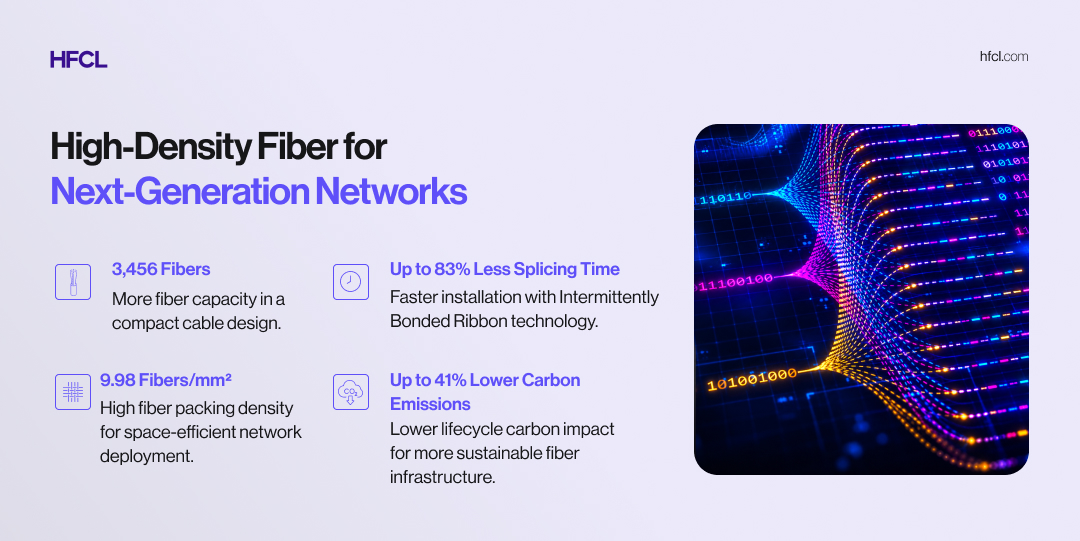
The cable accommodates 3,456 fibers within a compact architecture and achieves a fiber packing density of 9.98 fibers per mm². This enables operators to deploy substantially more capacity within the same physical footprint compared with conventional cable designs.
More Capacity Within Existing Infrastructure
One of the key advantages of the 3456F is its ability to unlock additional capacity from existing duct infrastructure.
Built using advanced 200µm fiber technology, the cable achieves a smaller overall diameter than comparable 250µm fiber designs. This enables service providers to increase fiber counts while preserving valuable duct space for future expansion.
For metro networks, backbone routes, and hyperscale deployments, this can deliver significant operational and economic benefits.
Designed for Faster Deployment
Network capacity alone is not enough. Deployment speed has become a critical differentiator for operators seeking to bring new services online quickly.
HFCL's Intermittently Bonded Ribbon technology helps address this challenge by simplifying installation processes and improving deployment efficiency.
Accelerating Installation Through IBR Technology
Unlike traditional loose-fiber designs, the 3456F's ribbon architecture supports mass fusion splicing while maintaining access to individual fibers when required.
This approach can reduce splicing time by up to 83%, helping operators accelerate project execution and reduce labor requirements.
Faster installation translates directly into shorter deployment timelines and improved operational efficiency.
Enabling Long-Distance Installation Performance
The 3456F also incorporates a specialized luffa-shaped sheath that reduces friction and improves airflow during jetting operations.
This design supports blowing distances of up to 1,500 meters under standard installation conditions. Longer installation runs help reduce intermediate splice locations, simplify deployment activities, and improve project productivity.
For long-distance network deployments, these efficiencies can significantly improve project economics.
Supporting Sustainable Network Expansion
Sustainability is becoming a defining consideration in infrastructure planning and procurement decisions.
As operators expand their networks, they are increasingly looking for technologies that deliver both performance and environmental benefits.
The compact architecture of the 3456F uses less material than conventional cable designs while enabling substantially greater capacity.
Building More Energy-Efficient Infrastructure
The cable's reduced size and weight contribute to lower transportation requirements and more efficient installation processes. Combined with its optimized design, this can result in up to 41% lower carbon emissions across the product lifecycle.
These benefits help operators expand fiber infrastructure while supporting broader sustainability objectives.
Recognition as Validation of Industry Direction
The ISE Network Innovator Awards recognize technologies that solve real-world industry challenges and create measurable value for network operators. This global recognition places HFCL among the innovators shaping the future of fiber infrastructure.
We believe this recognition validates a broader industry shift toward solutions that combine density, scalability, deployment efficiency, and sustainability.
As AI adoption accelerates and digital ecosystems continue to expand, operators will increasingly depend on innovations that help them maximize network capacity while optimizing infrastructure investments.
The future of connectivity will be shaped not only by how much capacity networks can deliver, but also by how efficiently that capacity can be deployed.
“With the 3456F IBR Microcable, HFCL has merged multiple innovations into a single product. From easing installation and termination practices to enabling deployment through smaller pathways, the cable epitomizes product optimization.” — 2026 ISE Network Innovators' Awards Judge
Looking Ahead
The next decade of digital growth will be powered by AI-enabled applications, cloud-native services, and increasingly data-intensive digital experiences.
Meeting these demands will require continued innovation across the communications ecosystem, particularly within the fiber infrastructure that forms the foundation of modern connectivity.
At HFCL, we remain committed to developing technologies that help customers build resilient, scalable, and future-ready networks.
The ISE recognition of the 3456F IBR Microcable is an important milestone. More importantly, it reinforces the growing role that high-density fiber infrastructure will play in enabling the networks that power the digital economy of tomorrow.
FAQ
An Intermittently Bonded Ribbon (IBR) microcable is an ultra high density optical cable where individual fibers are bonded together at spaced intervals rather than continuously. This flexible design allows the ribbon to roll and compress into a compact, circular profile inside microducts, maximizing fiber packing density while still allowing technician access to single fibers or full 12 fiber ribbons for rapid mass fusion splicing.
AI training clusters and hyperscale computing generate massive volumes of server to server (east-west) traffic requiring ultra low latency and massive bandwidth. High density fiber allows network operators to pack thousands of optical fibers into existing, constrained conduits and pathways. This scales bandwidth capacity for data center interconnects without the disruptive costs of digging new trenches or expanding physical duct infrastructure.
200µm optical fiber uses a thinner protective coating compared to traditional 250µm fiber while maintaining the exact same standard glass core and optical performance. This reduction in diameter shrinks the overall cable size and weight, enabling significantly higher fiber counts within smaller microducts, improved blowing distances during jetting, and lower transportation footprint.
Traditional loose tube designs require technicians to splice each optical fiber individually, which is labor intensive on high fiber count lines. Ribbon architecture supports 12 fiber mass fusion splicing, reducing total splicing time by up to 83%. Additionally, dry gel free cores and aerodynamic cable jackets enable faster cable jetting over long distances, cutting down both project timelines and labor costs.