Inside the AI Data Center: The Hidden Fiber Tech Powering Quantum Networks
Quantum communication fiber is optical fiber engineered to carry quantum information, typically entangled photons, over long distances without breaking the fragile quantum state. It underpins secure quantum networks, and it shares its engineering foundation with the high density fiber optics powering modern AI infrastructure, hyperscale data centers, and cloud networking.
Quantum communication is reshaping the future of data transmission by leveraging the principles of quantum mechanics. At the center of this shift is fiber optic cable used in quantum communication, the same physical layer technology that also carries the classical traffic behind every AI data center, cloud infrastructure platform, and hyperscale network running today.
This connection matters more than it might first appear. The optical fiber, fiber network design, and network cabling discipline that quantum researchers depend on for coherence and low signal loss is the same discipline that hyperscale data center operators depend on for AI cluster performance. As AI infrastructure scales toward denser GPU fabrics and higher speed interconnects, the precision engineering born out of quantum grade fiber research is quietly raising the bar for every optical fiber network in operation today, including the ones running cloud data centers.
How Optical Fibre Powers Quantum Communication
Optical fibers act as the medium through which individual particles of light, or photons, carry quantum information. These photons can exist in multiple quantum states simultaneously, allowing quantum networks to transmit information with a level of security that classical network infrastructure cannot match.
Quantum Entanglement Transmission
Pairs of entangled photons travel through fiber optic cable, creating a link that enables instant correlation between distant nodes. This phenomenon underpins secure quantum protocols, including quantum cryptography, ensuring unhackable quantum communication.
Long Distance Quantum Networking
Traditional fiber optic networks face signal loss over long distances, but specialized quantum repeaters allow optical fibers to extend the reach of quantum fiber communication while preserving the integrity of quantum information. This same fight against signal loss and attenuation is central to fiber network design in any large scale data center networking environment.
Integration with Existing Fiber Optic Networks
Recent research shows quantum signals can coexist with classical data across the same fiber optic cable, opening the door to large scale quantum networks without requiring an entirely new infrastructure layer. Managing wavelengths and photon interactions carefully allows high fidelity quantum communication to run alongside conventional data infrastructure, the same principle that governs how modern network architecture separates and optimizes traffic across a shared fiber cabling backbone.
Advantages of Optical Fibre in Quantum and Classical Networks
- High Security: Any attempt to intercept quantum information alters the quantum state, immediately alerting parties to eavesdropping.
- High Speed Data Transmission: Photons travel at nearly the speed of light, enabling rapid data exchange across metropolitan and global fiber networks.
- Compatibility with Advanced Systems: Optical fibers integrate quantum memories, quantum sensors, and quantum computing components, and in classical networks connect GPU clusters, switches, and storage within AI data centers.
- Scalable Network Connectivity: The same low loss, high density fiber cabling that supports quantum coherence also supports the network connectivity demands of hyperscale data centers running AI and cloud workloads.
Innovations Enhancing Quantum and AI Ready Fiber Networks
Emerging fiber technologies, such as hollow core fibers, reduce photon interaction with the surrounding medium, minimizing signal loss and improving coherence. Adaptive polarization systems, quantum transceivers, and entanglement swapping protocols are addressing challenges like noise, dispersion, and long distance scalability.
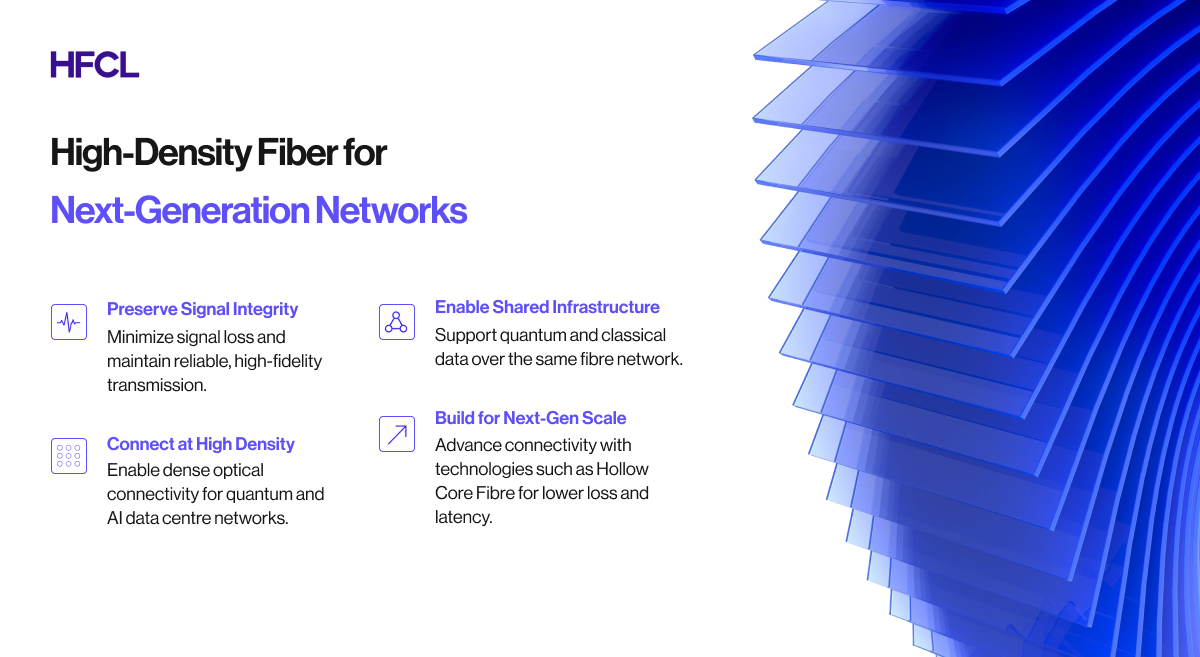
India is now contributing directly to this research frontier. In February 2026, HFCL joined a Department of Telecommunications funded research consortium led by IIT Delhi to advance hollow core fiber technology for next generation communication networks, including 6G and quantum communication systems. HFCL is contributing manufacturing expertise and integrated optical fiber facilities to support the translational, real world deployment side of the research, while IIT Delhi leads the underlying optical physics, materials engineering, and electromagnetic design work. The collaboration reflects a broader industry view that the fiber engineering priorities behind quantum research, density, precision, and low signal loss, are the same priorities that will define next generation AI infrastructure.
This is where OptiQ AI by HFCL enters the picture. OptiQ AI is an end to end optical connectivity platform purpose built for AI, hyperscale, and next generation data center infrastructure. It brings together high density IBR microcables (up to 6912F), fiber pigtails, patch cords, trunks, assemblies, and high density and ultra high density cassette and panel systems into a single, integrated portfolio, engineered around five principles: High Quality, Quantum Bandwidth, Densely Quantified design, Quick Rollouts, and Q Class Uptime.
Just as quantum fiber networks depend on structured, low loss optical paths to preserve information integrity, AI data centers depend on structured cabling and high density optical fiber to preserve signal integrity as speeds push toward 400G, 800G, and 1.6T. OptiQ AI addresses this directly, replacing fragmented, point solution approaches to data center infrastructure with one unified system, reducing the field testing cycles, rack density constraints, and compatibility issues that slow deployment for hyperscale data center and cloud data center operators alike.
Real World Applications
Quantum Internet Development
Optical fibers form the infrastructure for transmitting quantum information securely across cities, countries, and continents.
Secure Financial Transactions
Banks can use quantum networks to protect sensitive data through quantum cryptography.
Quantum Enabled AI and Cloud Computing
Optical fiber facilitates rapid transmission of data between computational nodes, supporting AI driven decision making and complex simulations. This is the point where quantum grade fiber science and everyday AI infrastructure genuinely converge, both need dense, low loss, high fidelity optical fiber network paths to function at scale.
AI Data Centers and Hyperscale Networks
Hyperscale data centers, cloud service providers, and AI infrastructure providers are undergoing the same physical layer transformation that quantum networking researchers have been solving for years, moving from copper constrained, fragmented network architecture to unified, high density fiber cabling systems. Platforms like OptiQ AI apply that same rigor to structured cabling, Data Center Interconnect (DCI), and rack level connectivity, giving hyperscalers, colocation providers, and enterprise data centers a single vendor path to AI ready digital infrastructure.
Challenges and the Path Forward
Despite remarkable progress, deploying quantum fiber networks faces real challenges:
- Signal attenuation over long distances
- Integration with classical networks without interference
- Maintaining quantum entanglement and coherence in real world environments
Classical AI infrastructure faces a parallel set of challenges: signal integrity at higher transmission speeds, throughput bottlenecks between GPU clusters, density limits within existing racks, slow deployment timelines, and near zero tolerance for network failure under hyperscaler SLAs. Research into novel fibers and repeaters is closing the gap for quantum networks, and integrated portfolios such as OptiQ AI are closing the equivalent gap for AI data center infrastructure.
Conclusion
Optical fibre in quantum communication is no longer a theoretical concept, it is the practical backbone for the next generation of secure, high speed, and scalable networks. The same engineering discipline that makes quantum communication fiber possible, density, precision, and low signal loss, is now defining how AI infrastructure, hyperscale data centers, and cloud networking are built. With research collaborations such as HFCL and IIT Delhi advancing hollow core fiber for 6G and quantum systems, and integrated portfolios such as OptiQ AI applying that same rigor to everyday AI and cloud infrastructure, India is positioning itself at both ends of this fiber engineering shift, from foundational research to commercial deployment.
FAQ
Quantum-grade optical fiber improves AI data centers by providing ultra-low signal attenuation, high physical core density, and superior signal integrity. Modern AI clusters rely on dense GPU-to-GPU interconnects operating at speeds of 400G, 800G, and 1.6T. The precise optical engineering required to preserve fragile quantum states (such as entangled photons) directly translates to classical network cabling, reducing latency, eliminating throughput bottlenecks, and maximizing rack space efficiency in hyperscale environments.
Yes, quantum signals can coexist with classical data over the same fiber optic infrastructure through advanced wavelength-division multiplexing and precise photon management. By isolating specific transmission wavelengths and mitigating cross-talk, network operators can run high-fidelity quantum cryptographic channels alongside standard data traffic, avoiding the need to deploy separate, dedicated physical fiber lines.
Hollow Core Fiber (HCF) guides light through an air or vacuum channel rather than a solid glass core, reducing photon-medium interactions. This provides three major technical advantages:
- Lower latency: Light travels roughly 30% to 40% faster in air than in solid silica glass.
- Reduced signal loss and dispersion: Minimizes attenuation and non-linear distortion over long-distance transmission.
- Higher coherence: Enhances entanglement preservation for quantum networks while boosting high-bandwidth throughput for 6G and AI interconnects.
Both domains face physical-layer constraints that require distinct engineering approaches:
- Quantum Network Challenges: Long-distance signal attenuation, environmental decoherence, and cross-talk during classical coexistence. These issues are addressed using quantum repeaters, adaptive polarization systems, and hollow-core fibers.
- AI Infrastructure Challenges: Signal loss at ultra-high transmission speeds (800G/1.6T), severe throughput bottlenecks between GPU clusters, and physical rack density limitations. These constraints are solved using ultra-high-density microcables (up to 6912F), structured cassette panels, and unified optical platforms like HFCL's OptiQ AI.