AI Data Center Architecture: Breaking the 100kW Thermal Wall

In 2026, the data center industry has undergone a radical transformation. These facilities are no longer passive warehouses for servers. Instead, they serve as the primary engine for global progress. Artificial intelligence, hyperscale cloud services, and high-performance computing are driving an unprecedented demand for compute capacity and ultra-fast connectivity. Data centers are now designed as strategic digital infrastructure that powers everything from real-time analytics to autonomous systems. As workloads continue to scale rapidly, operators are forced to rethink how these facilities are built, cooled, and powered. As we navigate this tech supercycle, the industry prioritizes liquid cooling, sustainable power, and rapid deployment speed.
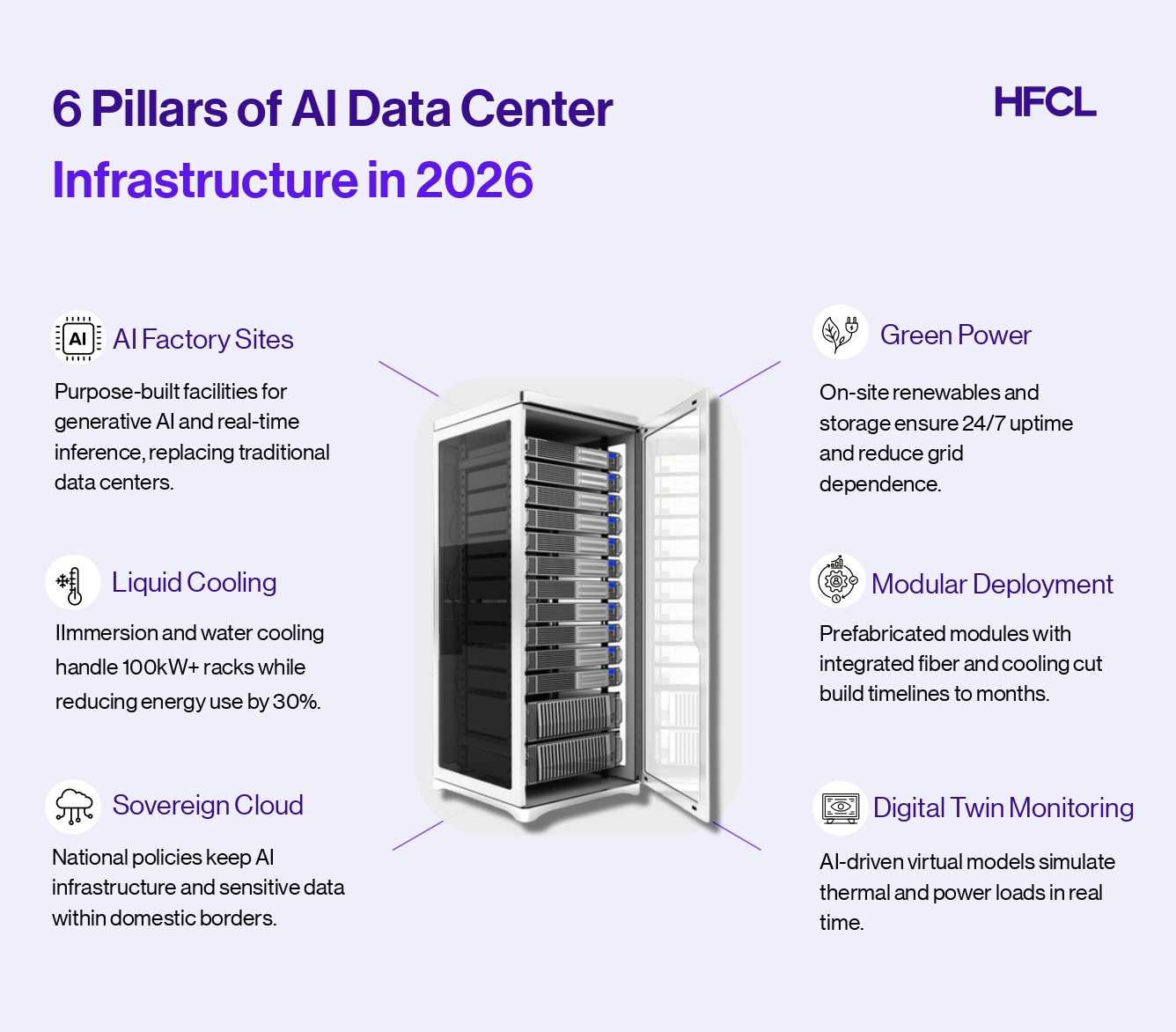
The 2026 Shift: Building AI Factories
Traditional facility designs are now obsolete. We are witnessing the rise of the AI Factory sites engineered to support the intense demands of generative AI.
Real Time AI at the Edge
The industry has reached a tipping point. Most AI activity now focuses on inferencethe process of running live models. To ensure real time results, compute power must sit closer to the end-user. This shift drives a new wave of investment from every major cloud service provider into urban edge clusters.
Sovereign Cloud and Data Security
National security concerns now drive infrastructure choices. Programs like "Make in India" ensure that ai data center assets stay within national borders. Companies like HFCL are leading this charge by providing domestic, high-performance connectivity solutions. This strategy secures the large scale supply chain and protects data sovereignty against global disruptions.
Using Liquid Cooling to Break the Thermal Wall
As server rack densities exceed 100kW, traditional air cooling cannot keep up. In 2026, liquid cooling has become the industry standard for any high-performance site.
- Advanced Methods: Technologies like water cooling and immersion cooling are now the primary choices for operators. These systems improve energy efficiency by nearly 30% compared to legacy air-cooled designs.
- Specific Requirements: Engineers must address specific requirements for each chip set. A custom cooling solution is now a core part of the facility design.
- High-Density Connectivity: Operators now use high-density fiber and MPO assemblies to manage data flow. This reduces the "cable jungle" under the floor, allowing better airflow so the data center requires less power to maintain stable temperatures.
Fiber at the Foundation of AI Ready Infrastructure
To handle the bandwidth of a modern GPU cluster, the physical layer must evolve. HFCL is currently scaling its production to meet these needs, aiming for a massive 19.01 million fiber km capacity by mid-2026.
Their focus on Base-16 and Base-32 MPO solutions is critical for 1.6T and 3.2T networks. By using pre-terminated MPO Trunk Cable Assemblies and Fanout Assemblies, HFCL helps operators achieve the high density required for AI workloads. This level of high-density fiber integration ensures that the connectivity backbone does not become a bottleneck for the AI engine.
Solving the Global Power Crisis
The primary constraint in 2026 is data center power. With aging grids reaching their limits, hyperscalers like amazon web services are taking control of their own energy production.
- Green Energy Integration: New builds now feature cost effective on-site solar and wind arrays. These are paired with advanced battery storage to ensure 24/7 uptime.
- The Digital Twin: A Digital Twin is a virtual model of the physical facility. It uses AI to monitor power usage and simulate thermal loads. This technology ensures the facility remains future proof as workloads evolve.
Accelerating Deployment Speed
The demand for AI capacity moves faster than traditional construction. Modular construction is the new playbook for achieving large scale growth at record speeds.
- Rapid Builds: By using ready-made modules, firms achieve high deployment speed. This process slashes construction timelines from several years down to just a few months.
- Smart Infrastructure: These modules arrive with high-density fiber and cooling loops pre-installed. This setup supports continuous deployment of new hardware and speeds up software delivery.
Regulatory Landscape and Urban Integration
Governments now enforce strict regulatory compliance regarding water and energy use. Data centers must prove their efficiency to stay operational.
- Heat Reuse Projects: In modern Smart Cities, heat is a resource. A high-density GPU cluster generates significant warmth. Cities now capture this waste heat and pipe it into local district heating systems.
- Global Connectivity: We are currently preparing for 1.6T networking speeds. The high-density fiber infrastructure we install today provides the foundation for this growth. You can research the evolution of these standards on wikipedia the free encyclopedia to see how quickly bandwidth needs have scaled.
Setting the New Standard
The transition to AI-native infrastructure is a decade-long journey. In 2026, the industry finally broke through the noise to deliver sustainable, large scale results. By focusing on liquid cooling and maximizing deployment speed, leaders are doing more than just meeting demand. They are building the high-performance foundations for a world defined by artificial intelligence.
As we look toward the future, the integration of high-density fiber and cost effective power management will remain the gold standard. Companies are providing the essential MPO and fiber building blocks to make this possible. Operators who balance the specific requirements of their hardware with the urgency of generative ai will lead the next era of global progress. Staying updated on these shifts multiple times a day is no longer optional it is a business necessity.
FAQ
An AI Factory is a purpose-built facility engineered from the ground up to handle the massive compute, throughput, and thermal demands of generative AI and real time model inference.
Unlike traditional data centers that function as passive warehouses for mixed, low-density server workloads, AI Factories are highly specialized digital infrastructure engines. They are architected to support extreme rack densities exceeding 100kW, whereas legacy facilities typically average under 15kW per rack. Additionally, AI Factories integrate liquid cooling directly into the core design rather than retrofitting it, and they rely on next-generation optical networks to prevent data bottlenecks between interconnected GPU clusters.
The thermal wall refers to the physical limitation where traditional air cooling can no longer safely or effectively dissipate the intense heat generated by modern high-performance hardware. When server rack densities climb past 100kW, relying on fans and chilled air becomes mechanically impossible.
Liquid cooling has become the industry standard because liquids conduct heat significantly better than air. Transitioning to advanced methods like direct-to-chip water cooling or immersion cooling improves overall facility energy efficiency by nearly 30 percent. This shift allows operators to run high-density GPU clusters at peak performance without thermal throttling while simultaneously lowering power consumption.
High-density fiber is the critical physical foundation required to support the massive bandwidth and ultra-low latency demands of modern AI workloads. As networks transition to 1.6T and 3.2T speeds, operators must utilize Base-16 and Base-32 MPO assemblies to ensure the connectivity backbone does not become a bottleneck for the AI engine.
Beyond managing raw data flow, pre-terminated MPO trunk and fanout assemblies drastically reduce physical cable bulk. Minimizing the cable jungle underneath facility floors significantly improves airflow dynamics. This cleaner routing allows air to move freely, meaning the data center requires less overall power to maintain stable operational temperatures.
Data center operators are overcoming aging grid limitations and strict utility regulations by shifting from passive energy consumers into self-sustaining power producers.
Operators are deploying cost-effective on-site solar and wind arrays paired with advanced battery storage systems to ensure 24/7 uptime. To maximize this energy, they use Digital Twin technology to simulate thermal loads and optimize power usage in real time. Furthermore, to comply with strict urban environmental policies, modern facilities are capturing the waste heat generated by GPU clusters and piping it directly into local municipal district heating systems.