800G Fiber Networking Guide for Enterprise Networks

Ask any IT leader managing AI, analytics, or cloud workloads today, and they are likely to identify the same challenge: the network has become the bottleneck. It is no longer the servers or the storage limiting application performance. Instead, the rapid growth of AI, cloud computing, and data-intensive applications is placing unprecedented pressure on enterprise networks.
Bandwidth that comfortably supported business operations just a few years ago is now struggling to keep pace with modern workloads. AI model training, real-time analytics, cloud services, and distributed applications generate enormous east-west traffic inside data centers. As organizations continue their digital transformation journeys, upgrading network infrastructure is becoming a strategic business decision rather than a routine technology refresh.
800G fiber networking represents the next step in optical networking, delivering the high-speed fiber connectivity required for today's and tomorrow's workloads. Before making the transition, enterprises need to understand what is driving adoption, how the technology works, and how to plan a cost-effective enterprise network upgrade.
Why Are the World's Biggest Networks Already Moving?
The transition to 800G is not being driven by future expectations alone. It is already underway as hyperscalers, telecom operators, cloud providers, and large enterprises expand their data center infrastructure to support increasing traffic volumes and AI applications.
Organizations are processing larger amounts of data than ever before. AI workloads, high-definition video conferencing, cloud-based collaboration platforms, and digital services require a high bandwidth network capable of transmitting data with minimal latency. As a result, network upgrades have become an immediate priority rather than a long-term consideration.
AI and Cloud Workloads Are Accelerating Demand
Artificial intelligence is fundamentally changing traffic patterns inside enterprise data centers. Training large AI models requires thousands of GPUs exchanging information continuously, while inference workloads generate persistent traffic across distributed computing environments.
Similarly, cloud services continue to increase east-west traffic between servers. Every new cloud application, analytics platform, or storage service adds pressure to existing network infrastructure. Higher bandwidth is no longer optional it is essential for maintaining application performance.
Enterprises Are Planning Earlier Than Before
Industry adoption is expanding beyond hyperscalers. Financial institutions, healthcare organizations, manufacturers, and research institutions are evaluating 800G as part of their long-term digital transformation strategies.
Another reason organizations are planning earlier is supply chain readiness. Demand for advanced networking equipment and high-density optical transceivers continues to grow, resulting in longer procurement cycles. Enterprises that begin planning today are better positioned to manage budgets, deployment schedules, and vendor availability.
What Actually Makes 800G Different?
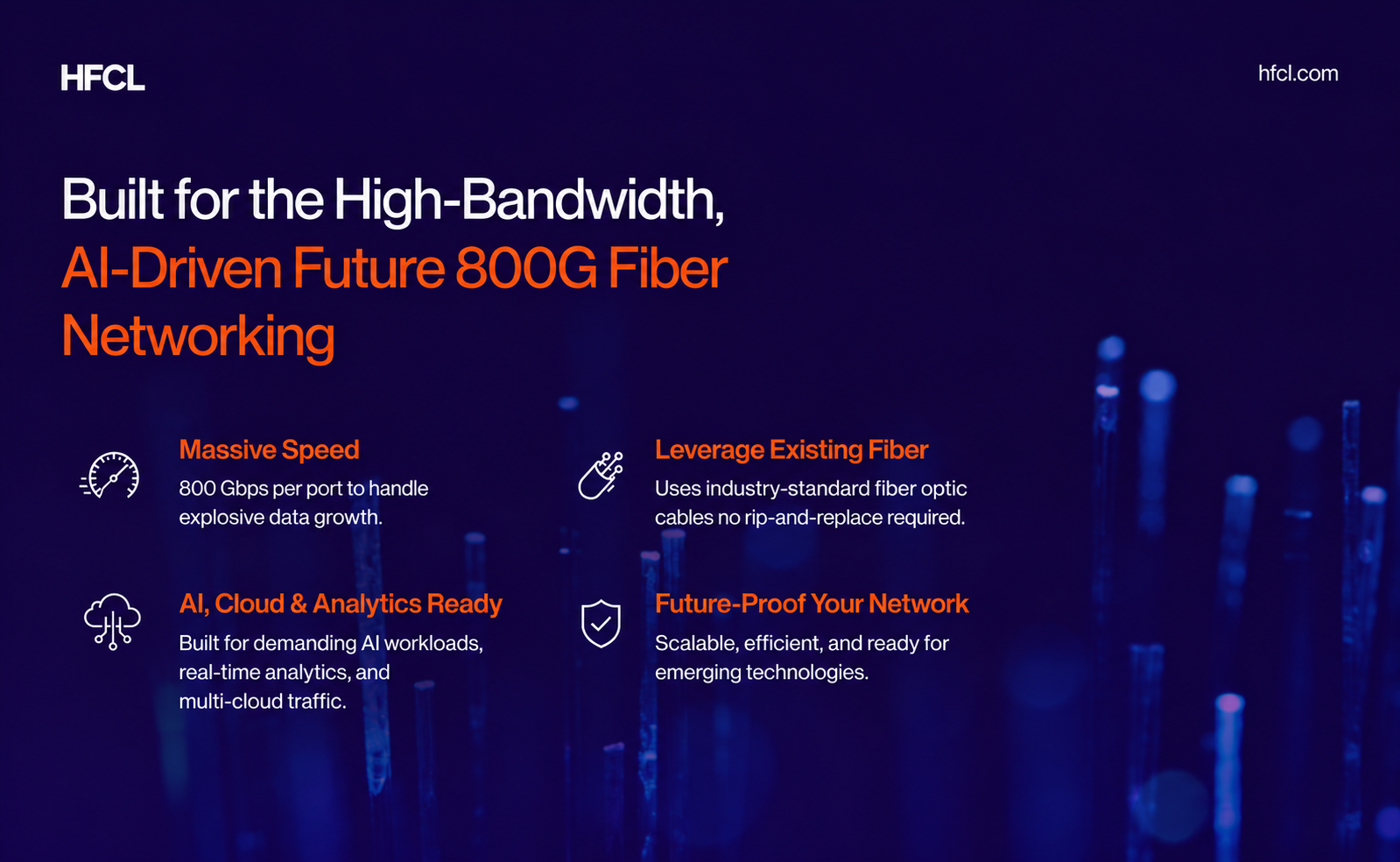
At its simplest, an 800G network port can transmit 800 gigabits of data every second. However, the innovation extends far beyond increasing raw speed. Modern 800G systems improve how data travels through optical fibers, enabling greater capacity without proportionally increasing physical infrastructure.
The technology combines multiple high-speed lanes while using advanced modulation techniques that encode more information into each light signal. This enables significantly more efficient transmitting of data over existing fiber infrastructure.
How 800G Delivers Higher Bandwidth?
Unlike traditional electrical signals that become increasingly inefficient over longer distances and higher speeds, optical networking relies on light signals to carry massive volumes of information across fiber optic cables.
Modern digital signal processors, advanced modulation technologies, and improved switching silicon work together to increase the amount of data transmitted while maintaining signal quality. These innovations also improve power efficiency and reduce latency, making 800G suitable for AI clusters and large-scale cloud environments.
The result is a future-proof network capable of supporting emerging technologies without requiring constant infrastructure upgrades.
Can Existing Fiber Infrastructure Support 800G?
One of the biggest misconceptions surrounding 800G is that enterprises must replace all existing cabling.
In reality, many organizations already have standard single-mode fiber optic cables installed within the last decade. These optical fibers can often support 800G transmission over long distances when paired with compatible transceivers and switching platforms.
Instead of replacing every cable, organizations should validate cable quality, transmission distances, connector performance, and equipment compatibility before deployment. This makes the migration considerably more cost effective than many decision-makers initially expect.
So Where Do You Actually Begin?
Moving to 800G does not require replacing an entire network overnight. Most successful deployments follow a phased approach that minimizes operational risk while maximizing business value.
A structured migration also allows organizations to modernize network infrastructure without disrupting mission-critical applications.
Upgrade the Network Spine First
The network spine carries the highest traffic volumes inside modern data centers. Upgrading the backbone first delivers immediate performance improvements while preparing the broader network architecture for future expansion.
This approach also distributes capital expenditure across multiple budget cycles instead of requiring a single large investment. IT teams gain valuable operational experience before expanding upgrades to aggregation and access layers.
A phased deployment reduces implementation risks while allowing organizations to validate performance improvements at every stage.
Three Checks Before You Upgrade
Before investing in new networking equipment, enterprises should complete three essential assessments.
- First, verify that bandwidth limitations are genuinely the primary performance bottleneck rather than storage or compute resources.
- Second, evaluate available power and cooling capacity. High-density 800G switches consume more power than previous generations, making electrical capacity an important planning consideration.
- Finally, assess the existing fiber optic infrastructure. Confirm that current fiber optic cables can support the required transmission distances and performance requirements for the planned deployment.
Completing these evaluations early helps reduce unexpected costs while ensuring a smoother enterprise network upgrade.
Conclusion
800G is far more than another increase in network speed. It represents the foundation of the next-generation network that enterprises will depend on to support AI, automation, cloud services, and rapidly growing digital workloads over the coming years.
Organizations adopting 800G today are responding to measurable business requirements rather than following technology trends. As workloads continue generating larger amounts of data, existing 400G networks will increasingly struggle to deliver the performance modern applications demand.
The good news is that the technology ecosystem has matured significantly. From advanced optical networking solutions to enterprise-grade networking equipment, organizations now have access to proven technologies that simplify deployment and improve scalability.
Specialized providers like HFCL are helping enterprises build scalable optical networking infrastructure that supports higher bandwidth, AI-ready architectures, and long-term business growth.
Ultimately, investing in 800G fiber networking is not simply a technology decision—it is a business decision. Organizations that modernize their network infrastructure today will be better prepared to support future innovation, improve operational efficiency, and remain competitive in an increasingly data-driven world.
FAQ
Not necessarily. Most data centers built in the last decade run on standard single-mode fiber, which is already compatible with 800G signals. The upgrade is primarily at the hardware layer—switches, transceivers, and line cards—rather than the physical cable infrastructure. That said, you should verify cable quality and distances before assuming full compatibility.
800G switches consume significantly more power than their 400G predecessors—a single high-density 800G switch can draw as much electricity as several home appliances running simultaneously. Power capacity is one of the three pre-upgrade checks every enterprise should complete before committing to the transition. Without adequate power and cooling headroom, the upgrade will create a new bottleneck rather than solve the existing one.
No. While hyperscalers were the early adopters, 800G is increasingly a conversation in enterprise IT across financial services, healthcare, and manufacturing. Any organization running AI workloads, real-time analytics, or high-density multi-cloud traffic will encounter the same bandwidth ceiling that is pushing larger players toward 800G. The question is not whether the need will arrive—it is when.
A phased approach is not just possible, it is the recommended path. Start with the network spine, where traffic density is highest, to capture the biggest performance gains first. This also spreads capital expenditure across multiple budget cycles and gives your team time to build operational familiarity with 800G equipment before it rolls out to edge layers. Attempting a full-network cutover in one go is both unnecessary and high-risk.
The earlier, the better. Lead times on high-density 800G transceivers are already stretching as demand accelerates from cloud providers, telecom operators, and enterprises simultaneously. Organizations that lock in procurement plans now negotiate from a stronger position both on pricing and delivery timelines. Waiting until bandwidth problems become critical removes the ability to plan the transition on your own terms.