A Premier Engineering PSU's Enterprise Aggregation Layer Runs on an HFCL IP/MPLS Router

At a Glance
- HFCL DCR 1100 deployed as the enterprise LAN aggregation layer at a premier engineering PSU, connecting all access switches to the core network
- MPLS VPN segmentation enforced at the aggregation layer, isolating engineering project traffic from administrative and general office traffic
- QoS enforced at the routing layer, guaranteeing priority bandwidth for engineering workloads before traffic reaches the core
- Carrier-grade reliability at the aggregation layer with redundant power and hot-swap hardware, eliminating the single point of risk a traditional aggregation switch carries
- Indigenous IP/MPLS router in the aggregation role, replacing the capability ceiling of a standard enterprise L3 switch
About the Organisation
Decades of experience engineering India's most critical infrastructure

With decades of experience under a central government ministry, this organisation is one of India's most respected engineering consultancy and project management firms, delivering end-to-end engineering across critical national infrastructure projects spanning energy, petrochemicals, and related sectors.
The organisation's work is technical, not advisory. It employs thousands of engineers across civil, structural, mechanical, process, electrical, instrumentation, and environmental disciplines. Their output is the detailed engineering that turns a project concept into a plant that operates safely at industrial scale, often for decades.
Underlying all of this is a network that engineering teams depend on every working day. Design files, project databases, collaboration tools, ERP systems, and document management platforms all flow through it. For an organisation where project timelines are contractually bound and engineering accuracy is non-negotiable, the network's performance and reliability are operational requirements, not background concerns.
The Challenge
An aggregation layer with no intelligence at the centre of a demanding network
The aggregation layer is where the network comes together. Every access switch on every floor feeds into it. Every user, every workstation, every engineering application flows through it before reaching the core. It is the most consequential point in the LAN, and it is typically built on the least capable device in the stack.
At this organisation, the aggregation layer carried limitations that a standard L3 aggregation switch could not resolve.
No traffic intelligence at the convergence point
A traditional L3 aggregation switch aggregates traffic from all access switches and forwards it to the core without any meaningful separation or prioritisation at that layer. Engineering project data, administrative traffic, and general office internet activity all converge at the same point and are treated equally. During peak hours, general traffic competes for the same bandwidth as engineering applications that require consistent, uninterrupted performance.
For an organisation where engineers are accessing large drawing sets, running project management platforms, and collaborating in real time on work that has contractual deadlines, the absence of intelligent traffic management at the aggregation layer is a direct operational risk.
A single point of risk with no automatic recovery
The aggregation layer sits at the centre of the LAN. Every user and every access switch depends on it. A fault at the aggregation device does not affect one department or one floor. It affects everyone simultaneously. On a traditional aggregation switch, fault recovery depends on manual detection and manual intervention, which means the exposure window is measured in minutes to hours.
For an engineering organisation working against project deadlines, a network outage of that duration at the aggregation layer is not a technical inconvenience. It is a disruption that stops work across the entire office until someone identifies and resolves it.
A capability ceiling the network was already approaching
As the organisation's network requirements evolved, the aggregation layer built on a standard L3 switch created a ceiling. MPLS capabilities, Segment Routing, advanced QoS enforcement, and IP routing intelligence are features a traditional aggregation switch does not offer. Every future network improvement that required these capabilities would be limited by what the aggregation device could do. The choice made at the aggregation layer shapes what the network can become.
The Approach
Putting routing intelligence where convergence happens
The insight behind HFCL's solution was straightforward. The aggregation layer is the most important traffic management point in the LAN. Every packet from every user passes through it. Placing an IP/MPLS router at that point instead of a standard L3 switch transforms the aggregation layer from a passive convergence point into an active traffic management layer.
At the aggregation layer, the DCR 1100 can enforce MPLS VPN separation between traffic domains before they reach the core. It can apply QoS policy at the routing layer for all traffic flowing upward. And it brings the hardware reliability of a carrier-grade platform to the point in the LAN where a failure has the widest impact. A router at the aggregation layer is not overkill. It is the reason the network has capabilities that a standard aggregation switch fundamentally cannot provide.
The Solution
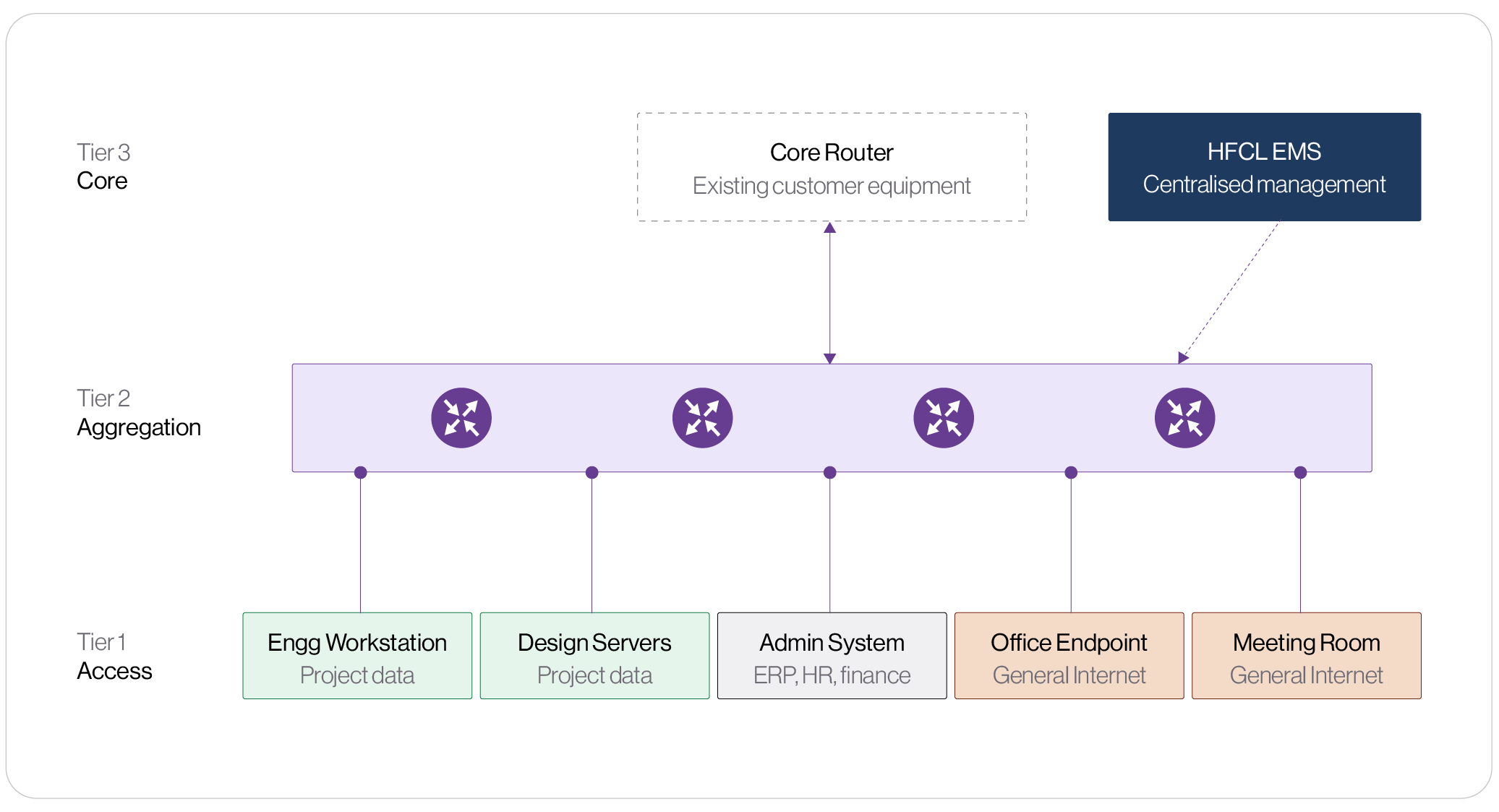
Network Architecture: Three-tier LAN with DCR 1100 at the aggregation layer
Key Capabilities
What the DCR 1100 delivered at Engineers India Limited
EMS: HFCL Element Management System
For EIL's network team, managing the aggregation layer through HFCL EMS means real-time visibility into device status, link utilisation, and traffic classification performance from a single interface. Fault alerts identify the location and nature of any issue at the aggregation device immediately. Policy changes and QoS updates are pushed centrally and applied without requiring physical access to the device. A team managing a critical aggregation point now has the same visibility and control tools that carrier networks use for national infrastructure.
Results
What the network looks like now
Indicative benchmarks based on this architecture and deployment type. All figures to be confirmed with the IT team and HFCL deployment engineers before external publication.
Architecture
- HFCL DCR 1100 deployed as aggregation layer device in a three-tier LAN, aggregating all access switches and connecting northbound to the existing core router
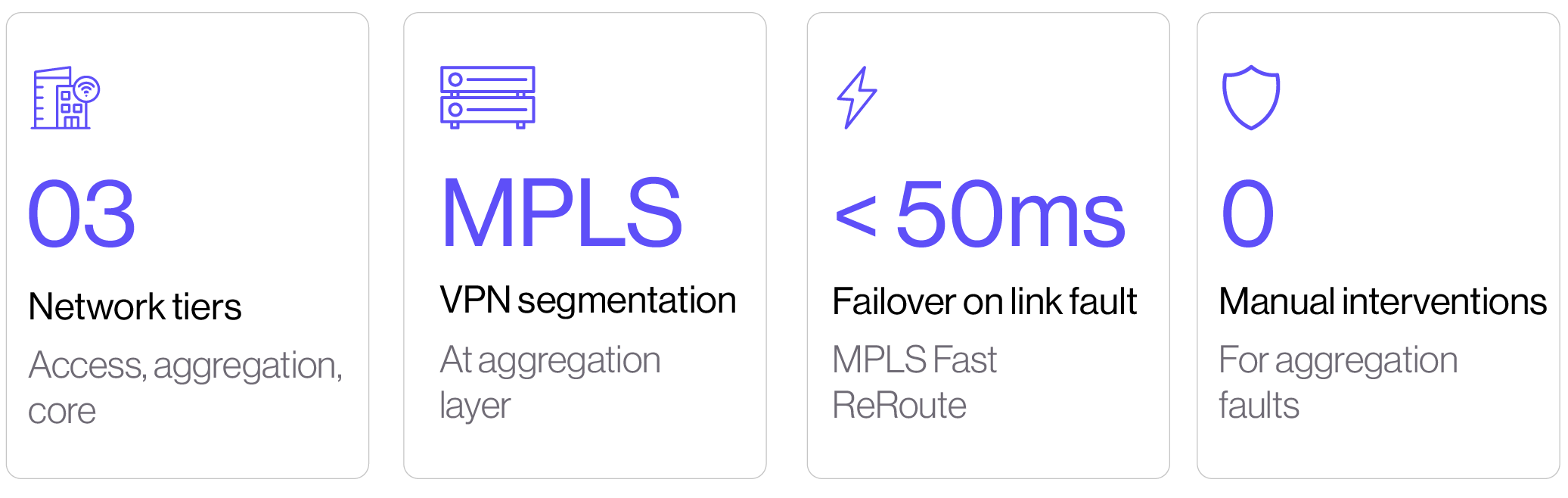
- MPLS VPN domains configured at the aggregation layer: engineering project traffic, administrative systems, and general office traffic in separate isolated logical paths
Traffic management
- Engineering project traffic running in a dedicated MPLS VPN domain at the aggregation layer, logically isolated from administrative and general office traffic
- QoS policy enforced at the routing layer for all upstream traffic, with engineering applications in the highest priority class
Reliability
- Redundant power supplies and hot-swap hardware at the aggregation layer eliminate the single point of failure that a standard aggregation switch carries
- Automatic link fault recovery in under 50ms via MPLS Fast ReRoute
Operations
- Aggregation layer managed via HFCL EMS with real-time telemetry, fault alerting, and centralised policy control
- Configuration and QoS policy changes applied centrally without physical access to the aggregation device
Why HFCL
Choosing the device that sits at the aggregation layer is really a decision about what the network can do next and who answers the phone when that layer has a problem. The organisation looked at three things. Whether the platform had already carried serious traffic at scale. Whether it would work with the network that was already in place. And whether the people behind it could be reached when it mattered. The DCR 1100 answered all three.
Proven in Tier 1 telecom networks before it reached the enterprise
The DCR 1100 was not designed for office LANs. It was designed for telecom operators, and that is where its record was built. HFCL has orders for over 80,000 of these routers under BharatNet, the world's largest rural broadband programme, in what is the largest deployment of Made in India routers to date. In a Tier 1 Indian telecom network, the same DCR 1100 series runs at both he access and pre-aggregation layers, delivering 360 Gbps at access and 800 Gbps at pre-aggregation and taking that operator to roughly five times its earlier network capacity.
It works with the core that is already there
An aggregation device only earns its place if it fits the network around it. The DCR 1100 hands off northbound to the organisation's existing core router over standard routed interfaces, so nothing at the core had to be replaced or reconfigured around it. The practical result is that the aggregation layer was upgraded without disturbing anything above or below it. The access switches stayed. The core stayed. What changed was the intelligence at the point where all of it meets.
A router at the aggregation layer is a deliberate capability choice
Most enterprises put an L3 switch at the aggregation layer because that is the default. This organisation put a carrier-grade IP/MPLS router there because the capabilities a router provides at that position are categorically different from what a switch can offer. MPLS VPN segmentation, routing-layer QoS, Segment Routing readiness, and carrier-grade hardware reliability are not features an L3 aggregation switch provides. The DCR 1100 brings them to a network layer that has traditionally been limited by the device sitting at its centre.
The data at the aggregation layer deserves accountability in India
All LAN traffic flows through the aggregation device. Engineering drawings, project databases, administrative records, and internal communications pass through it continuously. With HFCL, the firmware running on that device is developed in India, the support chain is based in India, and when the team contacts HFCL, that conversation stays within India. Being able to point to where the firmware is written and where the support engineer sits is a practical governance argument for a public sector organisation handling data of this sensitivity.
What this means for enterprise network designers in India
The aggregation layer decision is one most enterprise network teams make without much deliberation. An L3 switch goes there because that is what has always gone there. This deployment shows that an indigenous carrier-grade router is a credible alternative at that position, backed by a telecom deployment record, standards-based interoperability with the network already in place, and a product family that scales with it.