Goldman Sachs Named Optical Networking the Next AI Mega Trend. Here Is What It Means

Goldman Sachs Global Research recently published a report, "Optical Networking: The Next Mega Trend in AI Infrastructure," that quietly changed the terms of the AI infrastructure debate.
The headline number from the report is a 9X expansion in the optical networking market, from approximately USD 15 billion in 2026 to USD 154 billion by 2028. That growth, compressed into two years, is the kind of figure that typically gets dismissed as hyperbole. It is not. It reflects something structural that has been building for three years and is now impossible to ignore.
The reason, Goldman explains, is simple: a GPU cluster without great optical connectivity is a very expensive piece of underperforming hardware. As clusters scale from thousands to hundreds of thousands of chips, the connections between those chips stop being a supporting concern and become the primary engineering challenge.
The bank puts it plainly: "Networking is the next frontier in AI infrastructure, poised to enhance computing capability through seamless data exchange and low latency."
For those of us who have spent decades building connectivity infrastructure, this is not a surprising conclusion. It is, however, a welcome validation and an important signal that the market has finally caught up with something the fiber and optical industry has been trying to communicate for years.
What Goldman Gets Right About Optical Networking and What Comes Before It
The Goldman report focuses on the active optical layer- pluggable transceivers, Co-Packaged Optics (CPO), silicon photonics modules, and the switching architectures that connect GPU clusters together. This analysis is sound. The transition from copper to optics inside the data centre is real, the economics are compelling, and the timeline is accelerating. But active optical components are only half the picture. Every transceiver, every CPO module, every optical switch port connects to optical fiber, which is a manufactured product with finite supply chains, specific performance grades, and lead times that have stretched to 60 weeks in 2026.
Here is a number Goldman's report does not discuss: AI data centres require up to 36 times more optical fiber than conventional cloud facilities of the same size. Not 36% more. 36 times more. The difference comes from the density of GPU-to-GPU interconnects that AI training workloads require, a completely different traffic pattern from anything the data centre industry has built before.
The market discovered this gap the hard way. Global fiber prices rose approximately 70% between 2021 and 2026. At least one major manufacturer sold its entire fiber inventory through 2026 before January of that year. And according to Flexential's 2026 State of AI Infrastructure Report, 91% of enterprise IT leaders said that fiber availability had directly limited their ability to choose where to deploy AI infrastructure. The optical networking supply chain was simply not built for this rate of demand, and that gap is now the defining constraint on AI deployment timelines.
"Optical infrastructure is now a first-order challenge in the AI era. The center of gravity was unmistakably AI data centres, and the optical backbone required to scale them."
— Woodside Capital Partners, OFC 2026 Analysis, March 2026
The Second Phase of AI is an Optical Networking Phase
There is a useful way to think about where we are in the AI infrastructure cycle. Phase one was about compute: acquiring GPUs, building data centre shells, securing power. That race was loud, expensive, and widely covered. It is not over, but it is maturing.
Phase two, which Goldman's report essentially names, is about system scalability. It is about whether the chips you have acquired can actually work together at the scale you need them to. That question is answered by the quality of the connections between them.
At OFC 2026, the optical communications industry's largest annual gathering, nearly 18,000 professionals met in Los Angeles to examine exactly this question. The consensus was unambiguous: demand for optical connectivity solutions across scale-up (within racks), scale-out (across facilities), and scale-across (between data centres) is not a future projection. It is a present commercial reality.
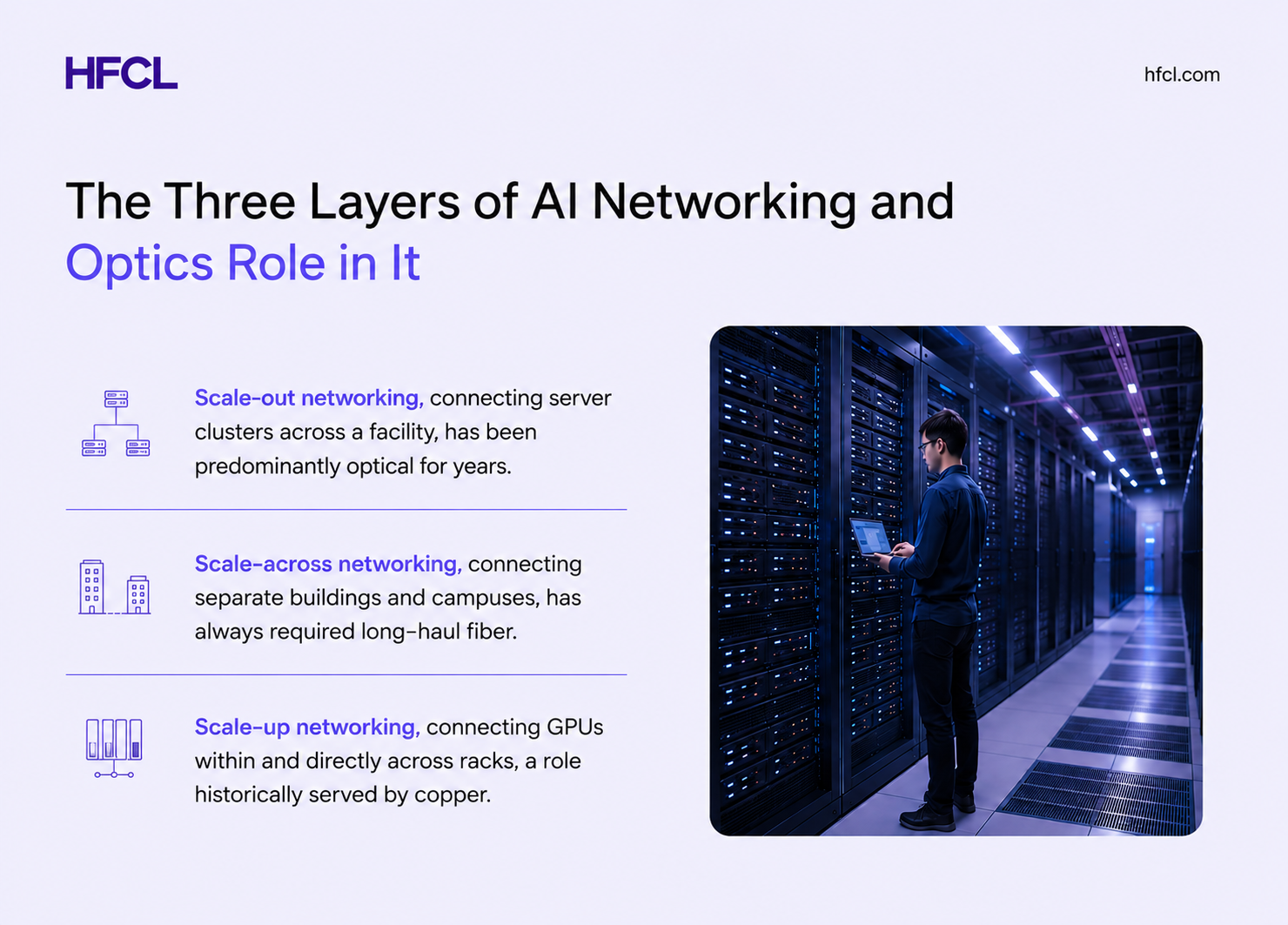
At 200 gigabits per second per lane, copper reaches its physical limits. Signal degrades. Power consumption spikes. The transition to optical at this layer multiplies the addressable market for optical components by approximately 13 times, according to Goldman.
Understanding where each layer sits within the optical networking stack, scale-up, scale-out, or scale-across, is the starting point for every infrastructure decision in the AI era.
We have explored how this plays out in practice in a separate piece on how hyperscalers are building fiber-rich AI networks, from ultra-dense ribbon designs inside racks to all-optical interiors replacing copper at short range.
Where India Fits in This Optical Networking Story
India's position in the global optical networking story is more strategic than it appears on the surface. Most international coverage of AI infrastructure treats India as a growth market, a destination for hyperscale investment, a consumer of AI services, and a market for GPUs and cloud platforms. That framing is incomplete.
India has something most markets in the AI conversation do not: domestic optical fiber manufacturing capacity, built over decades, capable of producing the passive foundation that every optical networking system depends on. At a moment when global fiber lead times are at 60 weeks, and prices are 70% above 2021 levels, this is not a peripheral industrial capability. It is a structural advantage.
Consider the demands being placed on India's connectivity infrastructure simultaneously: a 5G rollout requiring fiber backhaul to tens of thousands of new towers; BharatNet extending fiber to hundreds of thousands of village councils; data centre investment flowing into Mumbai, Chennai, Hyderabad, and Pune, creating scale-up and scale-out networking requirements domestically; and a national AI compute program that will need fiber the same way every other sovereign AI initiative does.
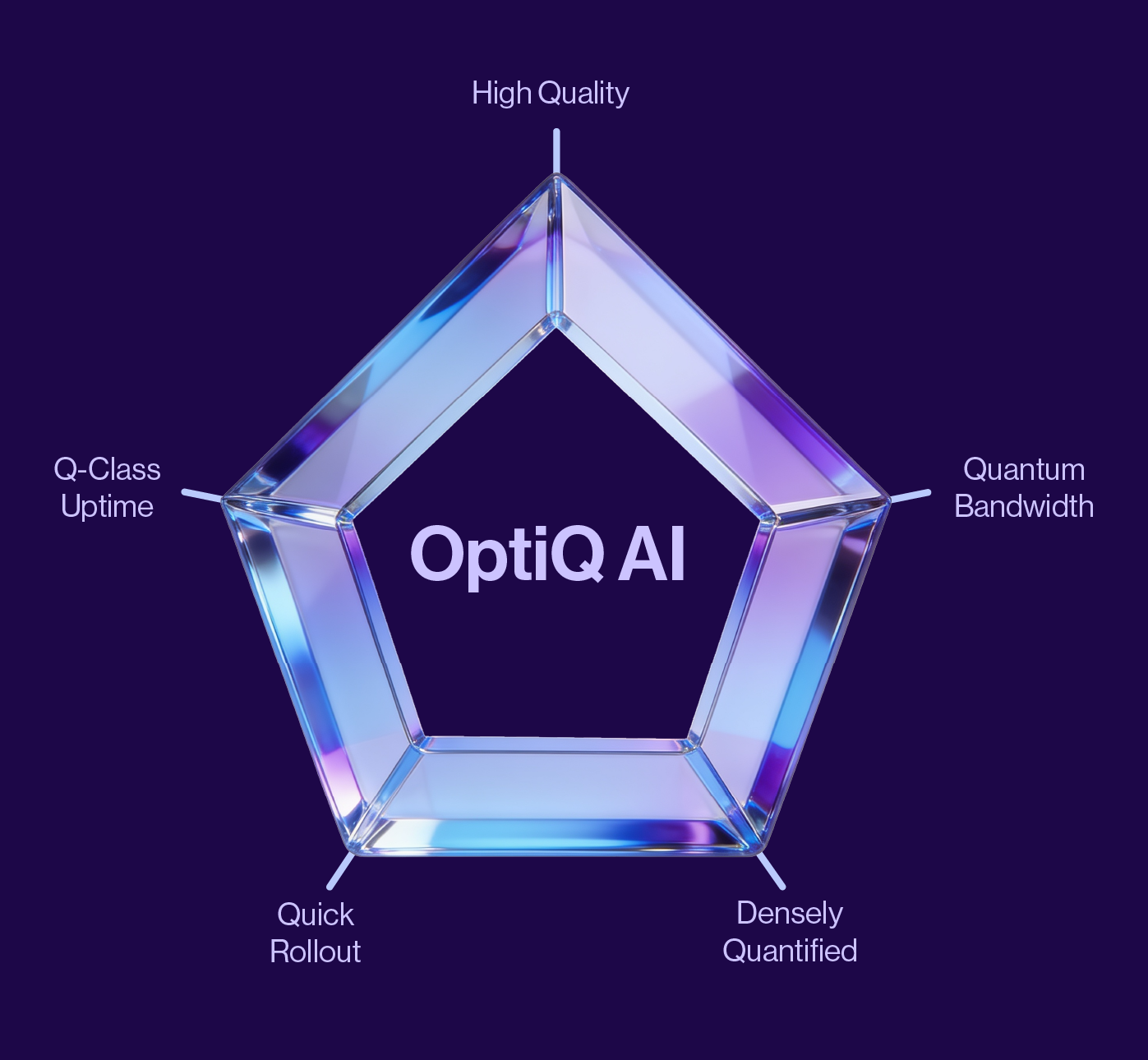
These are not competing demands for the same limited supply. They are layered demands that compound. This is the context in which HFCL introduced OptiQ AI™, the unified brand identity for our integrated optical connectivity portfolio, designed for AI, cloud, and hyperscale data centre environments. The portfolio brings together HFCL's established data centre offerings, Intermittently Bonded Ribbon (IBR) cables, fiber cable assemblies, patch cords, pigtails, high-performance trunks, high-density and ultra-high-density cassettes, and enclosure panels into a complete optical connectivity ecosystem. It is built around five pillars: High Quality, Quantum Bandwidth, Densely Quantified, Quick Rollout, and Q-Class Uptime. Together, these pillars are designed to deliver the signal integrity that high-performance AI workloads require, support the migration to 800G and 1.6T network architectures, maximise fiber density within constrained data centre footprints, accelerate deployment timelines, and strengthen network uptime, the requirements that define AI infrastructure as GPU clusters scale toward 100,000-GPU deployments. HFCL’s OptiQ AI is not a product responding to a trend; it is the consolidation of 35 years of optical manufacturing depth into the one place the Goldman thesis says it matters most, the layer that decides whether an AI data centre performs or merely exists. The 5G tower needs backhaul. The data centre needs intra-facility fiber. The user accessing the AI application needs last-mile fiber. The whole chain needs to work, end to end, for any of it to deliver value.
From where we stand, having manufactured and deployed optical fiber across every layer of India's connectivity stack for over three decades, the Goldman thesis translates to a simple operational reality: the window to build AI-ready fiber infrastructure in India is open now. The organizations that design and procure with AI specifications in mind today will be the ones deploying with confidence in 2027 and 2028. The ones who wait to see how the market develops will be waiting in a queue that is already long.
What Infrastructure Leaders Should Actually Do About Optical Networking
The most important shift in mindset is treating optical fiber not as a commodity to be sourced late in the procurement cycle, but as a strategic input to be planned for at the design stage. In a 60-week lead time environment, "we'll order the fiber once the data centre shell is ready" is a plan to miss your deployment window by six months.
More specifically, infrastructure leaders should be thinking about five things:
- Specify fiber grade at design time, not procurement time. Scale-up AI networking requires G.657A bend-insensitive fiber capable of navigating dense rack environments without signal degradation. Facilities designed around standard telecom-grade G.652D fiber will need to be recabled when AI racks arrive. That rework is expensive and disruptive.
- Design for the transceiver generation that will be deployed over the facility's life, not the one available today. 800G is deploying now. 1.6T is entering production. A facility being built in 2026 should specify fiber and cable plants capable of supporting these speeds and their successors.
- Stop treating backhaul as a separate decision from the AI deployment. Whether you are building a campus data centre or deploying 5G towers as AI edge nodes, the fiber backhaul connecting that facility to the network core is part of the AI system. Its bandwidth determines the latency your AI applications will deliver to users.
- Build supply chain relationships, not one-off orders. At 60-week lead times, the organizations that will execute on AI infrastructure timelines are the ones with committed supply partnerships already in place. Spot procurement in this market is a strategy for delay.
- Count the passive alongside the active. Goldman's USD 154 billion is an active components market. But every dollar of that market sits on passive fiber. Budget for both together, not sequentially.
Conclusion:
The Goldman Sachs report matters because it puts institutional credibility behind something the connectivity industry has known for two years: in the AI era, the network is not plumbing. It is infrastructure. And like all infrastructure, the time to build it is before you need it, not after. For organizations building AI infrastructure in India and globally, optical networking is not a future consideration; it is the decision that is already determining who deploys on time and who does not. It is exactly this decision that HFCL built OptiQ AI™ for, an end-to-end optical connectivity portfolio designed so that when the AI buildout arrives, the network is already ready.
FAQ
Optical networking in AI infrastructure refers to the use of fiber optic cables, photonic transceivers, and optical switching systems to carry data between AI chips, servers, storage systems, and data centres. Unlike copper cables, optical fibers transmit data as pulses of light, enabling the extremely high bandwidths and low latencies that AI workloads require. In May 2026, Goldman Sachs Research named optical networking "the next mega trend in AI infrastructure," projecting the market to grow from USD 15 billion to USD 154 billion by 2028 as GPU clusters scale in size and density, and as copper interconnects reach their physical limits at speeds above 200 gigabits per second.
Optical networking is growing rapidly in AI data centres for three converging reasons. First, AI training and inference workloads require continuous, high-speed communication between thousands of GPU chips simultaneously, a density of inter-chip traffic that copper cables cannot reliably carry above 200 Gbps per lane without signal degradation and excessive power consumption. Second, AI server racks have become dramatically denser; 2027 designs require up to 50 times the power of conventional racks, which forces co-packaged optics and high-density fiber assemblies that did not exist in standard data centre deployments. Third, AI clusters are scaling beyond the physical limits of a single facility, requiring optical inter-data-centre links for distributed training and inference. Goldman Sachs projects the market expanding 9x to USD 154 billion by 2028, driven by the scale-up networking segment alone, accounting for 69% of that total.
Co-packaged optics (CPO) integrates optical transceivers directly onto the same silicon substrate as a switch chip or AI accelerator, eliminating the conventional pluggable module. This integration shortens the electrical path between silicon and light from centimetres to millimetres, reducing power consumption from around 15 picojoules per bit to approximately 5 picojoules per bit, a threefold efficiency gain. Importantly, CPO changes the active optical component but still requires passive optical fiber cables to carry light between system nodes, meaning fiber infrastructure planning remains essential even as CPO adoption grows.
India combines a great, immediate demand for optical fiber, 5G rollout, BharatNet, data centre investment, and sovereign AI initiatives, with established domestic manufacturing capacity. With global fiber lead times at 60 weeks and prices up ~70% since 2021, import-dependent countries face structural delays; India is insulated from the worst of this. HFCL has consolidated this capability under OptiQ AI™, an integrated optical connectivity portfolio for AI, cloud, and hyperscale data centres, manufactured in India for global deployment.