How the AI Infrastructure Boom Is Reshaping Fiber Optic Network Design
The artificial intelligence revolution is not happening in the cloud. It is happening in steel racks, in sprawling hyperscale campuses, and in the millions of kilometers of fiber optic cabling threading through them. Every large language model trained, every inference query answered in real time, every GPU cluster synchronized at terabit speeds all of it depends on one thing: the optical fiber network underneath it all.
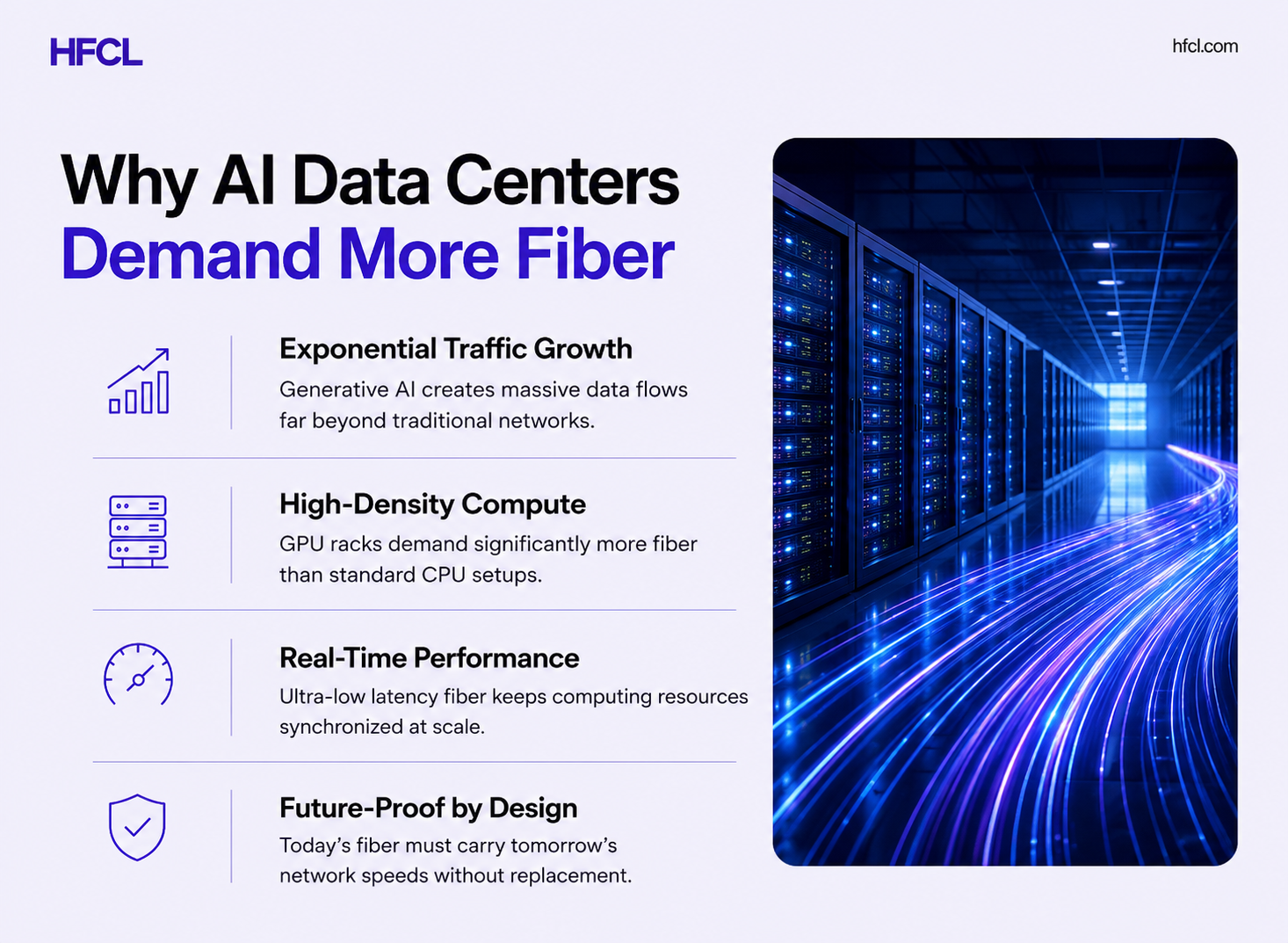
For HFCL, a globally recognized optical fiber cable manufacturer and integrated communications solutions provider, this moment represents both a validation of decades of engineering investment and an urgent call to innovate faster. AI-focused data centers require significantly more fiber to handle the massive data volumes and high-speed connectivity that GPU clusters demand estimates indicate roughly 36 times more fiber per rack than traditional CPU-based racks. The fiber optic data center design decisions being made today will define computing performance for the next ten years.
Why Fiber Remains the Only Medium for AI Workloads
Optical fiber is uniquely suited to the demands of AI infrastructure. Unlike copper, fiber can transmit light encoded as data pulses across large amounts of distance with negligible signal loss, near-zero electromagnetic interference, minimal heat output, and significantly lower power consumption per bit. These properties make it the industry standard medium for cloud-based AI applications where energy efficiency and bandwidth density are both critical design constraints.
Single-mode fiber, in particular, provides the signal integrity and low-latency characteristics that large-scale AI training and real-time data processing require across both intra-rack and long-distance inter-data-center links. The generative AI era has made these properties not just desirable but essential cloud services cannot deliver at the performance levels users now expect without fiber-based interconnects at every layer of the network stack.
Critically, the fiber infrastructure installed today can support 400G links through a transceiver upgrade tomorrow and 800G links the day after that. In a rapidly evolving technology environment, that long runway of forward compatibility is not a luxury; it is a strategic necessity for any modern data center.
The Shift From North-South to East-West Traffic
Traditional fiber optic data center network designs were optimized for north-south traffic data flowing in from a user, processed by a server, and returned. AI training and inference architectures are fundamentally different. Thousands of GPUs must communicate with each other continuously, exchanging gradient updates, synchronizing model states, and distributing AI workloads across computing resources in real time. This GPU-to-GPU communication is called east-west traffic, and it dominates the bandwidth profile of an AI-optimized modern data center.
The consequence for fiber optic cabling design is significant. Older hierarchical network topologies built for traditional cloud computing requests from the outside world simply cannot sustain the aggregate throughput of a GPU cluster operating at 400G or 800G per link. AI-ready fiber networks must be designed from the ground up around east-west traffic flows, with high-density cabling, low-latency interconnects, and sufficient fiber counts to support the full fabric at peak load.
Scale Up, Scale Out, Scale Across: The New Data Center Vocabulary
Network architects operating in the AI era are working with a new vocabulary. Scaling up means increasing compute density within existing racks. Scaling out means linking multiple compute nodes into a high-speed GPU cluster through a fabric network. Scaling across means connecting compute, storage systems, and networking resources between multiple data center facilities for cloud-based workloads. Each of these scaling dimensions places distinct demands on the fiber network: higher fiber counts within racks, higher-capacity campus interconnects, and high-performance data center interconnect (DCI) solutions between buildings and campuses. HFCL's portfolio is designed to address all three dimensions simultaneously.
The Surge in Fiber Volume Demand
The sheer volume of fiber now required to support AI infrastructure has caught much of the industry by surprise. Data center fiber demand grew roughly 76% year-on-year in 2025, and the segment is projected to account for 30% of total global fiber demand by 2027 a figure that stood below 5% just a few years ago. Each new GPU rack generation multiplies fiber requirements: newer 72-GPU nodes like NVIDIA's Blackwell require 16 times more fiber than traditional cloud switch racks, placing extraordinary pressure on both fiber manufacturers and data center designers.
This surge is not temporary. As generative AI model complexity grows and AI applications scale globally across cloud computing infrastructure, the fiber demand curve will steepen further. For designers and operators, the implication is clear: fiber networks must be planned not for today's workloads, but for the workloads that will arrive in 2028 and 2030. Building cost-effective, scalable infrastructure today is the only practical way to avoid expensive rip-and-replace cycles later.
Engineering Response to the AI Era
HFCL has been engineering optical fiber cables for over three decades, supplying leading telecom operators, enterprises, and hyperscale customers across India, North America, Europe, the Middle East, and beyond. The response to the AI infrastructure boom is built on a suite of innovations designed to pack large amounts of fibers into smaller spaces, deploy them faster in the field, and keep them performing reliably across a wide range of environments at the edge of what physics currently allows.
High Density IBR Cables: More Fibers, Smaller Footprint
At the heart of HFCL's fiber optic data center offering is its Intermittently Bonded Ribbon (IBR) cable family. IBR cables deliver twice the fiber packing density of traditional flat ribbon cables within the same duct or conduit diameter a critical high-density advantage when pathway space inside a data center is constrained and fiber counts are climbing into the millions per campus. The result is a more cost-effective use of existing duct infrastructure, delaying or eliminating the need for expensive civil expansion.
HFCL's IBR cable range spans 144 to 3456 fibers, covering everything from access layer runs to high-count spine interconnects supporting cloud-based AI workloads. At ISE EXPO 2024 in Dallas, HFCL launched a new single-jacket, single-armor IBR cable family spanning 144 to 3456 fibers, earning an ISE Innovators Award in recognition of the product's performance and deployment advantages. This patent-pending cable family uses a tubeless design for simplified core access, fiberglass-composite strength members in place of steel wire for improved bend performance, and a guide notch for faster field slitting. Compared to traditional armored IBR solutions, this design achieves diameter reductions of up to 24% and weight reductions of 18% to 48% directly reducing materials consumption, improving energy efficiency during installation, and simplifying field logistics.
Faster Splicing, Faster Deployment
One of the largest cost drivers in data center fiber deployment is labor. Industry data consistently shows that labor accounts for 60% to 80% of total fiber deployment costs. IBR architecture enables mass fusion splicing terminating multiple fibers simultaneously which dramatically compresses deployment timelines compared to single-fiber methods. For large-scale AI campuses where large amounts of fiber must be terminated under aggressive project schedules, the productivity advantage of IBR cables is a direct and measurable financial benefit for the computing resources being deployed.
High-Density IBR Cables: Maximizing Every Millimeter of Duct
For outside plant runs feeding AI campuses and metro data center interconnects supporting cloud services, the High-Density IBR Cables product line delivers exceptional high-density fiber performance in extremely compact form factors. HFCL's 11.2mm diameter 864-fiber High-Density IBR Cables maximizes fiber capacity within existing microducts enabling operators to extract maximum throughput from existing duct infrastructure without costly civil works, keeping total deployment cost-effective even at very high fiber counts.
This matters enormously for AI campus deployments, where multiple high-count cables must share limited underground duct between buildings. The ability to carry 864 fibers in a 11.2mm cable means more capacity per duct without expanding the pathway, preserving future expansion options and reducing total cost of infrastructure ownership. It is a wide-range solution equally suited to greenfield AI campuses and brownfield upgrades of existing cloud computing facilities.
Data Center Interconnect Solutions Built for 800G and Beyond
HFCL's Data Center Interconnect (DCI) solutions are designed to enable seamless, high-speed connectivity between and within data centers from intra-rack connections to inter-campus fiber links. The portfolio includes advanced optical fiber cabling, breakout assemblies, high-density MPO connectors, Very Small Form Factor (VSFF) connectors, splice cassettes, and scalable patch panel systems all industry standard components engineered to support network speeds from 100G through 800G across the full spectrum of cloud-based and on-premise AI applications.
From Intra-Rack to Inter-Campus: One Unified Fiber Strategy
This DCI approach enables operators to deploy high-speed 100G to 800G networks using high-density MPO and VSFF connectors across all segments of the data center fabric. Fiber optic cabling transmits light across every layer of the architecture from intra-rack links between storage systems and compute nodes to inter-campus dark fiber carrying petabytes of real-time data processing output between AI facilities. Breakout assemblies reduce splice points and accelerate commissioning. High-density panels provide organized, scalable fiber management with easy access for maintenance an important operational consideration when data center fabric networks must be modified or expanded under tight service-level constraints.
For hyperscale operators running multi-terabit AI workloads on cloud-based infrastructure, these DCI solutions provide the ultra-low latency and five-nine reliability needed to keep GPU clusters synchronized and generative AI training runs uninterrupted.
Designing AI-Ready Networks for the Next Decade
Bend-Insensitive Performance as a Baseline Requirement
Dense routing in AI racks, tight cable trays, and the physical realities of large-scale field installations all create situations where fiber must perform under mechanical stress. HFCL's optical fibers and cable designs are qualified to internationally recognized IEC, ITU, and Telcordia industry standards, including extended aging tests that simulate full cable lifetime across a wide range of environmental conditions. Specifying bend-insensitive fiber at the design stage eliminates costly rework and ensures that network performance does not degrade as facilities age supporting consistent energy efficiency and data processing reliability over the infrastructure's full service life.
Planning for the Next Decade, Not Just the Next Project
The decisions being made in 2025 and 2026 about fiber type, fiber count, conduit sizing, and connector format will shape data center performance through 2035 and beyond. AI model complexity will continue to grow. GPU counts per cluster will increase. Cloud services will demand more computing resources at lower latency. Network speeds will advance from 800G toward 1.6T and beyond, with the fiber infrastructure expected to carry each generation without requiring a full rip-and-replace. HFCL engineers its cables to provide this long-term runway combining current-generation optical performance with the physical characteristics that will accommodate tomorrow's transceiver roadmap.
Fiber Optic Infrastructure for the AI Economy
The AI infrastructure boom is the most significant expansion of modern data center capacity in a generation. It is reshaping how fiber optic cabling is designed, how high-density optical networks are specified, and how quickly cost-effective infrastructure must be deployed to keep pace with generative AI demand. HFCL brings together the engineering depth, global supply capability, and portfolio breadth to help operators meet this challenge from the highest-count IBR cables running between hyperscale buildings to the precision connector assemblies terminated at the GPU.
Whether you are designing a new AI campus from the ground up, upgrading an existing cloud computing facility for higher rack densities, or building out a metro fiber network to connect cloud-based infrastructure to end users, HFCL has the optical fiber solutions to make it perform across a wide range of AI applications and deployment environments.
FAQ
AI infrastructure relies on massive, synchronized GPU clusters rather than traditional CPU architecture. To train large language models and process real-time inference queries without latency bottlenecks, thousands of GPUs must continuously exchange data. This shifts the data center traffic profile from traditional North-South (user to server) to heavy East-West (server to server) traffic.
Because of this intense GPU-to-GPU communication, an AI-focused data center rack requires roughly 36 times more fiber than a traditional CPU rack, pushing total campus fiber counts into the millions.
An Intermittently Bonded Ribbon (IBR) cable features optical fibers that are bonded together at intermittent points rather than continuously. This unique design allows the fiber ribbon to be rolled up tightly like a bundle, or flattened out for mass fusion splicing.
In AI data center design, where pathway and duct space inside conduits are severely limited, IBR cables provide a critical high-density advantage. They deliver up to twice the fiber packing density of traditional flat ribbon cables within the same diameter. This allows operators to scale up fiber volume without expanding physical underground or indoor duct infrastructure.
Civil engineering works, such as digging trenches and laying new conduits, account for a massive portion of outdoor network expansion costs. Nano Thin microcables pack exceptionally high fiber counts into extremely narrow outer diameters, such as fitting 864 fibers into a 10.6mm cable.
By maximizing the fiber capacity of existing 14mm microducts, operators can scale their Data Center Interconnect (DCI) networks and campus links without undergoing expensive, time-consuming civil expansion. This maximizes current infrastructure utilization and significantly lowers deployment timelines and labor costs.
As network speeds migrate from 100G and 400G toward 800G and beyond, physical space on patch panels and switches becomes prime real estate.
- Multi-Fiber Push-On (MPO) connectors allow multiple fibers (typically 12 or 24) to terminate in a single interface, dramatically cutting down on installation time.
- Very Small Form Factor (VSFF) connectors take density a step further, reducing the physical footprint at the transceiver interface.
Together with breakout assemblies, these components enable seamless, high-density patch management, allowing AI networks to scale across intra-rack and inter-campus links while minimizing signal attenuation and latency.
AI data center cabling requires dense routing through incredibly tight cable trays, dense racks, and complex patch panels. Standard fiber optic cables experience macro-bending losses, which means light leaks out of the fiber core when the cable is tightly bent, leading to signal degradation and packet loss.
Specifying bend-insensitive fiber as a baseline design requirement ensures that the optical network can withstand the severe physical stresses of high-density packaging. It guarantees long-term signal integrity, prevents expensive network rework, and ensures high reliability during continuous, multi-terabit AI training workloads.