High-Density Data Center Interconnect Solutions for 100G to 800G Networks

Data centers are entering a new performance phase. Hyperscale cloud platforms, artificial intelligence (AI), and high-performance computing (HPC) are driving steady growth in network traffic. To support this demand, data center network switches are moving from 100G to 400G and now toward 800G.
This evolution places new pressure on the physical layer. Faster switches alone are not enough. Data center interconnect solutions must also support low latency, efficient fiber use, and designs that can grow over time.
Traditional LC duplex fiber still works in many environments. However, it limits port density and airflow in modern racks. Because of this, many operators are adopting high-density data center cabling based on MPO and Very Small Form Factor (VSFF) connectors. These technologies are now central to hyperscale data center connectivity and modern enterprise data center solutions.
The Shift to Higher-Speed Data Center Networks
AI training, inference, and HPC workloads generate large volumes of east–west traffic inside the data center. These workloads require high bandwidth and predictable performance. As compute density increases, network connectivity must scale at the same pace.
This demand is one of the main reasons operators are transitioning to higher-speed network architectures.
Limits of Traditional LC Duplex Connectivity
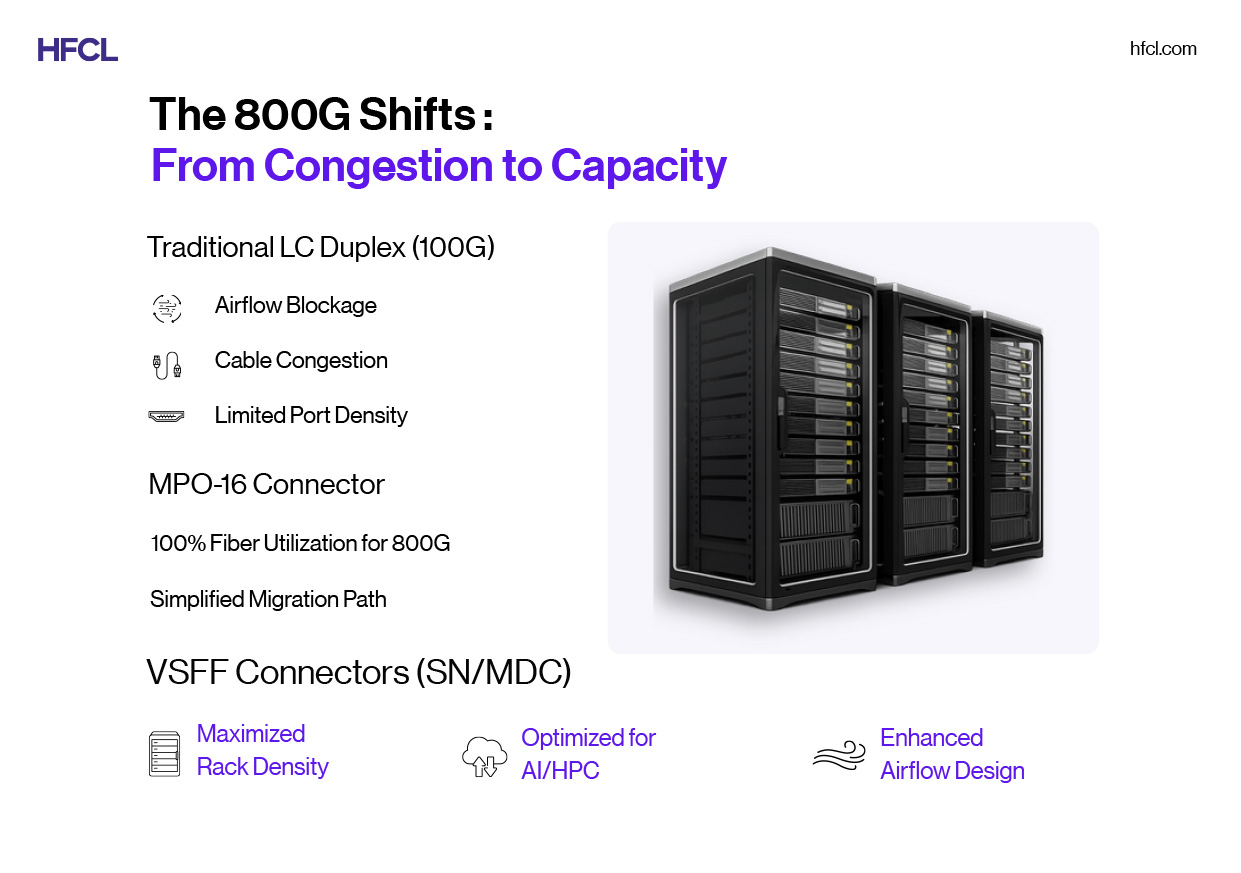
LC duplex connections remain reliable, but they take up more space per port. In dense switch faceplates, this creates challenges with airflow, cable congestion, and future expansion. These limits become more visible as speeds move beyond 100G.
Rethinking the Physical Layer for Modern Data Centers
Modern data center connectivity products must meet several key needs at the same time:
● Support more ports in less space
● Deliver low latency for AI and HPC traffic
● Allow upgrades without rebuilding the entire network
Meeting all three at once requires a shift in physical-layer design.
MPO Parallel Optics for High-Density Cabling
Parallel optics are now common in fiber connectivity for data centers operating at 400G and above. Instead of sending all traffic over one fiber pair, traffic is split across several fibers. This improves performance and supports larger network designs.
Why MPO-16 Fits 800G Network Architectures
MPO-12 supported earlier 40G and 100G links. However, 800G optics use eight transmit fibers and eight receive fibers.
● Better fiber use: MPO-16 matches 800G-SR8 and 800G-DR8 optics without unused fibers
● Base-8 structured cabling for hyperscale: MPO-8 and MPO-16 designs simplify planning and reduce conversion modules
● Fewer connection points: This supports low-latency interconnect for multi-campus data centers
Because of these advantages, MPO-16 is part of the best interconnect solutions for hyperscale data centers and largehyperscale data center infrastructure deployments.
VSFF Connectors and High-Density Rack Design
As QSFP-DD and OSFP ports fill switch faceplates, connector size becomes a real constraint. VSFF connectors address this issue:
● CS connectors support two duplex links in a single QSFP-DD port for 2×200G designs
● SN and MDC connectors support up to four duplex links, enabling 4×100G breakouts
These options improve high-density rack panels for data centers by reducing the need for external cassettes and complex fan-out assemblies.
Operational Benefits for Data Center Racks and Panels
VSFF connectors offer clear operational advantages:
● Push-pull designs make handling easier
● Smaller connectors improve airflow in dense racks
● Cleaner routing makes faults easier to locate
These benefits show how hyperscale data centers manage fiber scalability while keeping networks reliable.
Structured Cabling for Smooth Network Migration
Most data centers upgrade in stages rather than replacing the entire network at once. A structured cabling approach makes this possible by creating a stable physical foundation that supports change over time.
● MPO trunks act as a permanent cabling layer
● Switches and optics can move from 100G to 400G and 800G over time
● Existing OM4, OM5, or OS2 fiber can remain in place
This approach supports structured cabling solutions for hyperscale expansion while helping operators control cost and avoid unnecessary disruption.
Breakout and Reuse Options with MPO and VSFF
● MPO-16 trunks can break out into multiple 400G or 100G links
● VSFF patch cords enable clean intra-rack cabling solutions for seamless operations
● Clear layouts help teams understand how to improve data center fiber management
Supporting AI and HPC Traffic
AI and HPC systems generate heavy east–west traffic between servers. These workloads require stable bandwidth and low delay to perform efficiently.
High-Density Cabling for AI Data Center Connectivity
High-density MPO and VSFF designs provide:
● High-bandwidth connectivity for AI and HPC workloads
● Shorter fiber paths that help how to reduce latency in data center connectivity
● Designs that align with modern AI clusters and GPU fabrics
These features are central to AI data center connectivity and purpose-built environments for advanced workloads.
Preparing Fiber Infrastructure for the Future
As data centers expand across campuses and regions, operators need future-proof fiber solutions for data center growth.
High-density MPO trunks, VSFF patch cords, and modular data center infrastructure solutions allow the physical layer to grow alongside compute and storage without repeated rebuilds.
Supporting Hyperscale and Enterprise Expansion
This approach supports both hyperscale operators and enterprises upgrading traditional data centers for modern workloads.
Conclusion
Moving from 100G to 800G is not only about faster switches. It is a physical-layer challenge.
High-density MPO cabling and VSFF connectors enable efficient, flexible, and low-latency data center networks. These data center cabling solutions simplify upgrades, improve fiber use, and support long-term growth.
For hyperscale and enterprise environments, the right physical design keeps connectivity simple, reliable, and ready for what comes next
FAQ
VSFF connectors such as SN, MDC, and CS address the space and density limitations of traditional LC connectors in 400G and 800G environments. They enable multiple duplex connections within a single QSFP-DD or OSFP port, allowing direct breakouts at the switch faceplate. This reduces external fan-out hardware, improves airflow in dense racks, simplifies fiber management, and supports scalable high-density cabling.
Existing MPO infrastructure can support 800G if it follows a Base-8 architecture. MPO-8 and MPO-16 cabling aligns with modern 400G and 800G transceivers using eight transmit and eight receive lanes. MPO-16 ensures full fiber utilization for 800G optics, while legacy MPO-12 deployments may require conversion modules that add loss and complexity.
High-density cabling reduces latency by minimizing connection points and simplifying optical paths. MPO trunking combined with direct VSFF breakouts lowers insertion loss, reduces reflections, and shortens signal paths. Fewer interconnects improve signal integrity, which is critical for AI and HPC workloads relying on low-latency, high-bandwidth east–west traffic.
Structured cabling provides a stable, long-term physical layer that remains in place as active equipment evolves. In hyperscale environments, MPO trunks form the permanent backbone, while transceivers and patch cords are upgraded over time. This enables phased expansion, faster deployments, and seamless migration from 100G to 400G and 800G.
Yes. Enterprises deploying private cloud, AI clusters, or multi-campus data centers face similar challenges around density, scalability, and latency. High-density MPO and VSFF solutions help optimize rack space, improve fiber management, and prepare for future speed upgrades, delivering a future-ready physical layer without frequent infrastructure changes.