Co-Packaged Optics Explained: Benefits, Challenges, and Real-World Use Cases

The explosive growth of Artificial Intelligence (AI), High-Performance Computing (HPC), Machine Learning (ML), and hyperscale data centers is pushing the limits of traditional network infrastructure. As data rates climb to 800G and beyond, conventional pluggable transceivers are approaching their physical and thermal boundaries. Power use continues to rise, and space on switch faceplates is running out.
To keep up with these demands, the industry is shifting toward Co-Packaged Optics (CPO), a design approach that brings optical connections closer to the chip. In simple terms, CPO integrates optical components directly with switch ASICs (Application-Specific Integrated Circuits) inside a single package. By removing long electrical traces between chips and optical modules, it delivers faster, cooler, and more compact data movement. This change marks a turning point in how high-speed communication is designed and delivered.
The Breaking Point for Pluggable Optics
In conventional switch architectures, optical transceivers sit on the front panel. Data travels from the switch ASIC through several centimeters of copper before reaching the transceiver. At lower speeds this works well, but at higher data rates beyond 400G, it introduces significant loss and heat.
Each additional centimeter of copper adds resistance, which weakens the signal and forces the system to use more power for equalization and correction. Retimers and amplifiers compensate for this loss, but they also increase latency and energy use. The result is a system that becomes less efficient as it scales.
As bandwidth demands reach terabit levels, this design model begins to break down. It becomes harder to cool, more power-hungry, and physically constrained by the size of pluggable modules. The need for a closer connection between chips and optics is clear.
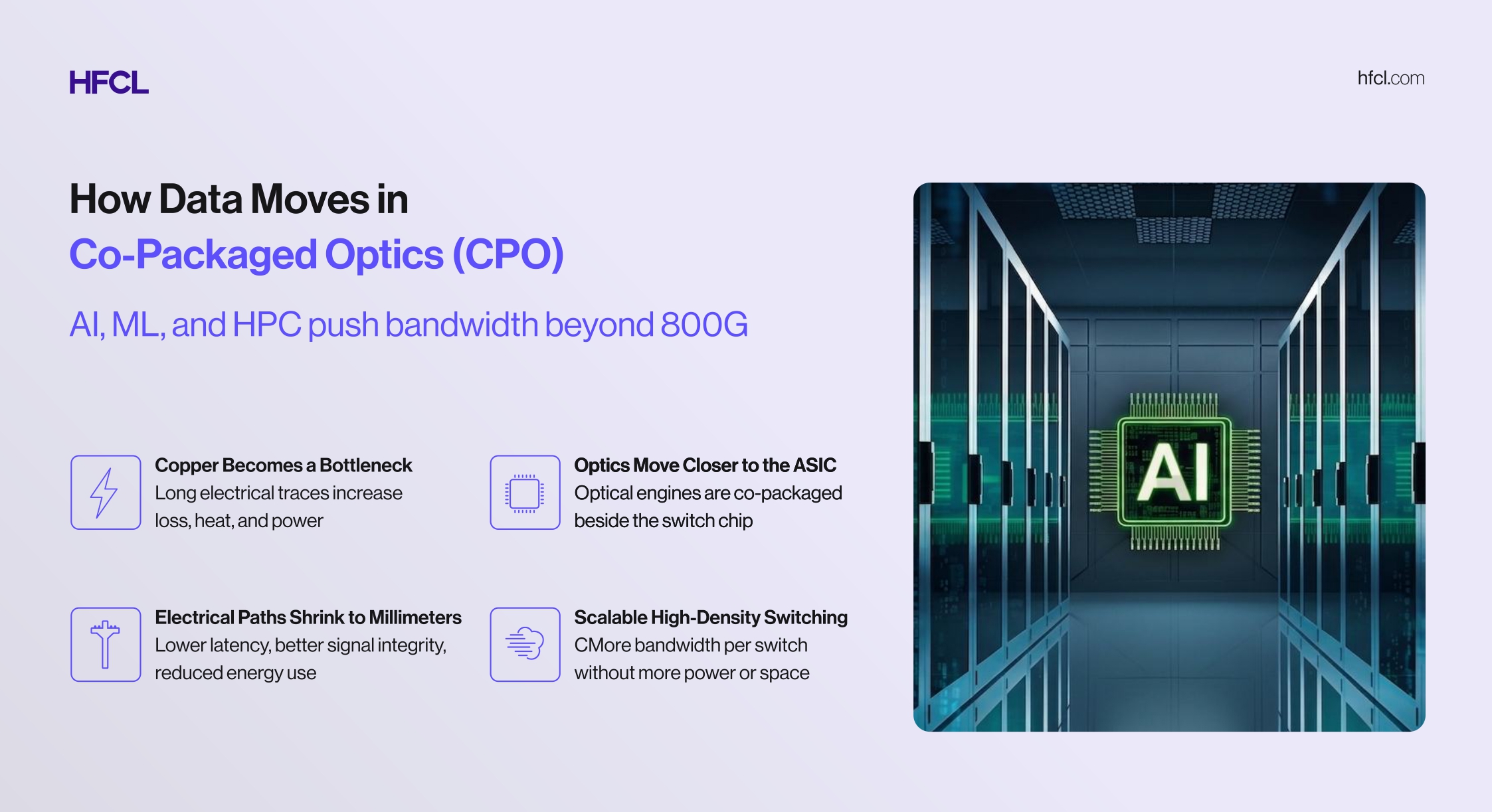
Co-Packaged Optics places the optical engines right beside the switch ASIC. Instead of routing signals across a circuit board, electrical paths are reduced to only a few millimeters. This short distance allows data to be converted to light almost immediately, minimizing signal degradation and power loss.
Inside a CPO system, photonic chips handle the light generation, modulation, and detection. These chips are coupled to high-precision fiber connectors that carry the optical signals out of the switch package. Because everything is built into a compact assembly, alignment accuracy and thermal stability are critical. Even small variations in positioning can affect performance, so the design must balance precision, heat control, and reliability.
The result is an architecture that moves data more efficiently, maintains signal integrity at extreme speeds, and supports higher port densities within the same footprint.
Bringing Fiber Directly to the Chip: The CPO Advantage
The central idea behind CPO is proximity. Placing optics closer to the ASIC reduces the distance electrical signals must travel before being converted into light. That proximity cuts down power consumption, lowers insertion loss, and improves signal quality.
Shorter paths also mean lower latency. The data transitions from electrical to optical form with minimal delay, which is critical in environments where microseconds matter. This architecture allows network designers to build switches with greater bandwidth without increasing their power budgets or expanding their physical size.
By removing the constraints of front-panel modules, CPO enables a new level of scalability. It gives designers more room to innovate, with the potential to reshape how data centers approach high-speed connectivity.
Design and Engineering Challenges
While Co-Packaged Optics offers clear advantages, it brings several engineering challenges. The first is heat management. The switch ASIC generates substantial heat, and the optical components beside it are sensitive to temperature. Designing an effective cooling solution that keeps both within their optimal ranges is complex but essential for stability and longevity.
Precision alignment is another key factor. Fiber connections must be positioned with micrometer accuracy to maintain performance. This level of precision adds complexity to manufacturing and quality control.
Finally, maintenance and scalability require new strategies. Unlike pluggable optics, which can be replaced individually, co-packaged designs are integrated assemblies. Future systems will need to account for serviceability and redundancy to ensure uptime in large-scale deployments.
Industry Momentum and Real Deployments
Co-Packaged Optics is moving from research into production. The first systems are being tested in high-performance networks that demand extreme bandwidth and low power use. These trials are showing that the technology can operate reliably under real-world conditions, with measurable gains in performance and energy efficiency.
Data center operators, cloud providers, and hardware designers are all exploring how to implement CPO within next-generation architectures. The transition will likely begin with hybrid designs that combine traditional pluggable modules and co-packaged solutions, allowing gradual adoption without disrupting existing infrastructure.
What Lies Ahead
Co-Packaged Optics is more than a design improvement; it represents a shift in how high-speed systems are built. As packaging technology matures and component costs decrease, CPO will become the foundation for scalable, energy-efficient networks.
In the long term, this approach may extend beyond switches to processors and memory, allowing chips to communicate optically within a system rather than through copper traces. That evolution could redefine data center performance, reducing latency and power use across entire computing environments.
By bringing light directly to the silicon, Co-Packaged Optics sets the stage for the next phase of high-speed connectivity.
Conclusion
Co-Packaged Optics brings optics and electronics together in a way that addresses the key challenges of modern data movement. It reduces power, improves density, and supports the rising bandwidth demands of advanced computing. As data centers grow and digital workloads expand, CPO stands out as a practical and forward-looking step toward a faster, more sustainable network future.
FAQ
Traditional pluggable optics connect through front-panel modules, requiring long electrical traces between the ASIC and transceiver. Co-Packaged Optics integrates optical engines directly beside the ASIC, reducing electrical distance, power loss, and latency. This design creates faster, more efficient data movement and supports higher bandwidth in compact, energy-conscious systems.
Co-Packaged Optics enables data centers to scale bandwidth while lowering power and cooling requirements. By bringing optical conversion closer to the chip, it improves efficiency, reduces heat, and allows greater port density. These advantages help operators meet escalating AI and HPC demands without increasing their energy footprint or physical footprint.
In Co-Packaged Optics, optical fibers connect directly to photonic chips inside the package, carrying high-speed light signals to and from the switch. This tight integration ensures exceptional signal quality, minimal loss, and compact form factors, making fiber the essential bridge between silicon processing and optical data transmission.
CPO introduces complex engineering challenges, particularly in thermal management and precision alignment. The optical components must stay cool despite the ASIC’s heat, while fiber connections require micrometer accuracy. Manufacturing scalability and long-term serviceability are also critical to ensuring reliability and operational efficiency in hyperscale deployments.
Yes, Co-Packaged Optics is moving from prototype to deployment. Early trials in hyperscale networks show measurable gains in speed and energy efficiency. Wider adoption is expected as ecosystem standards, cooling techniques, and packaging processes mature, paving the way for reliable, cost-effective large-scale implementation.
Not right away. The near future will see hybrid systems that blend pluggable and co-packaged optics. This approach allows gradual transition, preserving existing infrastructure while introducing next-generation efficiency. As technology advances and manufacturing costs fall, Co-Packaged Optics will eventually become the mainstream architecture for high-speed connectivity.

.jpg)
.jpg)