Why Modern Data Centers Cannot Afford to Compromise on Optical Fiber Infrastructure

The digital world is experiencing an unprecedented expansion. In 2025, global data creation reached 181 zettabytes (Statista, 2024), equivalent to 1.45 trillion gigabytes generated daily, a figure that underscores the exponential trajectory of our data-driven economy. To put this in perspective, this represents data volumes doubling approximately every two years, creating immense pressure on the infrastructure that stores, processes, and transmits this information.
This growth isn't abstract, it's being driven by concrete technological forces. IoT devices alone are expected to generate over 73 zettabytes in 2025 (IDC, 2024), while artificial intelligence workloads demand processing capabilities that dwarf traditional computing needs. The convergence of 5G networks, edge computing, cloud services, and AI/ML applications has fundamentally transformed what we expect from digital infrastructure.
For data center operators and technology leaders, these numbers translate into a critical question: Is your optical fiber infrastructure prepared for what's coming next?
Why Copper No Longer Suffices: The Technical Case for Optical Fiber Infrastructure
The transition from copper to optical fiber infrastructure isn't merely an upgrade, it's a fundamental requirement for modern data center operations. The technical advantages are clear and compelling:
Speed and Bandwidth
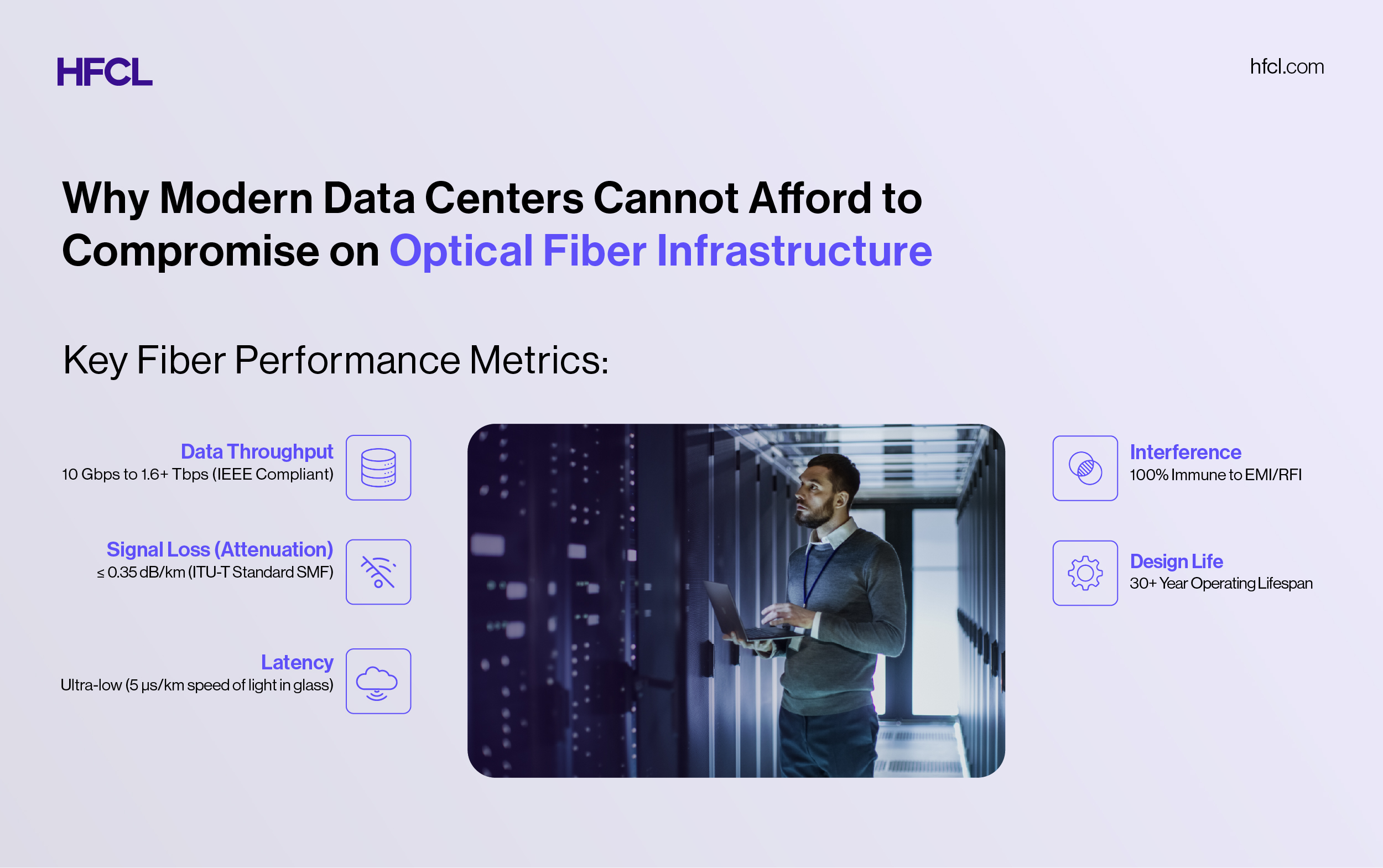
Modern hyperscale data centers achieve fiber optic transmission speeds exceeding 800Gbps, with 1.6Tbps possible though not widely adopted (IEEE standards, 2024), while copper cable maxes out at approximately 10Gbps (industry standard). This isn't an incremental improvement; it's an order of magnitude difference that enables entirely new classes of applications.
The bandwidth advantage extends beyond raw speed. Fiber optic connections commonly range from 10 to 100 gigabits per second and can extend to terabits per second in advanced setups, providing the headroom needed for AI training workloads, real-time analytics, and high-frequency trading applications where microseconds matter.
Distance and Signal Integrity
Fiber optic cables experience less signal degradation over long distances, resulting in lower latency, essential for real-time applications like video conferencing, online gaming, and financial transactions. Unlike copper, which suffers from significant attenuation beyond 100 meters (TIA/EIA standards), fiber can transmit data across kilometers without meaningful signal loss.
This characteristic becomes critical in modern campus-style data centers where buildings may be distributed across large areas. The ability to interconnect facilities without signal boosters or repeaters simplifies architecture and reduces potential failure points.
Electromagnetic Immunity
Data centers are electrically noisy environments. Power distribution units, transformers, cooling systems, and thousands of computing devices create electromagnetic interference that can corrupt data transmitted over copper cables. Fiber optic cables are less prone to electromagnetic interference, ensuring reliable data transmission in the high-EMI environment of a data center.
This immunity isn't just about reliability, it's about security. Fiber optic cables do not radiate electromagnetic signals, making it extremely difficult to intercept or eavesdrop on transmitted data, providing inherent physical security advantages.
Energy Efficiency
The light signals used in fiber optic cables experience minimal attenuation (typically <0.5 dB/km for modern single-mode fiber - ITU-T standards), allowing data to travel longer distances without frequent signal amplification or regeneration, reducing energy consumption associated with signal-boosting equipment. In an era where data center energy consumption is under intense scrutiny, every efficiency gain matters.
Global data centers used 7.4 GW in 2023 compared to 4.9 GW in 2022 (Uptime Institute, 2024), with utility costs rising by a median of 16 percent (Uptime Institute, 2024). The lightweight nature and reduced power requirements of optical fiber infrastructure contribute to lowering both operational costs and environmental impact.
Density Revolution: Meeting Space Constraints with High-Fiber-Count Solutions
One of the most pressing challenges facing data center operators is space, specifically, conduit space. As facilities scale, the physical constraints of existing infrastructure become bottlenecks.
Modern innovations push this even further: Ultra High-Density cabling can pack up to 6,912 fibers or more into a single cable, a capability that would have been impossible just a few years ago.
HFCL's Intermittent Bonded Ribbon (IBR) Cables, available with fiber counts from 72 to 1,728 fibers (HFCL specifications, 2024), offer twice the fiber packing density of traditional flat ribbon cables. These cables feature reduced outer diameters with 250µm and 200µm G.657.A1 optical fibers arranged into a flowing ribbon configuration. The IBR technology supports efficient mass fusion splicing, achieving 11%-time savings on end-entry access and 36% on mid-span accessing compared to dual-jacketed designs. These cables provide backward splicing compatibility with legacy 250µm fibers while enabling higher fiber counts per duct and reduced carbon footprint.
The practical impact is profound. The compact size and lightweight construction of fiber optic cables minimize space requirements for cable routing and management, allowing data center operators to maximize rack density and floor space utilization. This translates directly into better economics, more revenue-generating equipment in the same footprint.
The AI Challenge: Infrastructure for the Next Computing Era
AI workloads represent a fundamentally different challenge than traditional cloud computing. AI-optimized servers are projected to represent 21% of total data center power usage in 2025 and 44% by 2030, with their electricity usage set to rise nearly fivefold, from 93 TWh in 2025 to 432 TWh in 2030 (IEA, 2024).
These workloads demand not just power, but also unprecedented interconnect bandwidth. Training large language models requires thousands of GPUs to communicate constantly, exchanging gradients and model updates. The network becomes a critical bottleneck, or enabler, of AI performance.
To keep up with the tremendous demands of AI and ML applications, many hyperscale data centers have begun to deploy 800-gigabit transceivers, with companies planning roadmaps for higher capacity network switches interconnected with higher capacity transceivers as they become available. These speeds require optical fiber for low-loss transmission.
The architectural implications extend beyond backbone connectivity. Fiber optic cables are increasingly used for server-to-server connections, especially for high-performance computing clusters and storage area networks, allowing for ultra-fast data exchange between servers and supporting demanding applications like cloud computing and artificial intelligence.
Installation Velocity: Time-to-Market as Competitive Advantage
In a market where companies face 24-month waiting periods for data center capacity (JLL Research, 2024), deployment speed provides competitive advantage. Pre-engineered solutions are transforming installation timelines.
The simplified cable management afforded by fiber optic infrastructure reduces installation time and labor costs associated with network deployment and maintenance, with the ease of handling and maneuverability of fiber optic cables streamlining installation procedures and minimizing downtime.
These time savings compound across large deployments. When building out thousands of racks, reducing per-rack installation time from hours to minutes can mean the difference between meeting market windows or losing opportunities to competitors.
Advanced Technologies: Innovations Shaping the Future
The fiber optics industry continues to innovate, developing technologies that will enable the next generation of data centers:
Bend-Resistant Fiber
The main benefit of bend-resistant fiber optic cabling is simplified installation, bend resistance allows for easy routing in any data center environment, paving the way for more efficient use of data center white space. This flexibility reduces installation complexity and enables denser deployments.
Wavelength Division Multiplexing (WDM)
WDM technology empowers the transmission of multiple data streams on a single fiber optic cable, augmenting its capacity manifold by utilizing different wavelengths of light for simultaneous transmission of multiple data channels. This effectively multiplies the bandwidth available on existing fiber infrastructure.
Hollow Core and Space Division Multiplexing
While still emerging, hollow core fibers and space division multiplexing represent the next step in fiber evolution, though the best hollow core fibers still have higher losses than traditional fibers (approximately 0.28 dB/km vs. <0.2 dB/km for conventional fiber - research data, 2024), meaning link building over distance is not yet practical. These technologies promise even greater capabilities as they mature.
The Interconnected Future:
Modern data center networks don't exist in isolation. They're part of a global fabric of connectivity that extends from server racks to metropolitan rings, backbone networks, and long-haul telecommunications infrastructure linking regions and continents.
HFCL's General Purpose Loose Tube Cables are extensively employed in long-haul telecommunications and outdoor installations. These cables serve as versatile workhorses in outside plant applications, supporting installation via aerial lashing, direct burial, or placement in ducts. HFCL's comprehensive cable portfolio spans from 1F to 1,152F configurations, engineered to meet diverse application requirements including data center interconnections, metro rings, access networks, and backbone deployments. The company's cables comply with international standards including IEC 60794, Telcordia GR-20, and ICEA S-122-744, ensuring interoperability and reliability across global deployments.
This integration enables hyperscale operators and telecommunications providers to treat their infrastructure as a unified network spanning from local data centers to regional hubs and national backbone networks. Data centers connect to the broader Internet through high-speed, redundant connections provided by Internet Service Providers, with these external connections relying on robust fiber optic infrastructure to handle the massive data volumes flowing in and out of facilities, volumes that continue to grow as AI, cloud computing, and edge services proliferate
Implementation Best Practices: Getting Optical Fiber Infrastructure Right
Successfully deploying fiber optic infrastructure requires attention to several critical factors:
Structured Cabling Systems
Structured cabling systems furnish a modular infrastructure conducive to facile expansion and reconfiguration as data center requisites evolve, allowing data centers to easily accommodate growth and adapt to changing requirements. Planning for modularity from the outset prevents costly retrofits.
Proper Fiber Management
Data centers are increasingly embracing fiber-rich mesh architectures, but the ability to identify, access, and manage the dense fiber infrastructure is required to minimize the mean time-to-resolution of problems and maximize turn-up speed. Investment in management systems pays dividends in operational efficiency.
Single-mode vs. Multimode Selection
Single-mode fiber is designed for long-distance transmission and is commonly used in large-scale data centers with small core diameter (typically 8-10 microns - ITU-T standard) allowing a single light mode to propagate, reducing dispersion and enhancing signal quality, while multi-mode fiber (50-62.5 micron core - TIA standards) is best suited for short-distance communication within data centers. Choosing appropriately for each application optimizes cost and performance.
The Economics: Total Cost of Ownership Perspective
While fiber optic infrastructure requires upfront investment, the total cost of ownership analysis strongly favors optical solutions:
Reduced Operational Costs: Lower power consumption translates directly to reduced utility bills over the facility's lifetime.
Longer Lifespan: Optical fiber is engineered for a service life of 30 years or longer (industry standards), significantly exceeding copper cable lifecycles.
Reduced Footprint Costs: Higher density means less space consumed by cabling, freeing revenue-generating floor space for IT equipment.
Lower Cooling Requirements: Less heat generation from signal transmission reduces cooling loads and associated energy costs.
Simplified Maintenance: The lightweight nature of fiber optic cables contributes to lower shipping, transportation, and logistics costs compared to traditional copper cables.
Sustainability: Meeting ESG Commitments
Environmental, social, and governance considerations are no longer optional. Optical fiber is an energy-efficient option as it uses less energy for data transmission, directly supporting corporate sustainability goals.
The reduced material requirements matter too. The reduced outer diameter of modern fibers allows for more efficient use of materials in manufacturing and higher fiber counts per duct, resulting in a reduced carbon footprint.
As pressure mounts on the technology sector to reduce environmental impact, fiber optic infrastructure provides a clear path to meeting sustainability commitments while maintaining and improving performance.
Looking Forward: Preparing for Tomorrow's Demands
The data center industry faces a fundamental challenge: projected growth requires an estimated $1 trillion in development needed between 2025-2030 (Goldman Sachs Research, 2024). This investment must be directed wisely, building infrastructure that won't become obsolete as requirements evolve.
Several trends will shape fiber deployment strategies:
Edge Computing Expansion: As processing moves closer to users, fiber infrastructure must extend to distributed edge locations while maintaining performance characteristics.
AI/ML Maturation: As AI workloads evolve from experimental to production, network requirements will shift toward sustained high-bandwidth, low-latency connectivity.
Quantum Computing Integration: While still nascent, quantum computing will eventually require specialized optical interconnects designed for quantum state transmission.
Autonomous Network Management: AI can dynamically route traffic, balance workloads, and reconfigure network topologies to maximize performance and minimize latency, leveraging AI to optimize fiber optics.
The Strategic Imperative
The question facing data center operators isn't whether to deploy fiber optic infrastructure, it's how quickly they can do so while maintaining operational continuity. The competitive landscape offers no room for infrastructure that constrains business capabilities.
Organizations that invest in high-quality, high-density fiber infrastructure position themselves to:
- Support emerging AI and ML workloads without architectural constraints
- Scale efficiently as demand grows without major infrastructure overhauls
- Reduce operational costs through energy efficiency and reduced maintenance
- Meet sustainability commitments while improving performance
- Attract and retain hyperscale tenants seeking premium connectivity
Those that defer investment or compromise on fiber quality will find themselves at a disadvantage, constrained by bandwidth limitations, power consumption, and physical space as competitors leverage superior infrastructure.
Conclusion: Building the Foundation for Digital Transformation
The data center industry stands at an inflection point. The infrastructure decisions made today will determine which operators thrive and which struggle over the next decade. With global data expected to reach 394 zettabytes by 2028 (Statista, 2024), there's no option to wait and see.
Optical fiber infrastructure isn't simply a technical upgrade, it's the foundation upon which the next generation of digital services will be built. From AI training to edge computing, from autonomous vehicles to immersive extended reality experiences, virtually every emerging technology depends on the kind of high-bandwidth, low-latency, reliable connectivity that only fiber optics can provide.
For technology leaders, the path forward is clear: invest in robust, scalable, high-density fiber infrastructure today to enable the innovations of tomorrow. The digital economy's future depends on it.
FAQ
Optical fiber enables long-term scalability by supporting successive generations of higher-speed transceivers without requiring complete cable replacement. As data centers evolve from 100G to 400G, 800G, and beyond, existing single-mode fiber infrastructure can often be reused, significantly reducing upgrade costs, downtime, and disruption. This future-ready nature allows operators to scale bandwidth incrementally while protecting capital investments and avoiding repeated infrastructure overhauls.
Standard-compliant optical fiber infrastructure ensures interoperability across equipment from different vendors, reducing vendor lock-in and simplifying network expansion. Adherence to global standards such as IEC, Telcordia, and IEEE allows data centers to integrate switches, transceivers, and connectivity solutions seamlessly, improving procurement flexibility, operational resilience, and long-term network adaptability.
Yes. Optical fiber enables high-capacity, low-latency redundant paths between data halls, campuses, and geographically distributed facilities. This supports active-active architectures, faster failover, and real-time data replication, strengthening business continuity strategies and minimizing service disruption during outages or maintenance events.
Fiber’s lightweight construction, smaller bend radius, and high-density capabilities make it well-suited for retrofitting legacy data centers. Operators can increase network capacity within existing pathways and racks without major civil changes, accelerating modernization while controlling costs and operational risk.