HFCL A1 190 Optical Fiber
A1 190 Fiber: Bending Resilience, Seamless Integration, and Superior Transmission

About
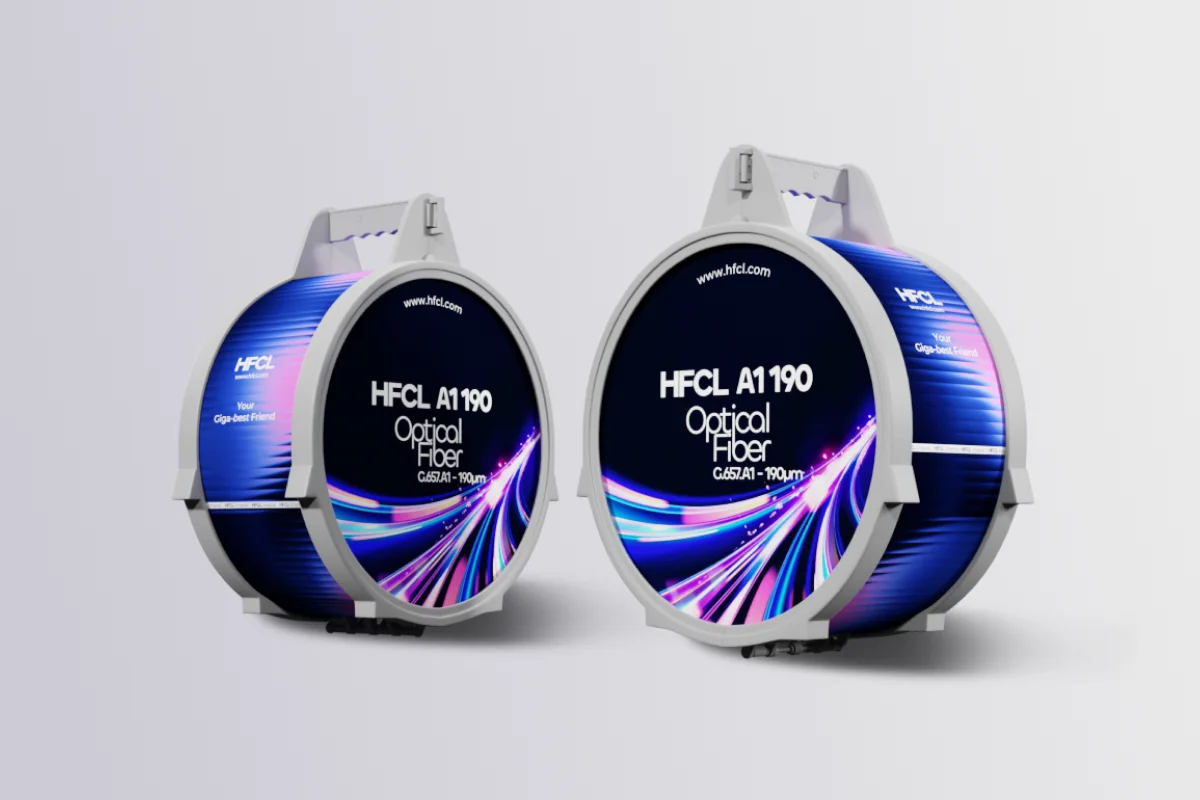
HFCL A1 190 Optical Fiber is a single-mode fiber designed with a reduced diameter to enable higher fiber counts within compact cable designs. Its enhanced bending resilience minimizes attenuation after cabling, ensuring improved transmission performance in dense network deployments. The fiber is fully compatible with existing network infrastructures and adheres to ITU-T G.657.A1 standards. It also offers seamless interoperability with legacy networks built on ITU-T G.652D and G.657.A1 fibers, making it a versatile choice for modern and upgrade-ready optical systems.
Features
Benefits
High Fiber Density
Designed for environments requiring a compact yet high fiber count within a single cable, optimizing network capabilities
Bending Resilience
Reduces attenuation losses post-cabling, ensuring robust and uninterrupted data transmission even in challenging conditions.
Full Network Compatibility
This optic fiber is fully compatible with existing networks, providing a seamless integration experience without the need for extensive modifications.
Key Specifications
Applications
- Long-haul transmission
- Mobile backhaul networks
- Metro networks
- Access networks
- FTTx networks
- Microcables
- Drop cables
Variants
FAQs
Connecting two optical fibers involves carefully aligning and joining their ends. This process, known as splicing, ensures a precise and low-loss connection. Techniques like fusion splicing and mechanical splicing are commonly employed, allowing the seamless transmission of light signals between the fibers.
Pulse broadening in optic fibers refers to the widening of light pulses as they travel through the fiber. This phenomenon occurs due to various factors like dispersion, where different wavelengths travel at different speeds, leading to temporal spreading of the pulse. Pulse broadening can impact the integrity of transmitted signals and is a crucial consideration in maintaining efficient data transmission.
Optic fibers transmit light without absorption by utilizing materials with low absorption coefficients, typically glass or other transparent substances. The core's composition ensures minimal loss, allowing light signals to propagate through the fiber with minimal absorption, resulting in efficient and reliable data transmission.