About
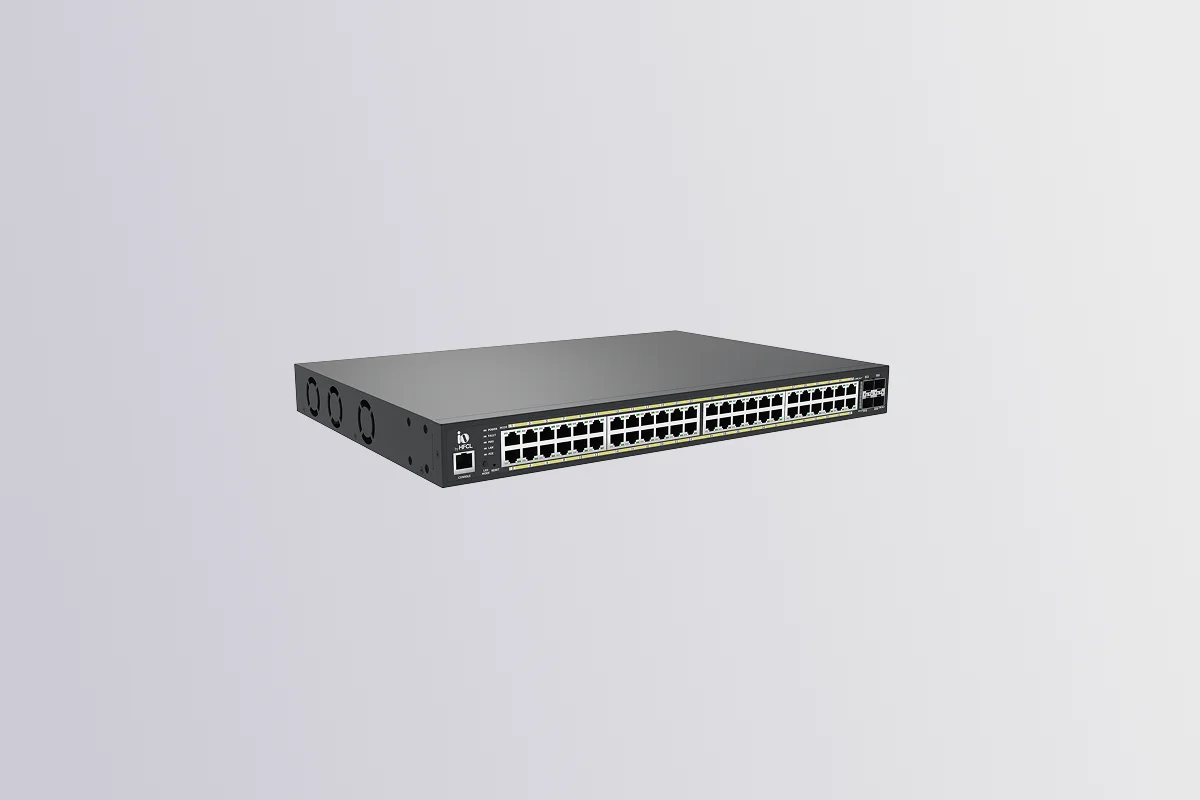
Elevate your network infrastructure with our high-performance 48-port PoE+ switch i.e. HSP-IO-48GE4XS-C1PA, designed to deliver exceptional connectivity, power distribution, and network intelligence. Engineered for modern enterprise environments, this switch combines robust port density, advanced security features, and comprehensive power management to support a wide range of networked devices seamlessly. Whether you're building a large enterprise network, expanding campus infrastructure, or creating a robust telecommunications backbone, this switch delivers the performance, intelligence, and scalability to future-proof your network architecture.
Features
Benefits
Comprehensive PoE Support
Robust 740W PoE budget enables extensive deployment of IP phones, Wi-Fi APs, and CCTV cameras with reliable power delivery
Hyperscale Network Performance
176 Gbps switching capacity and 130.944 Mpps ensure wire-speed performance for demanding enterprise networks
Flexible Connectivity
48x10/100/1000M Base-T PoE/PoE+ access ports with 4x1/10G SFP+ uplinks provide versatile network integration options
Advanced Security Framework
Integrated L2/L3/L4 access controls, 802.1X authentication, and comprehensive security protocols protect network integrity
Intelligent Network Management
Dual-stack IPv4/IPv6 management, WebGUI, CLI, SNMP, SSH, and advanced monitoring tools simplify network administration
Energy-Efficient Design
Complies with IEEE 802.3az energy-efficient Ethernet standards, optimizing power consumption and reducing operational costs
Key Specifications
Applications
- Enterprise Network Infrastructure
- IP Telephony Deployments
- Wireless Access Point Networks
- Video Surveillance Systems
- Educational Campus Networks
- Hospitality Connectivity
- Retail Store Networks
- Healthcare Facility Networking
Variants
- HSP-IO-48GE4XS-C1A
48-Port Non PoE L2 Managed Switch (48x1G access + 4x1/10G SFP+ uplinks)
FAQs
A 48-port switch is a high-density network switch used in large organizations, data centers, and campus networks. Its primary purpose is to act as a high-capacity aggregation point, connecting a large number of wired network devices, such as servers, workstations, and IP-based systems, within a single floor or department. This ensures high-speed connectivity, efficient traffic management, and scalability for rapidly growing business networks.
A 48-port managed switch is essential for large organizations, campuses, and data-intensive environments. Managed switches offer centralized control, advanced security features like VLAN segmentation, QoS (Quality of Service) for prioritizing critical traffic, and scalability. This makes them a fundamental component for building a robust and reliable network infrastructure that can support mission-critical applications.
A 48-port PoE+ switch with 48 Gigabit ports and a 740W PoE budget can power a large number of devices, including high-power Wi-Fi 6 access points, IP surveillance cameras, and VoIP phones, all without separate power adapters. This dramatically simplifies cabling, lowers infrastructure costs, and ensures reliable connectivity across corporate offices, campuses, and smart city projects, making large-scale deployments faster and more efficient.
A network switch is a device that connects multiple computers and network devices within a local area network (LAN). It operates at the Data Link Layer (Layer 2) of the OSI model and uses the unique MAC addresses of connected devices to efficiently forward data frames only to the intended recipient, thereby improving network performance by reducing unnecessary network traffic.
A switch connects devices within a single network (a LAN), while a router connects different networks together. A switch uses MAC addresses to forward data frames between devices on the same network. A router, in contrast, uses IP addresses to route data packets between different networks, such as your home network and the internet, making it the gateway to the wider world.