A Million-Premise FWA Deployment. Turning 5G Coverage into Home Broadband Revenue

How HFCL 5G FWA CPE helped one of India’s largest mobile operators turn 5G coverage into a scaled home broadband business?
At a Glance
Operator Profile
One of India's largest mobile operators with nationwide 5G coverage, serving hundreds of millions of subscribers across all telecom circles.
Challenge
Monetise existing 5G coverage by converting millions of homes into fixed broadband subscribers, without degrading mobile experience or losing control of operational costs.
Solution
HFCL Limited 5G FWA CPE portfolio: Outdoor (Sub-6/mmWave, IP67, PoE) units with TR-069 remote management and installer app.
Scale
More than one million HFCL 5G FWA CPE units shipped in a single financial year.
Key Results
1Million+ 5G FWA CPE units deployed in FY25
Sub-45 minute average installation (outdoor PoE)
Significantly lower complaint volume per 1,000 subscribers
The Opportunity
India's Broadband Gap Is the World's Largest FWA Market
India has more than 300 million households. Fewer than one in six has a fixed broadband connection. Wired infrastructure faces persistent barriers: right of way approvals, underground civil works, high last mile costs, and long lead times. For the vast majority of Indian homes, fibre is not arriving soon enough.
5G Fixed Wireless Access changes that equation. By converting existing 5G radio coverage into home broadband, FWA lets operators reach households in weeks rather than months, at a fraction of the per-home cost of fibre to the home. India's 5G FWA subscriber base crossed 12.3 million by March 2026, the fastest 5G FWA growth of any major market in 2025, with near equal adoption in urban and rural areas. Industry forecasts project India will become the world's largest 5G FWA market by 2030, with 37 million connections representing 40 percent of the global total.
Globally, FWA is the fastest-growing broadband access technology. Total connections are expected to rise from 71 million in 2024 to 150 million by 2030, with 5G networks driving 88 percent of that base. FWA vendors shipped 28 million units in 2024 and is projected to reach 35.3 million in 2025.
One of India's largest mobile operators decided to move on this opportunity early, building a nationwide 5G FWA programme among the largest in the world. HFCL Limited 5G FWA CPE played a central role in making that scale possible.
The Challenge
Monetise 5G at Speed Without Breaking Mobile or the P&L
The operator had invested heavily in 5G spectrum and network infrastructure. The commercial question was clear: where will the return come from? Mobile data consumption was growing but average revenue per user was under pressure. The fixed broadband market offered a large, untapped revenue pool, but reaching it through fibre alone would take years and billions more in civil works capital expenditure.
FWA presented the fastest path. But early pilots exposed several operational challenges that had to be solved before the programme could scale nationally.
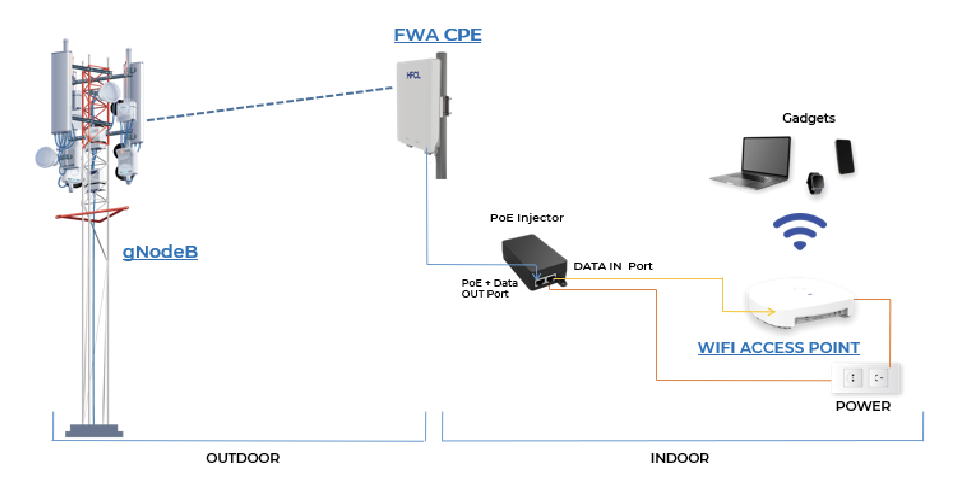
Before HFCL: The Friction Points
Installation Complexity
Initial FWA deployments using multi-box configurations required trained technicians, indoor wiring approvals, and multiple site visits. Average installation time exceeded 90 minutes per premise, and a significant share of installations required a follow-up visit within the first week.
Mobile QoE Protection
The biggest strategic fear: FWA traffic consuming so much radio capacity that mobile users on the same 5G network experienced degraded performance. The CPE had to support standalone 5G profiles and QoS alignment so FWA and mobile could co-exist harmoniously on shared spectrum.
Single Plan, Single Speed
CPE limitations forced the operator into a one-size-fits-all broadband offering. Without the ability to differentiate service tiers through QoS policy at the device level, the operator was leaving ARPU on the table and competing only on price against fibre incumbents.
Device Management at Scale
As the subscriber base grew past the first few hundred thousand, manual firmware updates and configuration changes consumed disproportionate NOC resources. The operator needed FWA CPE that could be managed as part of the platform, not as isolated endpoints.
Device reliability under Indian weather
Early generation outdoor CPE units showed elevated failure rates during monsoon and peak summer months. Device replacements triggered truck rolls, customer complaints, and unexpected OPEX spikes. In some circles, replacement rates during monsoon season exceeded five percent per month.
The Solution: HFCL 5G FWA CPE
HFCL Limited deployed its indigenously developed 5G FWA CPE portfolio across the operator's nationwide footprint. In a single financial year, more than one million HFCL FWA CPE units were shipped, commissioned, and brought into the operator's device management ecosystem.

Product Portfolio
The deployment drew on multiple product variants matched to different coverage scenarios and subscriber segments.
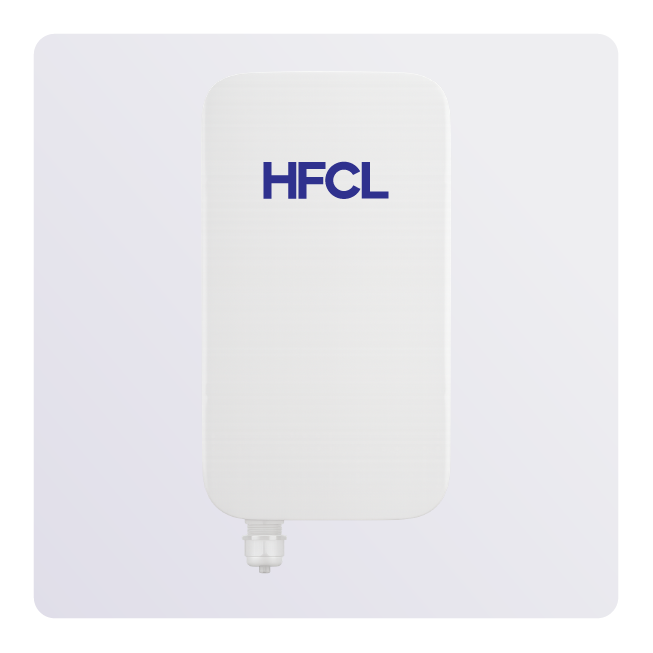
Outdoor CPE (Primary Volume Driver)
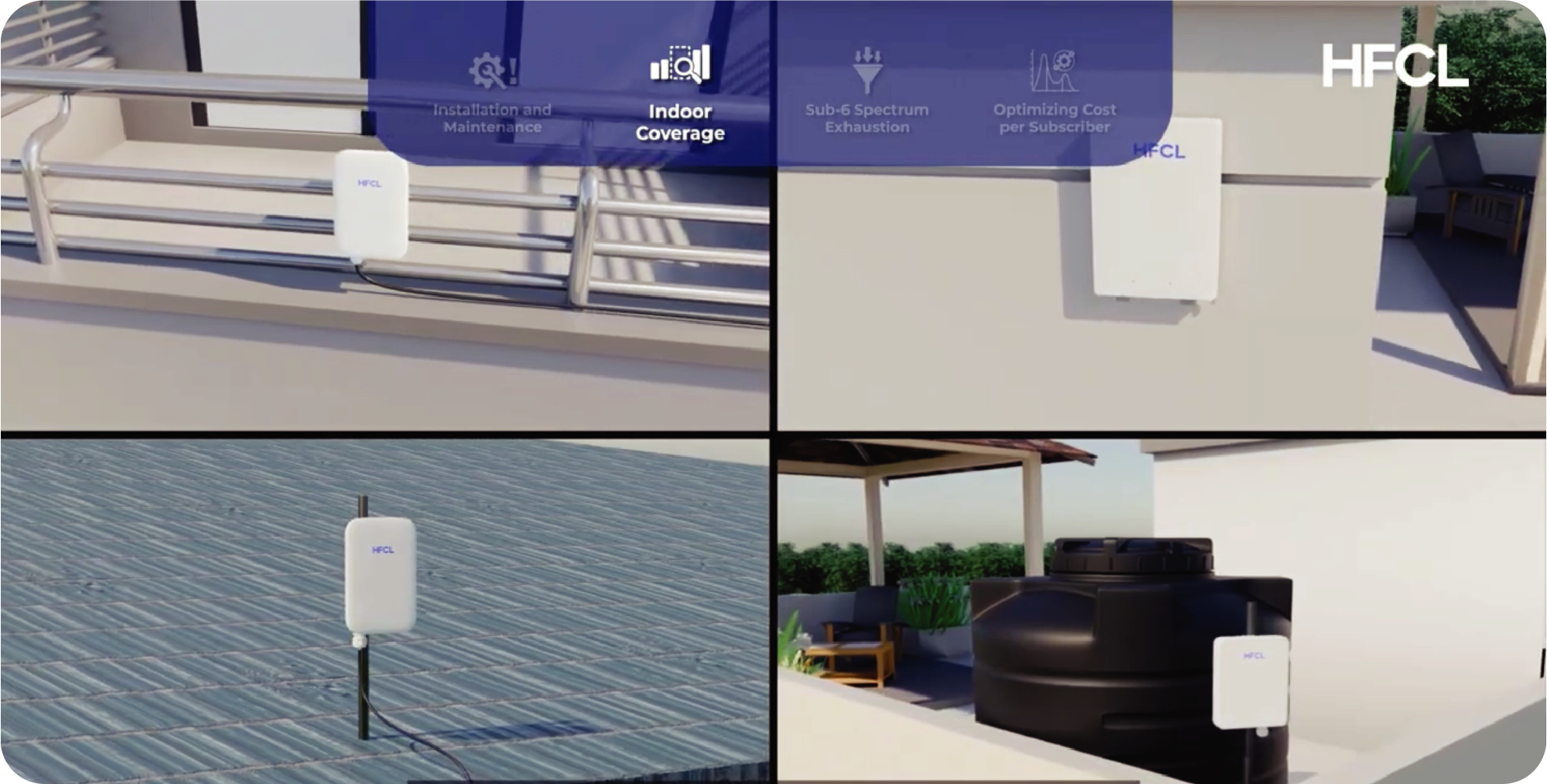
Sub-6 GHz, 5G Standalone, IP67 rated, powered via PoE. Designed for rooftop and building exterior mounting across India's full climate range. Carrier aggregation on n78 delivering gigabit class throughput. This variant eliminated indoor wiring approvals entirely and allowed the operator to use a wider pool of field installation partners.
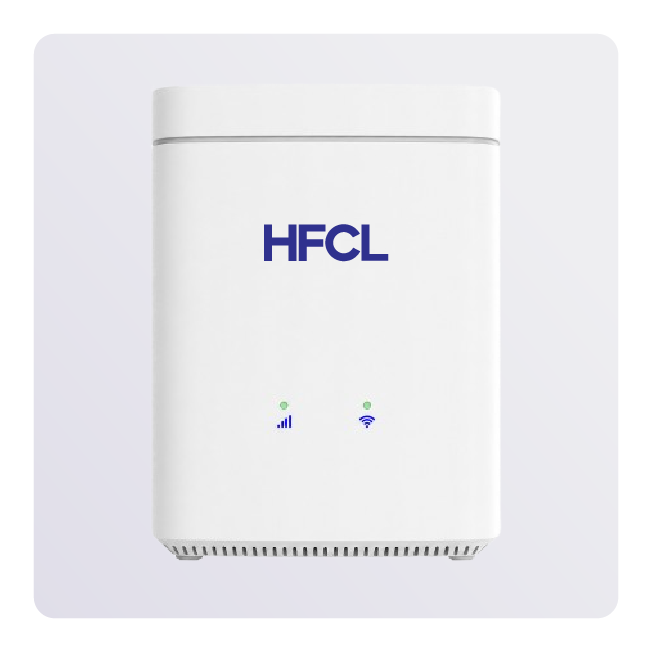
Indoor CPE
Sub-6 GHz, SA/NSA compatible, supporting all deployment bands. Integrated Wi-Fi 6 (AX3600) gateway providing high-performance wireless distribution inside the home. Plug and play form factor for urban subscribers in strong 5G coverage zones.
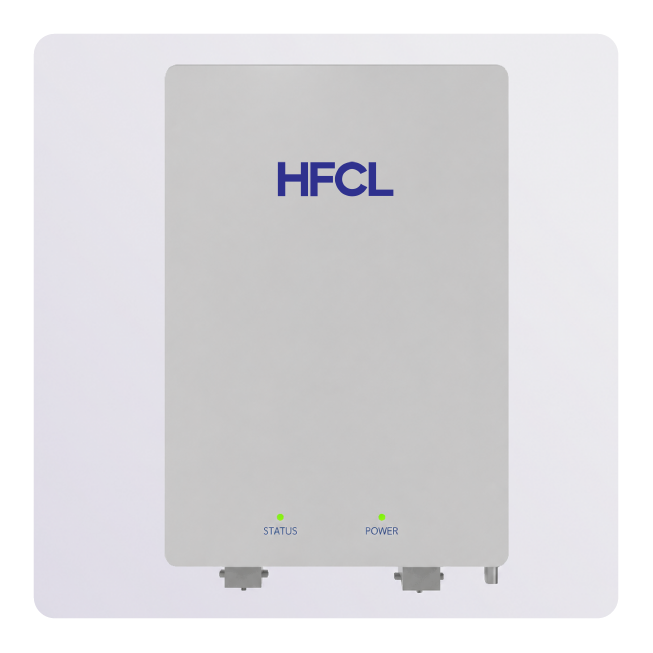
mmWave Ready Variants
Outdoor units supporting Sub-6 plus mmWave (NRDC) and LTE plus mmWave (ENDC) configurations, all IP67 rated. These units position the operator for future mmWave densification and premium tier offerings without requiring a CPE swap.
Solution Architecture
HFCL FWA CPE was engineered to operate as part of the telco's platform, not as a standalone device. Key integration points included:
TR-069 and Remote Device Management
Every unit shipped with full TR-069 support, connecting into the operator's existing auto-configuration server (ACS). This enabled zero-touch provisioning at activation, bulk firmware updates across hundreds of thousands of devices in a single operation, and remote diagnostics without truck rolls.
Installer Application with Signal Intelligence
HFCL's AI integrated mobile application guided field installers through site selection, antenna alignment, and signal quality verification. The app showed real-time band information, signal strength and optimal mounting direction, enabling contractors and channel partners to deliver consistent installation quality without specialised RF training.
QoS Policy Alignment
The CPE supported 5G Standalone network slicing profiles, allowing the operator to enforce differentiated broadband tiers at the device level. This was the technical enabler for the operator's tiered FWA pricing strategy.

The Impact: What Changed After HFCL 5G FWA CPE Went to Scale
HFCL FWA CPE was engineered to operate as part of the telco’s platform, not as a standalone device. Key integration points included:
Deployment Scale
HFCL Limited shipped and activated more than one million 5G FWA CPE units to this operator in a single financial year. The ramp from initial deployment to full-scale production delivery demonstrated HFCL's manufacturing capacity, supply chain readiness, and ability to sustain quality at volume.
Mobile QoE Protection
HFCL CPE's support for 5G Standalone profiles and QoS alignment allowed the operator to run FWA broadband on a clean network slice without degrading mobile 5G KPIs. FWA adoption did not trigger the mobile quality regression that is the number one fear in any FWA rollout. The two services co-existed on shared spectrum with independently managed quality of experience.
Installation Efficiency
The outdoor PoE form factor, combined with the installer app, brought average installation time to under 45 minutes per premise. The efficient design minimized indoor wiring, approvals and allowed the operator to onboard installation partners from its existing retail and distribution network rather than relying exclusively on specialised fibre crews. The result: the operator scaled to millions of connected premises without proportional growth in installation OPEX.
Revenue Enablement
Because HFCL CPE supported QoS differentiation at the device level, the operator introduced tiered broadband plans ranging from entry level speeds to gigabit class performance. Premium tiers generated significantly higher ARPU compared to the single speed plan that was the only option before CPE capabilities allowed tiering. This moved the FWA business from a volume only play to a margin play.
Device Reliability
HFCL's carrier-grade outdoor engineering (IP67, designed for temperatures ranging from extreme summer heat to sustained monsoon conditions) delivered device replacement rates below two percent across two full monsoon seasons. This is a critical metric in Indian FWA deployments, where climate related device failures have historically been one of the primary OPEX risks. Low replacement rates directly reduced truck rolls, NOC complaints, and customer churn.
Operational Stability at Scale
Complaint volume per 1,000 subscribers remained below the operator's internal baseline threshold during the most aggressive phase of subscriber growth. Stable signal quality across mounting scenarios, reliable performance through weather extremes, and remote management capability meant that the growth curve did not generate a proportional support cost curve.
Beyond Residential
The combination of stable outdoor RF performance and high Wi-Fi throughput inside the premise made HFCL CPE viable for small and medium enterprise clusters, schools, clinics, retail chains, and digital-first small businesses. Every new segment the operator could address with the same CPE family expanded the total addressable market without additional hardware qualification cycles.
Why HFCL: What Made the Difference
FWA CPE is available from several global suppliers. The operator's decision to deploy HFCL Limited at this scale was driven by a specific set of advantages.
Indigenous Design and Manufacturing
HFCL's 5G FWA CPE is designed and manufactured in India, qualifying under the government's trusted source and production linked incentive frameworks. For operators managing policy compliance alongside commercial decisions, this simplifies procurement.
Single Product Family from Sub-6 to mmWave
HFCL offers indoor, outdoor sub-6, and outdoor mmWave variants within a unified product architecture. Operators can start with sub-6 for mass residential coverage and add mmWave units for dense zones and premium tiers without changing the device management stack, the installation workflow, or the supply chain relationship. This reduces multi-vendor complexity and extends the useful life of the CPE investment.
Customisation Velocity
As an Indian OEM working directly with Indian operators, HFCL was able to respond to firmware customisation requests, band configuration changes, and installer app feature additions faster than global CPE vendors operating through regional sales channels. Speed of iteration mattered during the scale-up phase when field feedback had to be incorporated into production units within weeks.
Looking Ahead: What Comes Next for 5G FWA CPE
The FWA market is not slowing down. Global 5G FWA connections are projected to reach 150 million by 2030, generating $46 billion in service revenues. India alone is expected to account for 40 percent of the global 5G FWA subscriber base. The GSA reports that 131 service providers worldwide now offer FWA services over 5G, and the CPE shipment market is growing at 26 percent annually.
Several technology shifts will shape the next phase of FWA CPE requirements.

mmWave Densification
As operators move FWA into denser urban zones and premium speed tiers, mmWave capable CPE will move from niche to mainstream. GSA data projected mmWave CPE shipments to grow 47 percent year on year, reaching over one million units in 2025. HFCL's existing mmWave outdoor CPE variants (supporting both ENDC and NRDC configurations) position operators to address this shift with no platform change.
AI-Driven CPE Intelligence
The next generation of FWA CPE will integrate AI capabilities for signal optimisation, predictive fault detection, and self-healing connectivity. HFCL has already introduced AI assisted features in its installer application and is extending these capabilities to the CPE firmware layer. For operators evaluating their FWA strategy, the lesson from this deployment is direct. Scale is achievable. The economics work. The CPE is not a commodity decision. It is a strategic choice that determines installation velocity, device reliability, revenue flexibility, and long-term platform extensibility. HFCL Limited has demonstrated, at million-unit scale with one of India's largest operators, that its 5G FWA CPE delivers on all four.
5G RedCap for Cost-Sensitive Segments
Industry momentum toward RedCap is building. Nearly six in ten FWA CPE vendors surveyed by the GSA in 2025 either already offered or planned to introduce RedCap capable FWA products, creating a new lower-cost 5G device tier for price-sensitive segments.
Learn More
To learn more about HFCL Limited's 5G FWA CPE solutions, schedule a product briefing, or request a deployment consultation, contact your HFCL account team or visit www.hfcl.com/hfcl-5g-fwa-cpa
Sources and References
· TRAI Telecom Subscription Data (March 2026)
· Omdia 5G FWA Go-to-Market Strategies (October 2025)
· GSA FWA CPE Vendor Survey (September 2025)
· Point Topic Global Broadband Subscribers (Q2 2025) Confidential