What Makes IBR Indoor Cable the Faster, Cleaner Way to Deploy High Density Fiber?
Bandwidth demand is growing relentlessly. Hyperscale and enterprise data centers, 5G sites, FTTx rollouts and smart-building projects all depend on one thing: dense, high-performance optical fibers that go in quickly and work dependably. They need high bandwidth and high speed connectivity, and fiber optic cable has overtaken traditional copper cable because it can transmit data faster and farther.
As fiber count inside buildings climbs into the hundreds and thousands, the traditional way of installing cable becomes a bottleneck. Crews pull bare fiber and terminate it on site, which is slow, skill-dependent and hard to repeat.
An IBR indoor cable addresses this challenge directly. It combines the high density and flexibility of intermittent bonding with factory-installed connectors, so the cable arrives on site ready to plug in. Industry estimates suggest this pre-connectorized cable approach can cut installation time by up to 70%.
What is a Pre-Connectorized IBR Indoor Cable?
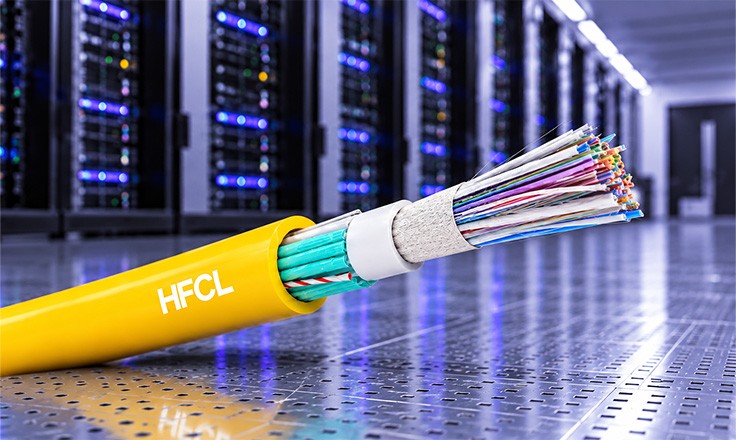
An Intermittently Bonded Ribbon (IBR), also called a rollable or flexible ribbon, is a fiber ribbon in which the fibers bond to each other only at regular intervals. They do not bond along the entire length. This lets the ribbon roll or fold into a compact shape, which gives a very high fiber density inside the cable.
At the same time, the fibers keep the ribbon format, so crews can use mass fusion splicing or terminate the fibers in groups. Trade press says a rollable ribbon fiber cable can double the fiber density of a typical 1.25-inch or 2-inch duct compared with flat ribbon. HFCL's patented IBR portfolio covers ribbon constructions from 144 to 3,456 fibers, including an OFNR-rated indoor version for data center and high-density access use.
In a pre-connectorized cable, the factory fits connectors to the fiber ends, such as MPO/MTP or LC depending on the design. It then tests each assembly for insertion loss and return loss. The cable ships with protective pulling grips and end protection. The result is a plug-and-play optical link that needs no field termination.
Why is Pre-Connectorization Needed?
Field termination has always been the most skill-dependent and time-consuming step of a fiber installation. Three trends make it harder to justify today.
The first driver is scale. A modern data center or high-rise may need thousands of fibers terminated. Every extra termination adds labour hours, test time and a chance of error. Artificial intelligence is pushing this further. Industry estimates suggest AI-focused data centers need roughly 36 times more fiber per rack than traditional CPU racks, and CRU data, as reported by the tech press, shows data center fiber demand grew roughly 76% in 2025.
India shows the same large scale growth. Savills India reports that the country added 258 MW in H1 2026, lifting capacity to 1.8 GW IT, with more than 7 GW IT expected by 2030. CBRE says India added a record 440 MW in 2025, and JLL expects capacity to grow from 1.6 GW to 6 GW by 2029. Data center requirements keep rising, so project schedules keep tightening. Data center, telecom and enterprise builds are planned in weeks, and any delay in cabling holds up equipment installation, commissioning and revenue.
The second driver is skill and consistency. Quality termination and splicing need trained technicians, specialised equipment and a clean working environment. A cable tray, a dusty riser or a ladder rarely offers any of these. Connector end-face geometry, polish and cleanliness strongly influence insertion loss and return loss. A factory controls them far better, because its process is automated, inspected and repeatable.
The third driver is the nature of indoor spaces. Risers, ceiling voids and equipment rooms offer limited working room. Occupied buildings often restrict extended on-site work, dust and hot work.
Pre-connectorization addresses all three drivers at once. It moves the most delicate and time-consuming work out of the building and into a controlled, tested manufacturing process.
What are the Key Benefits of IBR Indoor Cable?
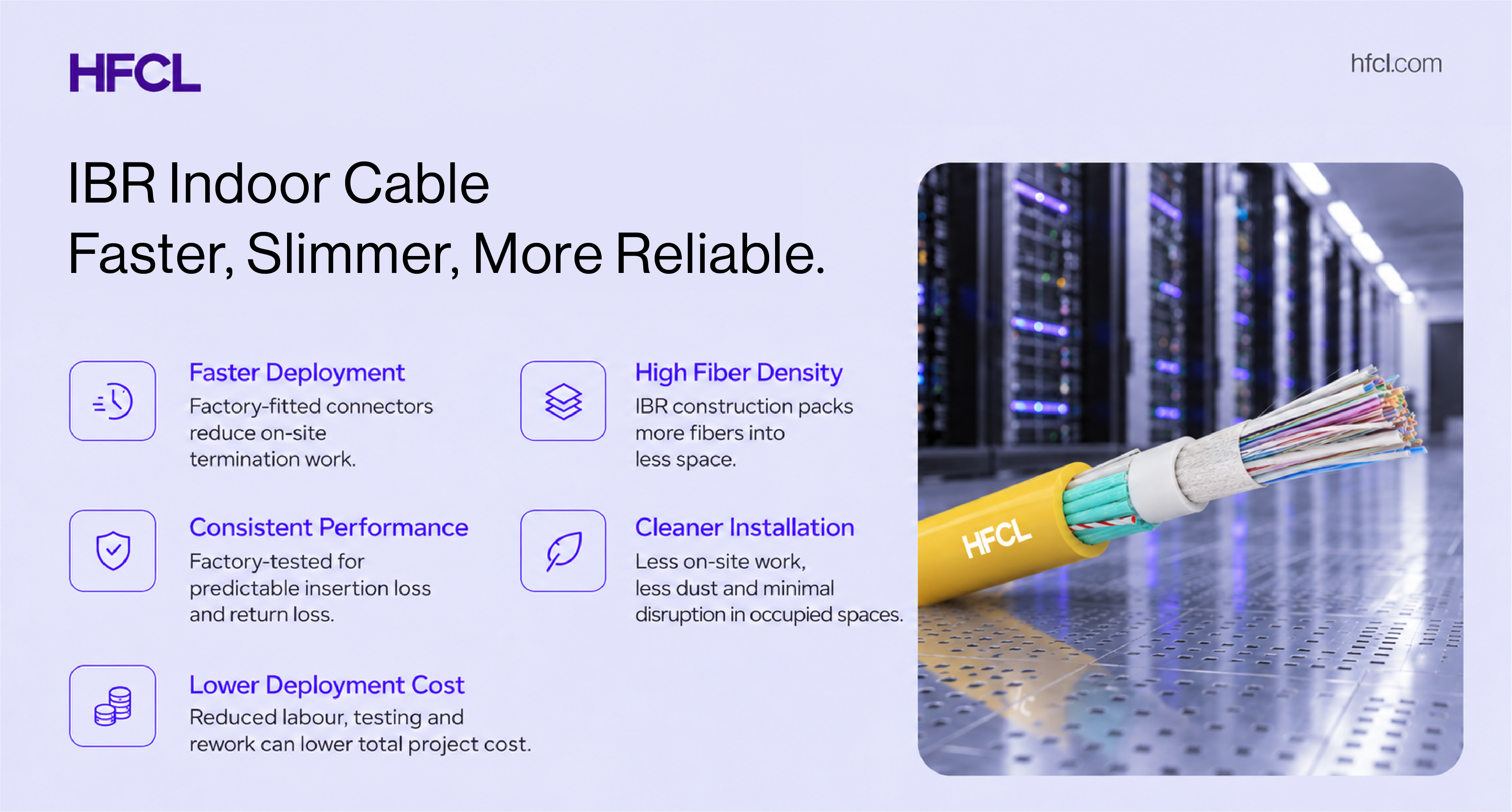
- Faster deployment. With terminations already done, installers pull the cable, route it and plug it in. Installation time drops substantially compared with field termination.
- Consistent, tested performance. Every assembly is factory tested, with results available per link. This gives predictable insertion loss and return loss and cuts the risk of rework. It matters because dirty connectors cause trouble: one test-equipment maker estimates that roughly 85% of fiber network failures trace back to dirty end faces.
- High density in a small footprint. IBR construction packs a large number of fibers into a compact, flexible indoor cable. This saves pathway space, eases routing in congested trays and ducts, and supports future growth in data center fiber.
- Lower dependence on specialised skills. Plug-and-play assemblies reduce the need for on-site splicing equipment and highly trained termination crews.
- Reduced total cost of deployment. A factory-terminated cable carries a premium. Savings in labour, time, test effort and rework generally make the project cost effective overall.
- Cleaner and safer installation. Less on-site work means less debris, less contamination risk to connectors and fewer hazards in occupied buildings.
- Flexibility and scalability. Standardised connector trunks make moves, adds and changes simpler. They also let you expand capacity in a modular way.
Where is IBR Indoor Cable Used?
An IBR cable suits many indoor environments. The best fits are:
- Data centers: backbone and trunk links between meet-me rooms, main distribution areas, and spine and leaf switches, and between halls and buildings.
- Enterprise campuses and commercial buildings: riser and horizontal cabling, and links between telecom rooms and equipment rooms.
- Telecom central offices and exchanges: high-density interconnects between racks and distribution frames.
- 5G and FTTx infrastructure: indoor distribution at aggregation points, hubs and building entry points.
- Smart buildings, hospitals, campuses and transport hubs: locations where fast, low-disruption installation is important.
How Does Pre-Connectorization Simplify Installation?
A conventional installation involves pulling the cable and preparing the ends. Crews then splice pigtails or fit connectors, protect the splices, test each link and fix any failures on the spot. A pre-connectorized installation is much shorter:
- Plan and measure: Survey route lengths and specify the assemblies accordingly.
- Receive tested assemblies: The cable arrives with connectors fitted, ends protected and test reports available.
- Pull and route: Use the protective pulling grip. The flexible IBR construction eases bends and routing in tight spaces.
- Connect: Clean, inspect and plug the connectors into panels or equipment.
- Verify: A quick end-to-end check confirms the link, instead of a full field test of every termination.
The outcome is fewer steps, shorter installation windows, less rework and a more predictable schedule.
What Should You Plan Before Installing IBR Indoor Cable?
A pre-connectorized assembly cannot be trimmed on site, so the quality of the survey determines the quality of the installation. Measure route lengths along the actual pathway, including vertical runs, bends and slack for service loops. Confirm the final assembly length with the manufacturer before production. Check pathway dimensions, such as conduit diameter and bend radius, against the size of the connector and pulling grip. The assembly must pass through without being opened.
During installation, respect the minimum bend radius and maximum pulling tension stated in the datasheet, and use the pulling grip throughout the pull. Keep protective caps on the connectors until the moment of mating. Inspect and clean the end faces before every connection, because connector contamination remains the most common cause of high loss. Single-mode, the type of fiber used for long, high-speed links, has a core only about 9 micrometres wide, so even a speck of dust can add loss.
After installation, run a simple end-to-end loss test. Together with the factory test report, it confirms that the link meets the design budget and gives the customer a complete record for acceptance.
Why Choose HFCL for IBR Indoor Cable?
Pre-connectorized IBR indoor cable is a natural extension of HFCL's strengths in optical fiber and cable design and manufacturing. It brings six practical advantages:
- A complete, ready-to-deploy offering. HFCL moves from plain cable to a tested connectivity solution.
- Strength in high-growth segments. Data center, enterprise and 5G infrastructure need dense, quickly installed fiber the most.
- Quality control end to end. Controlling fiber, ribbon, cable and termination under one roof ensures consistent quality and easy tracking of every batch.
- Innovation-led design. IBR design, optimised bonding patterns and compact indoor constructions reflect HFCL's focus on patented, technology-led solutions.
- Closer customer relationships. Customised lengths, connector types and breakout configurations let HFCL work with customers on project-specific needs.
- Fewer field issues. Factory-tested assemblies mean fewer installation complaints and a better customer experience.
Is IBR Indoor Cable the Right Choice for Your Network?
As networks grow denser and project timelines grow shorter, the way fiber is installed matters as much as the fiber itself. An IBR indoor cable brings together the density and flexibility of intermittent bonding with the speed and reliability of factory termination. It shortens installation, improves consistency, reduces dependence on specialised field skills and supports scalable network growth.
For customers, the result is faster, more predictable deployment. For HFCL, it is an opportunity to deliver complete, high-quality connectivity solutions and to reinforce its role as a trusted partner in the digital infrastructure ecosystem.
FAQ
An IBR indoor cable is an indoor fiber optic cable built with intermittent bonding. In its pre-connectorized form, it arrives with connectors already fitted at the factory. A standard cable arrives as bare fiber, so crews must splice it to pigtails or fit connectors on site. In an IBR cable, fibers bond to each other only at intervals. The ribbon rolls into a compact shape and carries more fibers in the same cable size. Mass fusion splicing still works where needed. Each assembly ships with insertion-loss and return-loss results, so installers only pull, clean, inspect and plug in. The result is less on-site work, predictable performance and a shorter schedule.
Industry estimates say pre-terminated fiber can cut installation time by as much as 70%. The saving comes from removing splicing, connector fitting, polishing and most testing from the site. Your actual figure depends on fiber count, pathway length, the number of assemblies and the crew you would otherwise use. Projects with many identical trunks, such as a multi-hall data center, usually gain the most because a factory scales far better than manual work. Treat published percentages as an upper-range guide and ask your supplier for a project-specific estimate.
Yes, with proper planning. IBR cable is flexible and has no preferred bend direction, which helps in congested trays and risers. The protective pulling grip shields the connectors during the pull. Check the physical limits first. Compare conduit or duct diameter with the connector and pulling-grip size, and read the datasheet for minimum bend radius and maximum pulling tension. The assembly cannot be trimmed on site, so measure route lengths along the actual pathway, including vertical runs and service loops. Confirm them with the manufacturer before production. A site survey before ordering is the best way to avoid delays.
Yes, but far less than a field-terminated link. Factory termination removes the variable steps, such as cleaving, polishing and splicing, where most quality problems begin. Each assembly also arrives with a test report. On site, inspect and clean every connector end face before mating. Dirty end faces are a leading cause of failure, and one estimate puts roughly 85% of network failures down to them. Keep protective caps on until connection, follow the IEC 61300-3-35 grading guidance, then run a simple end-to-end loss test. Together with the factory report, that gives a complete acceptance record.