What Is Network Infrastructure? A Complete Guide to Components, Trends, and Challenges in 2026

Every cloud application, video call, data transfer, connected device, and AI workload depends on an underlying system that most users rarely see i.e. network infrastructure.
The scale of this infrastructure is substantial. The global telecom network infrastructure market was valued at USD 108.8 billion in 2025 and is projected to reach USD 190.1 billion by 2033, according to Grand View Research. The market is segmented across wireless, fixed, core, and transport network infrastructure, among other categories.
At the same time, AI is creating new requirements for the networks connecting computing resources. Dell’Oro forecasts that cumulative spending on switches deployed in AI back-end networks will approach USD 1 trillion between 2026 and 2030.
This makes network infrastructure more than a connectivity layer. It is becoming a critical foundation for how modern digital systems are built, connected, and scaled.
This guide explains what network infrastructure is, its core components, the trends reshaping it, and the challenges organisations need to consider as networks evolve.
What Is Network Infrastructure?
Network infrastructure refers to the physical and logical components that enable data to move between devices, users, applications, and networks.
It can include:
- Optical fibre and cable infrastructure
- Routers and switches
- Optical transport systems
- Mobile and fixed access infrastructure
- Data centre connectivity
- Network management and orchestration systems
- Submarine cable systems
- Supporting physical infrastructure
A useful way to understand network infrastructure is to think of it as the underlying transport system of the digital world.
Applications generate data. Devices create and consume it. Network infrastructure provides pathways that allow that data to move.
The architecture varies depending on the environment. A telecom network, enterprise network, broadband network, and data centre network will use different combinations of technologies, but all depend on underlying infrastructure to move information reliably and efficiently.
What Are the Core Components of Network Infrastructure?
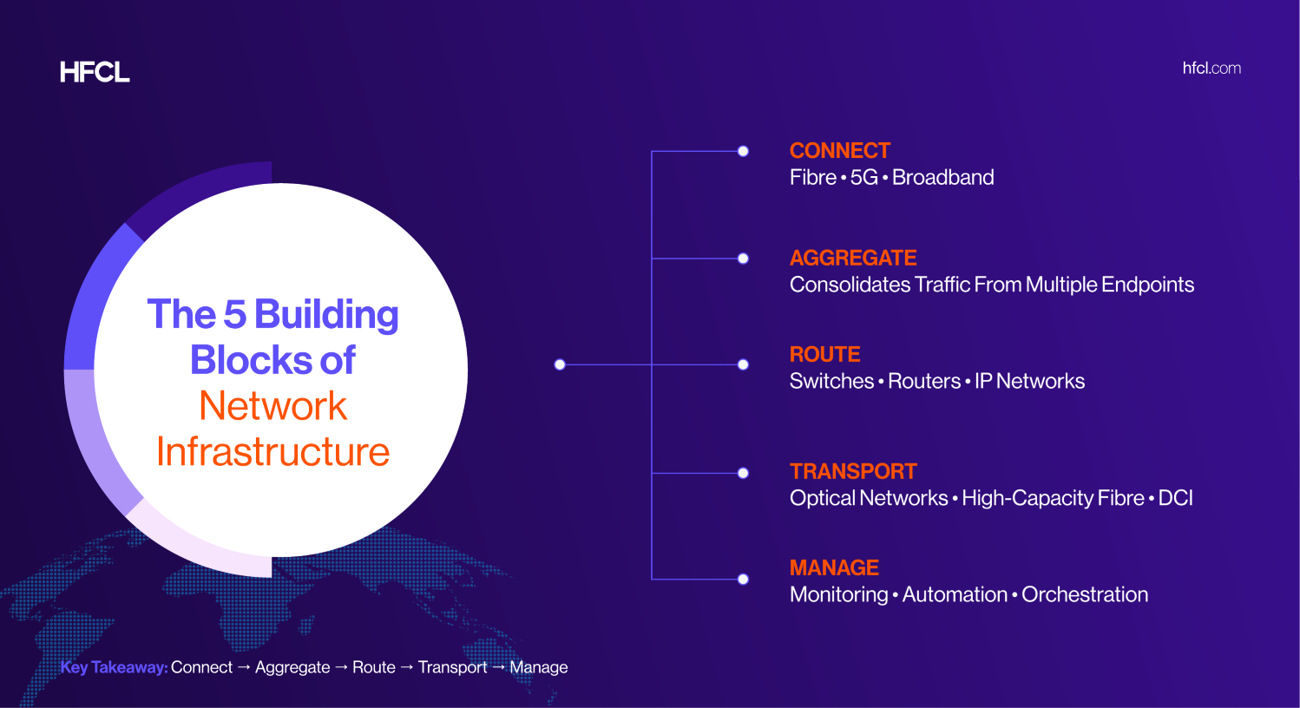
There is no single architecture that applies to every network. However, network infrastructure can broadly be understood through several interconnected components.
Physical and Optical Infrastructure
The physical infrastructure provides the connectivity pathways through which data travel. It includes both passive optical infrastructure and active networking, and transport equipment.
Passive optical infrastructure does not actively process or route network traffic. It provides the physical pathways and connection points between network elements. Examples include optical fibre cables, trunk cables, patch cords, pigtails, fibre assemblies, high-density cassette panels, enclosure systems, and Intermittently Bonded Ribbon (IBR) cables.
Active networking and transport infrastructure includes equipment that processes, switches, routes, or transports network traffic. Depending on the network architecture, this can include Ethernet switches, routers, optical transceivers, Dense Wavelength Division Multiplexing (DWDM) systems, and Reconfigurable Optical Add-Drop Multiplexers (ROADMs).
An optical transport network can contain both active equipment and passive optical components. The classification depends on the specific component and whether it actively generates, converts, switches, amplifies, or controls the optical signal.
This distinction is important for network design and procurement because passive connectivity and active equipment perform different functions and are evaluated against different requirements. Increasing network capacity may require changes to active equipment, passive connectivity, or both, depending on the existing architecture.
Optical fibre is particularly important for high-capacity networks because it can transmit large volumes of data over long distances with low attenuation and is largely immune to electromagnetic interference.
Its role extends across broadband access, mobile transport, long-haul networks, enterprise connectivity, and data centre interconnects.
At the international level, the importance of physical fibre infrastructure becomes even more apparent. According to the International Telecommunication Union (ITU), submarine cables carry more than 99% of international data flows. The global submarine cable network comprises around 500 submarine cable systems spanning more than 1.7 million kilometres.
Access and Aggregation Networks
The access network connects users, devices, homes, businesses, and other endpoints to the wider network.
Depending on the deployment, this can include fibre access systems, wireless access infrastructure, switches, and other last-mile technologies.
Aggregation networks collect traffic from multiple access points and direct it towards higher-capacity transport and core networks.
Together, access and aggregation infrastructure determine how efficiently traffic moves from individual users and endpoints into the wider network.
India provides a useful example of the scale at which access infrastructure operates.
TRAI recorded 1,092.79 million internet subscribers and 1,065.88 million broadband subscribers in March 2026. These figures represent subscriptions rather than unique individuals, but they illustrate the scale of India's digital access ecosystem.
Core and Transport Networks
Core and transport networks provide high-capacity connectivity between major network nodes, geographic regions, data centres, and other aggregation points.
Depending on the network architecture, these networks can incorporate:
- IP routing systems
- Optical transport platforms
- MPLS-based services
- Mobile backhaul
- High-capacity fibre links
- Data centre interconnects
The role of the transport layer becomes increasingly important as traffic moves between increasingly distributed locations.
A modern application may depend on connectivity between an end user, an access network, a cloud platform, a data centre, and multiple network nodes. The underlying transport infrastructure needs to support these connections without becoming a bottleneck.
Network Management and Orchestration
Network infrastructure also includes the systems used to operate and manage it.
Network management and orchestration technologies can provide visibility into network performance, support configuration and provisioning, identify faults, and automate selected operational processes.
As networks become larger and more distributed, operational visibility becomes increasingly important.
Modern infrastructure therefore combines physical connectivity with software and management systems that help operators monitor and control the network.
Why Is Network Infrastructure Becoming More Important?
Network infrastructure has always been fundamental to digital connectivity. What is changing is the scale, complexity, and diversity of the workloads that depend on it.
AI Is Creating New Networking Requirements
AI infrastructure introduces demanding connectivity requirements inside data centres.
AI environments can require high-bandwidth, low-latency communication between accelerators, servers, switches, and storage systems. The specific requirements depend on the workload and network architecture, including whether the environment uses scale-up, scale-out, or other networking approaches.
The scale of investment is already significant.
Dell’Oro forecasts that cumulative spending on switches deployed in AI back-end networks will approach USD 1 trillion between 2026 and 2030. The research also expects scale-up networking to account for more than half of this market by 2030.
This shift highlights an important point: supporting AI is not only a question of computing power. The connectivity architecture linking that compute is also an important consideration.
Data Centres Need Higher-Density Connectivity
As data centre networks move towards higher speeds and greater connection densities, the physical connectivity layer also needs to evolve.
More connections need to be accommodated within increasingly constrained physical environments. This places greater emphasis on:
- Fibre density
- Connector density
- Cable management
- Rack space
- Pathway utilisation
- Deployment efficiency
- Scalability
Higher-density optical connectivity can allow more connections to be accommodated within the same physical footprint, although the appropriate architecture depends on the application, equipment, and deployment environment.
This is particularly relevant as data centre operators move towards higher-speed interfaces such as 800G and 1.6T.
5G and Fibre Are Part of the Same Infrastructure Ecosystem
5G is often discussed as a wireless technology, but mobile networks also depend on extensive transport infrastructure behind the radio access layer.
Traffic generated by mobile users needs to move between radio sites, aggregation points, transport networks, and the mobile core.
Fibre can play an important role in this transport architecture because of its capacity and reach.
Depending on the network architecture, fibre can support mobile backhaul, midhaul, or fronthaul deployments.
The exact network design varies by operator, geography, and deployment model. However, the evolution towards higher-capacity mobile networks makes transport infrastructure an important part of 5G network planning.
International Connectivity Depends on Physical Infrastructure
The global internet is not a purely virtual system. It depends on physical infrastructure that crosses countries, oceans, and continents.
ITU data shows that international bandwidth has grown at an average rate of 22% annually since 2021. The scale of submarine infrastructure has also expanded significantly. Investment in submarine cables increased from approximately USD 0.8 billion in 2015 to USD 9.7 billion in 2025.
These figures reflect the growing importance of physical connectivity as cloud computing, digital services, AI, and international data exchange continue to expand.
What Are the Major Challenges Facing Network Infrastructure?
1. Scaling Capacity
Network traffic does not grow uniformly.
Different applications can create different traffic patterns, while data centres, enterprise locations, mobile networks, and cloud environments can experience different capacity requirements.
Infrastructure therefore needs to support capacity growth without requiring major redesigns for every incremental increase in demand.
Modular architectures, higher-density connectivity, and scalable optical systems can help organisations increase capacity as requirements evolve.
The objective is to balance current requirements with future capacity needs while making efficient use of existing physical infrastructure.
2. Managing Physical Space
Capacity is not only about bandwidth.
In data centres and other infrastructure environments, physical space can become a constraint.
More connections may need to fit into the same racks, pathways, and equipment areas. This makes fibre density, cable diameter, connector size, and installation efficiency increasingly relevant to network design.
High-density infrastructure can help address these constraints, provided it remains compatible with installation, maintenance, and operational requirements.
3. Network Resilience
The physical nature of network infrastructure also creates physical risks.
Submarine cables, for example, can be affected by fishing, anchoring, seabed activity, earthquakes, and other hazards.
According to the ITU's Global Connectivity Report, 86% of submarine cable faults are associated with human activities such as fishing and anchoring.
The issue is therefore not simply how much capacity a network has. It is also how many alternative routes are available and how quickly infrastructure can recover when disruption occurs.
Route diversity, redundancy, monitoring, and effective repair mechanisms can all contribute to network resilience.
4. Balancing Growth with Infrastructure Efficiency
Adding capacity often means adding physical equipment, fibre, power, space, and supporting infrastructure.
The challenge is to increase network capability while using physical resources efficiently.
This is one reason density and scalability have become increasingly important considerations in network infrastructure planning.
The right solution depends on the network environment, but infrastructure design increasingly needs to consider capacity and physical efficiency together.
5. Managing Increasingly Complex Networks
Modern network environments can span multiple technologies and locations.
An organisation may simultaneously operate or depend on:
- Fibre networks
- Wireless networks
- Data centres
- Cloud infrastructure
- Enterprise sites
- Internet exchanges
- Submarine connectivity
- Edge locations
Managing these environments requires visibility across different network domains and the ability to identify performance issues quickly.
This is driving greater interest in automation, orchestration, and software-defined network management.
What Are the Key Network Infrastructure Trends for 2026?
Higher-Density Optical Connectivity
As data centre speeds increase, network operators need to accommodate more optical connections within limited physical footprints.
This is driving interest in high-density fibre cables, smaller form-factor connectivity, and architectures designed for higher port density.
Very Small Form Factor Connectivity
Very Small Form Factor (VSFF) connectors are compact fibre-optic connector formats designed to support high-density connectivity.
Examples include CS, SN, and MDC connectors. Depending on the connector system and deployment architecture, they can help accommodate more optical connections within a given physical footprint.
VSFF connectivity can be particularly relevant in high-density data centre deployments where increasing port density needs to be balanced with space, accessibility, and cable management requirements.
Intermittently Bonded Ribbon Cables
Intermittently Bonded Ribbon (IBR) cables use a ribbon structure in which fibres are bonded at intervals rather than continuously.
This construction creates a more flexible ribbon structure that can be rolled, folded, and routed through constrained pathways, while still supporting ribbon-based mass fusion splicing in compatible designs.
IBR technology can therefore be relevant to environments where operators need to manage high fibre counts within constrained physical environments.
800G and 1.6T Connectivity
As AI and high-performance computing environments scale, higher-speed interfaces are becoming increasingly relevant to data centre networking.
The adoption of 800G and emerging 1.6T interfaces places greater demands on the optical and physical connectivity infrastructure used to deploy these links.
This includes active optical components as well as the passive connectivity layer, including fibre cables, connectors, trunks, patching systems, and other components required to establish and manage optical links.
The performance of an 800G or 1.6T link depends on the complete system, including active devices, fibre, connectors, link distance, and the physical-layer architecture.
AI-Ready Data Centre Infrastructure
AI is changing the design requirements of data centres.
The growth of AI back-end networking means connectivity needs to support increasingly intensive communication between computing resources.
Dell’Oro's forecast of nearly USD 1 trillion in cumulative AI back-end switch spending from 2026 to 2030 illustrates the scale of this infrastructure transition.
For optical infrastructure providers, this creates demand for solutions that can support higher speeds, greater density, and efficient deployment.
More Focus on Network Resilience
The increasing dependence on digital infrastructure is also placing greater emphasis on resilience.
For international networks, this includes greater attention to route diversity, cable protection, and redundancy.
The ITU's work on submarine cable resilience highlights physical risks and the importance of protecting the infrastructure that supports international connectivity.
Convergence Across Network Domains
Digital services increasingly depend on interconnected telecom, cloud, data centre, and enterprise network environments.
A single digital service can depend on several interconnected domains, from access and mobile networks to core transport, data centre interconnects, and cloud infrastructure.
As a result, network planning increasingly needs to consider how these domains work together rather than treating them as entirely separate systems.
Where Is Network Infrastructure Headed?
The next phase of network infrastructure is not simply about building larger networks.
It is about building networks that can support changing workloads, higher speeds, greater density, and more distributed digital environments.
For network operators, data centre providers, and enterprises, the priority will increasingly be to create infrastructure that can scale without compromising density, resilience, or operational efficiency.
Network Infrastructure and HFCL
As AI and hyperscale computing introduce new requirements, optical infrastructure must evolve alongside the network architectures it supports.
HFCL's OptiQ AI portfolio brings together optical connectivity solutions designed to address the density, scalability, and deployment requirements of AI, cloud, and hyperscale data centre environments.
The portfolio brings together solutions across high-density connectivity, Intermittently Bonded Ribbon (IBR) cables, fibre cable assemblies, patch cords, pigtails, trunks, cassette and enclosure panels, and other optical connectivity solutions.
The portfolio is positioned for high-speed environments including 800G and 1.6T applications, with a focus on connectivity density, scalability, and deployment efficiency.
For network infrastructure providers and data centre operators, the objective is not simply to add more connections. It is to create an optical infrastructure layer capable of supporting the increasing scale and density of next-generation networks.
FAQ
Passive network infrastructure provides physical connectivity without actively processing or routing network traffic. Examples include fibre cables, trunks, patch cords, pigtails, cassette panels, enclosure systems, and IBR cables.
Active infrastructure includes equipment that processes, switches, routes, or transports network traffic. Examples can include Ethernet switches, routers, optical transceivers, DWDM systems, and ROADMs.
Both layers are important to network performance, capacity, and scalability.
Fibre can support very high bandwidth over long distances while offering low attenuation and being largely immune to electromagnetic interference.
It is therefore widely used across broadband; telecom transport, enterprise networks, long-haul connectivity, and data centre interconnects.
AI is creating new networking requirements, particularly within data centres where large computing systems need high-speed, low-latency connections between computing and networking resources.
Dell’Oro forecasts that cumulative spending on switches deployed in AI back-end networks will approach USD 1 trillion between 2026 and 2030.
This is increasing the importance of high-speed networking, optical connectivity, density, and scalable infrastructure.
Very Small Form Factor (VSFF) connectors are compact optical connector formats designed to support high-density connectivity.
Examples include CS, SN, and MDC connectors. Depending on the connector system and deployment architecture, they can help data centre operators accommodate more optical connections within constrained rack and patching environments.
Virtually, every digitally connected industry depends on network infrastructure.
Telecommunications, cloud and data centre services, financial services, healthcare, manufacturing, government, retail, and professional services all rely on networks to connect people, applications, devices, and data.
As digital services and AI workloads expand, network infrastructure is becoming increasingly important across industries.