From Space Constraints to Seamless Installs: How HFCL Solved Fiber Density Challenges

Case Study Highlights
- Tool-free fiber access speeding up installation and maintenance
- Micro module unit kink diameter matches fiber kink diameter with unrestricted buffer skin
- Faster installations with low-friction jacket and air-blown techniques
- 1.35mm diameter micromodules with a minimal bend radius, preventing kinks
- Fully compatible with micro ducts ranging from duct inner diameter 8mm for respective fiber counts
Overview
The customer, an established service provider in Europe, was facing an increasing need for high-density fiber installations due to rapidly growing subscriber demand. Their existing network infrastructure was built using micro ducts with inner diameters of 8mm to 12mm, leaving limited space for further expansion. To address the rising demand for bandwidth, they needed a solution that could offer a higher fiber count while still fitting within the existing duct and networking components like compact closures. HFCL’s innovative Micromodule Micro-cable provided the ideal solution, combining high-density fiber technology with flexible micromodules. This new design enables seamless deployment, easy access for branching, and long-term reliability.
Challenges Faced
The customer faced several specific challenges that needed to be addressed to meet their growing infrastructure requirements:
Microduct Installation
The requested cables had to be compatible with blowing installation methods and fit into micro ducts of sizes 12/8mm, 14/10mm, and 16/12mm, ensuring efficient deployment within the existing microduct network.
Accessible Buffer Tubes
The cable requires buffer tubes for easy midspan access while ensuring a compact fit within closures and vaults without sacrificing accessibility.
Tone-ability for Easy Identification
With multiple cables already installed in the same conduits, the customer required a cable that included a toneable element, allowing for quick and easy identification during maintenance or network upgrades.
Infrastructure Limitations
Existing network constraints restricted the addition of new equipment or cabling without requiring extensive modifications.
High Installation Costs
The need for rapid deployment conflicted with the costs associated with retrofitting existing infrastructure, straining the project budget.
Scaling Fiber Capacity
The expanding subscriber base increased pressure on the service provider to manage increasing fiber count demands without compromising service quality. Scaling Fiber Capacity
HFCL's Approach
To address the specific challenges faced by the customer, HFCL implemented a structured approach that combined microcable technology with advanced micromodule designs.
- Low Bend Diameter for Easy Routing
The micromodule units feature an exceptionally small bend diameter comparable to the bend radius of the fiber itself. This allows the cable to be routed through limited spaces and closures with no restriction imposed by the tube material, ensuring smooth installation even in constrained environments.
- Blowing Installation for Micro ducts
HFCL’s micro cables were designed specifically for installation using air-blown techniques into micro ducts having inner diameter > 8mm. This method allowed for smooth cable installation into existing ducts without requiring any major changes to the infrastructure.
- Limitations of Conventional Micromodule Cable
Conventional micromodule cables are designed for larger ducts, such as 50/40mm or 40/33mm, making them unsuitable for the customer’s smaller micro ducts.
- Flexible, Kink Resistant Micromodules
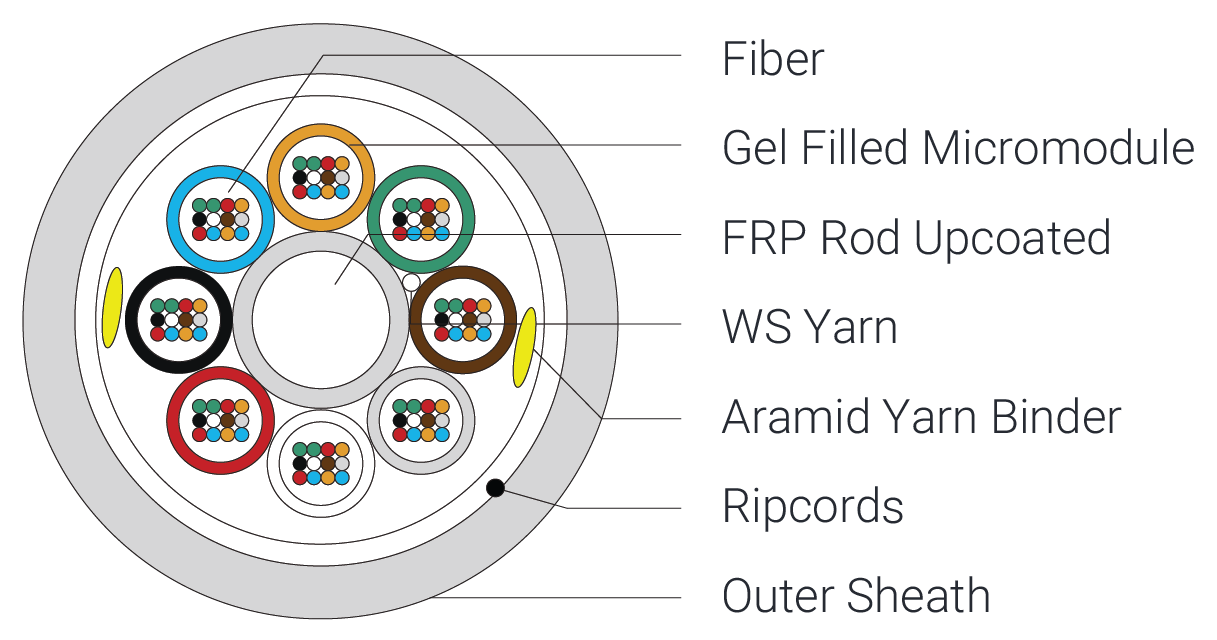
HFCL replaced rigid PBT tubes with flexible micromodule units. These have a kink diameter close to that of the fiber, designed for added bendability and kink resistance. The micromodules allow seamless routing through tight spaces, like closures and vaults, while protecting fiber integrity during installation. Inside closures, micromodules require 5X less space than conventional PBT buffer tubes.
- Toneable Cable Design
A key feature of HFCL’s solution was the incorporation of a toneable element. By adding an insulated copper wire along the outer jacket, the cable could be easily identified among other cables, addressing the customer’s requirement for quick identification in crowded ducts.
- High Fiber Density in a Reduced Cable Diameter
HFCL’s micromodule cables were engineered to support higher fiber counts, with each micromodule housing 12 or 24 fibers. The design leveraged bend-insensitive fibers, ensuring that the cable could accommodate a large number of fibers within a lower outer diameter.
- Low-Friction Jacket for Enhanced Blowing Performance
The micromodule cable’s outer jacket is made from low-friction materials, increasing the blowing length by 15-25%. This reduces resistance, allowing longer installations with minimal disruption. The micromodules also underwent rigorous durability testing
- Easy Access Micromodules:
HFCL developed micromodules with a jacket that can be easily peeled by hand, eliminating the need for specialized tools. This innovation simplifies fiber access, making installation and midspan branching easier for technicians.
- Uniform Bending with Central Strength Member
We incorporated the design with a central strength member, ensuring the cable maintained uniform bending properties. This avoided issues related to preferential bending, allowing the cable to be easily installed in smaller-diameter micro ducts.
Success Metrics
Efficient Installation and Longer Blowing Distances
The cables were equipped with a low-friction jacket optimized for air-blown installations, allowing for smoother deployment over longer distances through micro ducts. This design maximized fiber capacity within limited duct space while minimizing installation time and effort. HFCL’s flexible micromodule units further enhanced handling and routing, even in tight spaces like closures and vaults, ensuring faster and more efficient installations while reducing labor and costs, making them ideal for high-density cable deployments.
Minimal Bend Radius
HFCL's micromodules boast an exceptionally small minimum bend radius, with a nominal outer diameter of just 1.35mm for a 12-fiber configuration. This low bend diameter reduces the risk of kinking or fiber breaks, making the cables ideal for deployment in tight, restricted spaces where traditional cables might fail. The bend radius is so small that it matches the bend diameter of the fiber itself. This design allowed the cables to be routed in tight spaces without the risk of kinking or fiber damage, ensuring long-term reliability.
High Fiber Density in Smaller Ducts
HFCL’s micromodule micro-cables provide up to 288 fibers in a single, compact design that allows easy, tool-free access, optimized for micro ducts as narrow as 8mm in diameter. This allowed the customer to increase their network capacity without needing to install larger ducts or make significant changes to their existing infrastructure. The use of bend-insensitive fibers further ensured the cable’s ability to handle high-density fiber counts without compromising performance or installation efficiency.
Low Maintenance and Cost Savings
The lightweight and flexible design of the micromodule cables not only reduced installation effort but also minimized ongoing maintenance costs. The cables’ durability and ease of fiber access allowed for simpler and faster repairs, leading to significant long-term savings for the customer. Additionally, the smaller cable diameter reduced space-related expenses, allowing for more cost-effective deployment and expansion of the network.
Optimized Design for FTTx Networks
Additionally, a key advantage of the micromodule micro-cable design is its ability to withstand reduced pushing and crush forces during installation. This minimizes strain and deformation on the cable’s internal components, allowing for less mechanical protection. As a result, smaller and lighter cables have been developed, making them ideal for FTTx networks. These lightweight designs can be easily installed into microducts, achieving longer installation distances in shorter times with less effort, perfectly suited to meet the rapidly growing demands of FTTx deployments
Gold Awards Honoree
HFCL’s micromodule micro-cables were widely recognized for their innovation and performance, earning the Gold Award in the cable category at the prestigious Merit Awards. This accolade highlighted HFCL’s commitment to developing industry-leading fiber optic solutions that push the boundaries of performance, reliability, and ease of use.

Conclusion
HFCL delivered a range of micromodule micro-cables, ranging from 12 fibers (5.3mm outer diameter) up to 288 fibers (10.2mm outer diameter), with various configurations to suit different microduct sizes. The cables were installed using air-blown jetting, enabling quick deployment over long distances without complex pulling or pushing methods. Notably, a customer from the US was impressed with this design, leading to significant production orders.
In addition, the toneable variant of the cable simplified cable identification, significantly reducing the customer’s operational complexity during maintenance and repairs. Smaller cable diameters and reduced friction allowed installation in 8mm microducts, maximizing existing infrastructure use and minimizing service disruptions.